
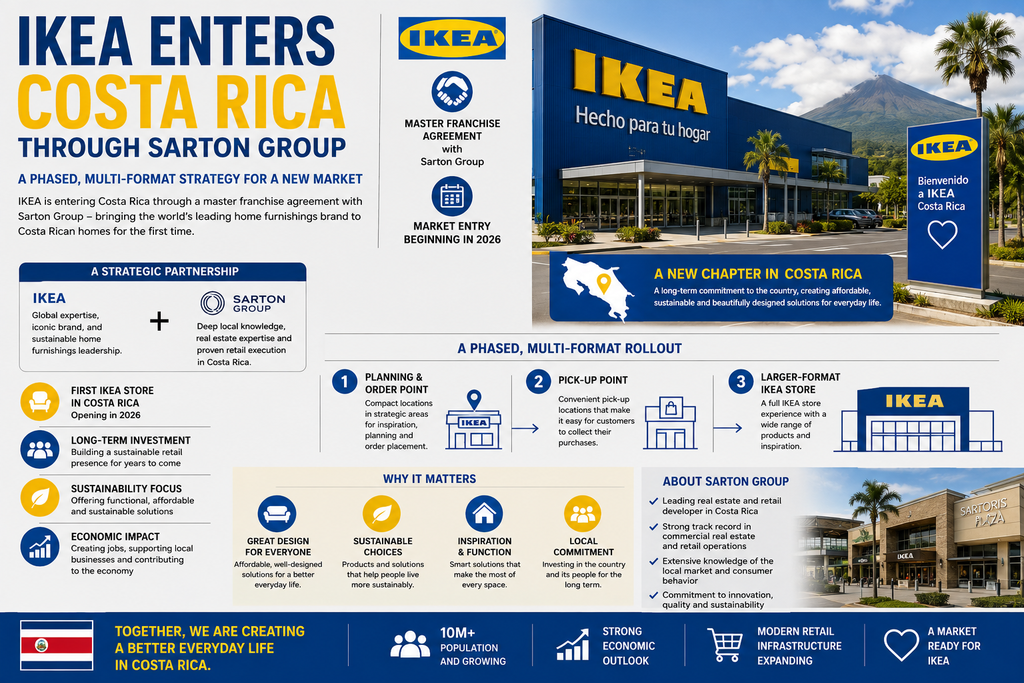
IKEA is expanding into Costa Rica through Sarton Group, but the structure of the rollout is considerably more interesting than a conventional new-country store opening.
Instead of beginning with one enormous IKEA destination store, the Costa Rican market is being developed through multiple retail and fulfilment formats, each serving a different role in the customer journey.
The initial network includes operations in Lindora, Curridabat and Escazú, combining planning, ordering, pickup, logistics, compact retail and a larger IKEA format.
The franchise partner is equally important.
Sarton Group is not approaching IKEA as a first-time operator. The company already operates the IKEA franchise in Puerto Rico, the Dominican Republic and the Spanish islands, giving it substantial experience developing the brand across markets that differ considerably from IKEA’s traditional large European territories.
Costa Rica therefore provides an important case study in how one of the world’s most recognisable retail franchises is adapting international expansion to the economics and infrastructure of individual markets.
The lesson is straightforward:
A global brand does not always need to reproduce its largest store format when entering a new country.
Sometimes the smarter strategy is to build the market in stages.
IKEA Is Entering Costa Rica Through an Experienced Franchise Partner
IKEA is often assumed to operate all of its stores directly.
It does not.
The IKEA retail system operates through a global franchise structure in which different franchise groups hold rights to develop the brand across specified territories.
Sarton Group is one of those franchise operators.
Its existing IKEA territories include Puerto Rico, the Dominican Republic and the Spanish islands.
Costa Rica extends that operating platform into Central America.
This matters because developing IKEA is considerably more complex than opening a conventional furniture store.
The operator must coordinate:
- retail development
- large product assortments
- warehousing
- importation
- logistics
- home delivery
- customer collection
- product assembly
- planning services
- e-commerce
- inventory management
- property development
Sarton already understands the IKEA system.
That dramatically changes the risk profile of entering another territory.
The First Step Is Not One Giant IKEA Store
Perhaps the most interesting feature of the Costa Rican expansion is the format strategy.
For decades, IKEA became famous for enormous destination stores located on the outskirts of major cities.
Customers would travel considerable distances, walk through extensive room displays, collect products from warehouse areas and transport purchases home.
That model remains important.
But it is no longer the only way IKEA enters a market.
Costa Rica demonstrates the evolution clearly.
The rollout is being built around three different locations and functions.
Lindora: Planning, Ordering, Pickup and Logistics
The Lindora operation plays a foundational role.
Rather than functioning simply as another traditional retail store, it combines customer-facing services with important logistics capabilities.
Customers can use the location for activities such as:
- product planning
- placing orders
- accessing IKEA expertise
- collecting purchases
Behind the customer experience sits something equally important: the infrastructure required to move products through the market.
This is significant because furniture retail depends heavily on logistics.
Selling a sofa online is easy.
Getting that sofa into the country, storing it economically, delivering it reliably and handling returns is much harder.
By establishing logistics and fulfilment capability early, the operator creates the foundation required for subsequent store growth.
Curridabat: A Compact IKEA Format
Curridabat introduces another element of the strategy: a compact-format IKEA store.
Compact stores allow IKEA to reach customers in areas where the economics or available property may not justify a traditional large-format destination store.
The concept can provide:
- product inspiration
- selected merchandise
- planning services
- ordering capability
- access to the wider IKEA assortment
This reduces the amount of real estate required while maintaining meaningful physical interaction with customers.
For a new market, that can be particularly valuable.
The franchisee gains physical presence without immediately committing to the capital requirements of several enormous stores.
Escazú: The Larger Retail Format
Escazú provides the larger-format component of the network.
The area is one of Costa Rica’s most important commercial and affluent consumer districts, making it a logical location for a more substantial IKEA presence.
Together, the three formats create something much more sophisticated than a conventional launch.
Lindora supports planning, fulfilment and logistics.
Curridabat provides compact retail access.
Escazú provides a larger destination experience.
E-commerce connects the network.
The result is not simply a collection of stores.
It is a market-entry architecture.
Why Costa Rica Does Not Need to Copy Sweden, London or Madrid
One of the most common mistakes in international retail expansion is assuming that a successful format must be reproduced exactly in every country.
That can create unnecessary risk.
Real-estate economics differ.
Population density differs.
Consumer behaviour differs.
Traffic patterns differ.
Import costs differ.
Average transaction values differ.
Home sizes differ.
Logistics infrastructure differs.
A 30,000-square-metre store that performs exceptionally well in one country may be completely inappropriate as the first investment in another.
IKEA’s increasingly flexible approach recognises this.
The objective is not to reproduce a building.
The objective is to reproduce the IKEA customer proposition in a commercially viable form.
Sarton Group Has Already Demonstrated This Flexibility
Sarton’s existing IKEA territories make it particularly well suited to this type of development.
Puerto Rico, the Dominican Republic and the Spanish islands are not identical markets.
Each requires different approaches to:
- property
- logistics
- consumer demand
- population distribution
- importation
- fulfilment
Operating across those territories gives Sarton experience adapting the IKEA system without abandoning the underlying brand standards.
Costa Rica becomes the next application of that capability.
This is one reason global brands frequently expand additional territories through franchisees that have already performed successfully elsewhere.
The franchisor does not have to discover whether the operator understands the system.
That has already been demonstrated.
IKEA Franchise Rights Are Highly Controlled
This is also important for investors researching an IKEA franchise opportunity.
IKEA does franchise internationally.
However, it is not a conventional open franchise system where individual investors simply apply for a single IKEA store.
Territorial rights are highly controlled and are generally awarded to sophisticated organisations capable of developing substantial markets.
The Costa Rican arrangement illustrates the level involved.
Sarton Group is responsible for much more than operating a shop.
The franchisee must develop an ecosystem around the brand.
That includes:
- retail locations
- logistics
- distribution
- e-commerce
- fulfilment
- customer service
- local management
- long-term market development
For a brand of IKEA’s scale, franchise partner qualification therefore operates at an institutional level.
The Franchisee Is Developing a Country, Not Buying a Store
This distinction is fundamental.
Many franchise enquiries begin with the question:
“How much does an IKEA franchise cost?”
But for controlled global franchise systems, that can be the wrong starting point.
The more relevant questions are:
- Is the country already allocated?
- Who holds the territorial rights?
- Is IKEA actively seeking a new franchisee?
- What development capability would be required?
- Can the operator fund national infrastructure?
- Can it manage importation and logistics?
- Can it develop multiple formats?
- Does it have the governance and management required for a long-term relationship?
Sarton is effectively developing an IKEA market.
That is very different from purchasing an individual franchise unit.
Why Costa Rica Is Attractive
Costa Rica offers several characteristics that support international retail expansion.
The country has:
- political and economic stability relative to much of the region
- a growing middle-income consumer base
- substantial urban concentration
- established shopping-centre infrastructure
- strong tourism
- increasing e-commerce adoption
- familiarity with international brands
The Greater San José area provides a concentrated consumer market from which IKEA can begin building awareness and distribution.
The phased approach also allows Sarton to learn how Costa Rican consumers interact with the brand before committing to a much larger national physical network.
E-Commerce Changes the Economics of Market Entry
Digital commerce is one of the reasons this type of rollout is possible.
Historically, customers needed a large physical store to access a broad IKEA assortment.
Today, the website can function as the largest store.
Physical locations can perform more specialised roles.
One location can provide planning.
Another can provide inspiration.
Another can handle pickup.
A larger store can provide the full physical experience.
A logistics centre can support all of them.
This means international retailers can separate functions that previously needed to exist under one enormous roof.
For smaller and medium-sized markets, that can dramatically improve expansion economics.
The First Store Is No Longer Necessarily the First Step
Costa Rica illustrates a wider shift in international retail.
Market entry increasingly begins before the traditional flagship opens.
The first investment may instead be:
- an e-commerce platform
- a warehouse
- a planning studio
- a pickup point
- a shop-in-shop
- a pop-up
- a compact store
- a concession
- a distribution agreement
The flagship can come later.
This allows the brand to build:
- customer data
- awareness
- logistics
- local management
- supplier relationships
- demand intelligence
before committing maximum capital.
For international expansion, this can be substantially more intelligent than starting with the most expensive possible format.
Market Entry Format Should Follow the Territory
This leads to a broader strategic principle.
Brands should not ask:
“What is our standard international store?”
They should ask:
“What combination of formats gives us the strongest route into this particular market?”
For one country, the answer may be a flagship.
For another, e-commerce plus pickup.
For another, a local distributor.
For another, a franchise partner.
For another, shop-in-shop locations.
The brand remains consistent.
The market-entry architecture changes.
IKEA’s Costa Rican rollout provides an unusually clear example.
Why This Matters Beyond Furniture
The same principle applies across numerous sectors.
Fashion
A brand can begin through department-store concessions before opening standalone boutiques.
Beauty
E-commerce and shop-in-shop counters can establish demand before flagship development.
Food and Beverage
Delivery kitchens, kiosks and compact formats can precede full restaurants.
Automotive
Digital sales and experience centres can precede conventional dealerships.
Consumer Electronics
Shop-in-shop partnerships can establish market presence before standalone stores.
Luxury
Temporary boutiques and concessions can test demand before long-term leases.
The first physical format should reflect market economics rather than corporate habit.
Logistics May Be More Important Than the Store
IKEA also highlights another aspect of retail expansion that investors frequently underestimate.
The customer sees the store.
The business depends on the supply chain behind it.
For furniture and home furnishings, the operator must manage:
- international sourcing
- shipping
- customs
- warehousing
- inventory
- last-mile delivery
- damaged products
- returns
- collection
- assembly
A beautiful showroom cannot compensate for unreliable fulfilment.
This is why the Lindora logistics component is strategically important.
It creates infrastructure that can support the wider network as the business expands.
What Investors Should Watch
Several developments will indicate how successfully the Costa Rican model performs.
Customer Adoption
How quickly Costa Rican consumers embrace IKEA will influence future development.
Format Productivity
The relative performance of compact, planning and larger formats will provide useful insight into which models work best.
E-Commerce Penetration
Digital purchasing could become particularly important if the physical network remains relatively concentrated.
Delivery Economics
Furniture logistics can be expensive. Efficient fulfilment will be critical to profitability.
Geographic Expansion
Future movement beyond the initial Greater San José footprint will indicate how broadly Sarton believes the market can support physical IKEA locations.
Regional Development
Costa Rica could also provide useful intelligence for further IKEA development elsewhere in Central America.
Could This Become a Central American Platform?
Sarton already operates IKEA across several territories and the broader regional strategy extends beyond a single country.
That raises an interesting longer-term question.
Can the logistics, management and market knowledge developed through Costa Rica support further expansion across Central America?
International franchise operators become particularly valuable when their infrastructure can serve multiple countries.
A warehouse, management team or regional procurement function that supports one territory may eventually support several.
This can materially improve the economics of expansion.
It is another reason franchisors value operators capable of thinking beyond one location.
Strategic Assessment
IKEA’s Costa Rican expansion provides an important lesson in how international retail is changing.
The brand is not simply transplanting its traditional large-format model into another country.
It is constructing a network around the specific requirements of the market.
That network combines:
planning + ordering + pickup + logistics + compact retail + larger-format retail + e-commerce.
Sarton Group provides the local and regional operating platform.
IKEA provides the global system.
Costa Rica provides the market.
The resulting structure reduces the need to make one enormous bet at the beginning of the relationship.
Instead, infrastructure and customer access can develop together.
Where Star Brands Consulting Group Fits In
Star Brands Consulting Group works with brands, investors and operators evaluating franchise, licensing and international market-entry opportunities.
One of the most important questions in market entry is not simply whether a country should be entered.
It is how.
Depending on the brand and territory, the appropriate entry architecture may involve:
- flagship stores
- compact stores
- kiosks
- concessions
- shop-in-shop locations
- planning centres
- pickup points
- e-commerce-first entry
- distribution
- franchising
- licensing
- joint ventures
Through Star Access™, investors and operators can assess not only territory availability but also the operating structure and infrastructure required to develop a global brand credibly.
For brands, Star Brands Consulting Group can also evaluate whether the traditional international format is commercially appropriate for the target market or whether a phased entry strategy would reduce risk and improve long-term economics.
IKEA Costa Rica demonstrates why that distinction matters.
International expansion is not simply about securing a territory.
It is about designing the right system for developing it.
Conclusion
IKEA’s entry into Costa Rica through Sarton Group is a sophisticated example of modern franchise-led market development.
The franchise partner already has experience operating IKEA across Puerto Rico, the Dominican Republic and the Spanish islands.
It is now applying that knowledge to a new Central American market.
But the most important feature of the expansion is the format strategy.
Costa Rica is not beginning with a single traditional IKEA megastore.
The market is being built through different formats serving different purposes across Lindora, Curridabat and Escazú, supported by logistics and digital commerce.
That approach allows the partners to establish infrastructure, learn from customers and increase physical presence progressively.
For international brands, the lesson is important.
The first store does not always have to be the first step.
And the largest global format does not always have to be the first store.
The strongest market-entry strategy is the one designed around the realities of the territory.
Leave a Reply