
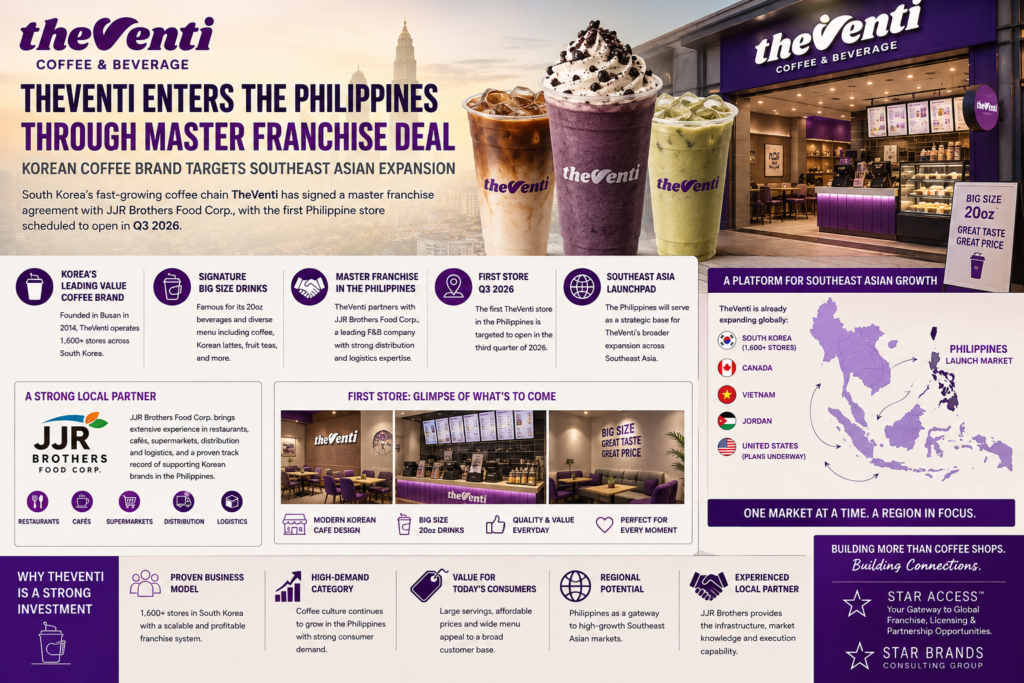
South Korean coffee chain TheVenti is entering the Philippines through a master franchise agreement with JJR Brothers Food Corp., establishing what the company intends to use as a platform for broader expansion across Southeast Asia.
The first Philippine store is scheduled to open in the third quarter of 2026.
For TheVenti, this is an important international move.
Founded in Busan in 2014, the brand has grown to more than 1,600 stores in South Korea, building its position around large-format beverages, accessible pricing and a broad menu that extends well beyond conventional coffee.
The Philippines now becomes another stage in TheVenti’s transition from a successful domestic franchise system into an international brand.
More importantly for investors and franchise operators, the company is not entering the country alone.
It has selected a local master franchise partner with existing food, beverage, distribution and logistics capabilities.
That structure tells us a great deal about how TheVenti intends to expand internationally.
TheVenti Has Built More Than 1,600 Stores in South Korea
TheVenti’s domestic scale is one of the first things prospective international partners should understand.
This is not an early-stage coffee concept attempting to prove whether its franchise model works.
The company has already developed a network exceeding 1,600 locations in South Korea.
That provides a substantial operating base from which international expansion can develop.
TheVenti’s concept is built around a straightforward proposition: provide consumers with generously sized beverages at accessible prices.
Its signature offering has historically centred around 20-ounce drinks, supported by a menu that includes:
- espresso-based coffee
- Korean grain lattes
- fruit teas
- flavoured beverages
- seasonal drinks
- desserts and complementary products
The model places TheVenti within South Korea’s highly competitive value-coffee segment, where convenience, price, speed and product variety are particularly important.
Why the Philippines?
The Philippine market offers several characteristics that align with TheVenti’s business model.
The country has:
- a large and relatively young population
- an established café culture
- significant shopping-centre infrastructure
- growing demand for affordable food and beverage concepts
- strong familiarity with Korean culture and consumer brands
- an expanding urban middle class
- high engagement with social media and digital trends
The country’s relationship with Korean culture is particularly relevant.
Korean entertainment, beauty, food and lifestyle brands already enjoy substantial recognition among Filipino consumers.
That does not guarantee success for every Korean concept entering the country, but it can reduce one of the biggest barriers facing a new international brand: consumer unfamiliarity.
TheVenti is entering a market where “Korean” already carries meaningful cultural recognition.
The Philippine Coffee Market Is Highly Competitive
The opportunity is substantial, but this is not an uncontested market.
Coffee consumption and café culture have grown significantly across the Philippines, attracting international and domestic operators across different price segments.
TheVenti will therefore need to establish a clear reason for customers to choose it.
Its large-serving, value-oriented positioning could provide that differentiation.
Rather than competing exclusively at the premium end of the coffee market, TheVenti can appeal to consumers seeking:
- affordable everyday beverages
- larger serving sizes
- variety
- Korean-inspired drinks
- convenient café formats
That proposition may be particularly relevant to younger consumers and high-frequency beverage customers.
JJR Brothers Is More Than a Financial Partner
The choice of JJR Brothers Food Corp. is central to the market-entry strategy.
The Philippine company has capabilities spanning:
- restaurants
- cafés
- supermarkets
- food and beverage distribution
- logistics
It also has experience supporting Korean food and beverage brands entering the Philippine market, particularly around Metro Manila.
That infrastructure matters.
A master franchise partner is not simply an investor purchasing the right to use a logo.
At country level, the partner may be responsible for building much of the local business.
That can include:
- store development
- real estate
- recruitment
- local supply chains
- operations
- marketing
- regulatory compliance
- logistics
- national expansion
TheVenti is therefore placing substantial responsibility in the hands of its Philippine partner.
What a Master Franchise Agreement Actually Means
The term master franchise is sometimes confused with an ordinary franchise agreement.
They are very different propositions.
A conventional franchisee may receive the right to operate one or several stores.
A master franchisee can receive much broader rights within a country or territory.
Depending on the agreement, those rights may include the ability to:
- develop multiple stores
- operate company-owned locations
- recruit local sub-franchisees
- provide franchisee support
- manage local training
- oversee brand standards
- coordinate supply chains
- develop the brand nationally
In return, the master franchisee takes on considerably greater responsibility.
This is effectively a market-development mandate.
The investor is not simply buying a coffee shop.
The investor is helping build the brand’s business in an entire country.
Why Global Brands Use Master Franchise Partners
Master franchising can provide a powerful route into international markets.
For the franchisor, entering directly would require substantial investment.
The company might otherwise need to build:
- a Philippine corporate organisation
- management teams
- local procurement
- logistics infrastructure
- property relationships
- recruitment systems
- regulatory expertise
- marketing operations
A capable master franchisee already understands much of that environment.
This allows the international brand to combine its operating system and intellectual property with the local partner’s capital and market knowledge.
When the partnership works, expansion can happen considerably faster than through direct corporate development.
Localisation Will Be Important
TheVenti has already indicated that it intends to adapt its Philippine offering to local conditions.
This is an important part of international franchise development.
Successful global brands rarely succeed by assuming that a model developed in their home market can be reproduced without modification elsewhere.
Consumer preferences differ.
Price sensitivity differs.
Shopping habits differ.
Real estate differs.
Even the way consumers use cafés can vary significantly between countries.
TheVenti plans to adapt both its menu composition and store operations as it learns more about Filipino consumers and individual trading locations.
The objective will be to preserve the core brand proposition while making the business commercially relevant to the local market.
The First Store Will Be an Important Test
The first Philippine store is expected to open during Q3 2026.
Its performance will provide useful early intelligence.
The initial location will allow the partners to evaluate:
- customer response
- beverage preferences
- price positioning
- average transaction values
- operating efficiency
- peak trading periods
- product localisation
- store format
- delivery demand
Those findings can then influence the wider rollout.
This is one reason experienced master franchise operators often avoid expanding too aggressively before validating the first locations.
A country-development agreement may ultimately involve dozens or hundreds of stores, but the economics still have to work at unit level.
The Philippines Is Intended to Be a Southeast Asian Launchpad
TheVenti has been unusually clear about the strategic significance of the Philippine agreement.
The company sees the country as a starting point for broader Southeast Asian expansion.
That makes the transaction considerably more important than a single-country franchise announcement.
Southeast Asia contains several large and rapidly developing consumer markets, including:
- Indonesia
- Thailand
- Vietnam
- Malaysia
- Singapore
- the Philippines
Collectively, the region represents hundreds of millions of consumers and a substantial long-term opportunity for food and beverage brands.
For Korean concepts in particular, Southeast Asia has become an increasingly important international growth region.
TheVenti’s Philippine entry could therefore become a reference point for future franchise development elsewhere in ASEAN.
TheVenti Is Already Building an International Network
The Philippines is not TheVenti’s first international market.
The company has already expanded into markets including:
- Canada
- Vietnam
- Jordan
It is also pursuing expansion into the United States, including plans for a Las Vegas location.
The Jordan entry is particularly relevant because it was also developed through a master franchise arrangement as part of a broader Middle East strategy.
A pattern is therefore emerging.
TheVenti is using capable local partners to establish footholds in strategically important regions.
South Korea provides the proven domestic system.
International master franchisees provide the local infrastructure required to translate that system into new markets.
The Korean Coffee Sector Is Going Global
TheVenti’s international push is part of a broader development.
South Korea has produced a highly competitive café industry.
Domestic brands have learned to compete through:
- price
- convenience
- store density
- menu innovation
- digital ordering
- strong visual branding
- rapid product development
After building large domestic networks, several Korean food and beverage companies are increasingly looking overseas.
This creates a new category of international franchise opportunities.
Historically, investors seeking major food franchises often focused primarily on American and European brands.
That landscape is changing.
South Korean, Chinese, Japanese and other Asian concepts are increasingly becoming international franchise exporters themselves.
For investors seeking emerging international brands, this deserves attention.
Why Value Coffee Could Travel Well
Premium coffee has become a global category.
Value coffee may represent another substantial opportunity.
Consumers want quality, but they are also increasingly sensitive to price.
A brand capable of delivering:
- attractive stores
- good beverages
- convenient locations
- large portions
- accessible pricing
can potentially occupy a valuable position between traditional low-cost coffee and premium international chains.
TheVenti has already demonstrated that the model can scale extensively in South Korea.
The international question is whether the same proposition can be adapted successfully to different consumer markets.
The Philippines will provide an important test.
What Investors Should Learn From the Deal
The TheVenti-JJR Brothers agreement provides several useful lessons for investors seeking international franchise rights.
Brands Want Infrastructure, Not Just Capital
Having sufficient money is important.
It is rarely sufficient for country-level rights.
A serious master franchise candidate needs to demonstrate the ability to build and operate the business.
Distribution Can Be a Major Advantage
JJR Brothers’ distribution and logistics capabilities strengthen its proposition considerably.
Food and beverage businesses depend heavily on reliable supply chains.
Local Experience Reduces Market-Entry Risk
Understanding Metro Manila’s property market, consumers, labour environment and regulatory conditions gives a local operator advantages an overseas brand may not possess.
Existing Industry Relationships Matter
Relationships with landlords, suppliers and other industry participants can accelerate development.
A Master Franchise Is a Long-Term Commitment
Country development can require years of capital investment before the full potential of the territory is realised.
Country Rights Are Different From Single-Store Franchises
For serious investors, this distinction is essential.
A single-store franchise is primarily an operating investment.
A master franchise is closer to building a company.
The master franchisee may need:
- a corporate headquarters
- development teams
- operations managers
- training infrastructure
- supply-chain management
- marketing teams
- franchise recruitment capability
- significant working capital
The potential opportunity is larger.
So are the obligations.
This is why international brands are selective when awarding master franchise rights.
A poor country partner can delay a brand’s development for years.
A strong partner can transform the territory.
What Happens When a Master Franchise Succeeds?
Successful country partnerships can become extremely valuable.
A strong master franchisee may eventually operate:
- dozens of corporate stores
- a network of sub-franchisees
- national distribution infrastructure
- digital commerce
- delivery operations
- regional training centres
The relationship can also lead to additional opportunities.
A partner that performs strongly in one country may eventually be considered for:
- neighbouring territories
- additional brands
- regional development rights
- joint ventures
This is how some of the largest franchise operating groups in the world have been built.
They did not begin with dozens of brands.
They proved themselves one relationship at a time.
What to Watch Next
Several developments will determine how significant TheVenti’s Philippine business becomes.
First Store Location
The initial location will provide insight into the customer segment and retail format being targeted.
Development Pace
How quickly JJR Brothers proceeds beyond the first location will reveal the ambition of the rollout.
Menu Localisation
The balance between Korean favourites and products adapted specifically for Filipino consumers will be important.
Pricing
TheVenti’s value proposition must translate effectively into Philippine purchasing power and competitive conditions.
Sub-Franchising
It will be important to watch whether the master franchise structure eventually creates opportunities for local franchise investors beneath JJR Brothers.
Southeast Asian Expansion
If the Philippines performs well, TheVenti’s next ASEAN market could provide further evidence of a larger regional strategy.
Strategic Assessment
TheVenti’s Philippine entry is a more significant franchise story than the opening of a single coffee shop.
A South Korean chain with more than 1,600 domestic stores has selected a Philippine company to develop its brand through a master franchise agreement and has identified the country as a starting point for broader Southeast Asian growth.
That represents a genuine transfer of international brand-development responsibility.
It also demonstrates where global franchise opportunity is increasingly emerging.
The next generation of internationally expanding franchise brands will not come exclusively from the United States and Western Europe.
Strong concepts are increasingly emerging from Asia and seeking experienced operators capable of taking them into new territories.
For investors, identifying these brands while their international networks are still developing can provide a very different opportunity from pursuing mature global systems where most attractive territories have already been allocated.
Where Star Brands Consulting Group Fits In
Star Brands Consulting Group works with investors and operators seeking international franchise, master franchise, licensing, distribution and strategic brand-partnership opportunities.
For investors interested in concepts such as TheVenti, our work can include:
- assessing target markets
- evaluating territory availability
- identifying the appropriate entry structure
- assessing investor financial and operational readiness
- preparing investor profiles
- developing market and territory propositions
- evaluating master franchise requirements
- supporting structured brand engagement
- identifying comparable opportunities where preferred territories are unavailable
Through Star Access™, qualified investors can evaluate opportunities based on actual brand expansion strategy, territory structure and investor fit.
This is particularly important for master franchise opportunities.
The objective is not simply to ask a brand whether it franchises.
The objective is to understand:
Where is the brand going next?
Which territories remain available?
What type of partner does the brand require?
Does the investor have the capability to develop that market?
Those questions determine whether an international franchise opportunity is genuinely actionable.
Conclusion
TheVenti’s entry into the Philippines represents an important step in the international development of one of South Korea’s large value-coffee chains.
With more than 1,600 stores in its domestic market, TheVenti already has considerable operating scale.
The next challenge is international replication.
Its agreement with JJR Brothers gives the company a local partner with food, beverage, distribution and logistics capability, while the Philippines provides a substantial consumer market from which wider Southeast Asian expansion can potentially develop.
For franchise investors, the structure is particularly instructive.
This is not simply a foreign company opening another overseas store.
It is a master franchise partnership designed to build a national business and potentially support a wider regional expansion strategy.
That is the level at which many of the most consequential international franchise opportunities are created.
Leave a Reply