
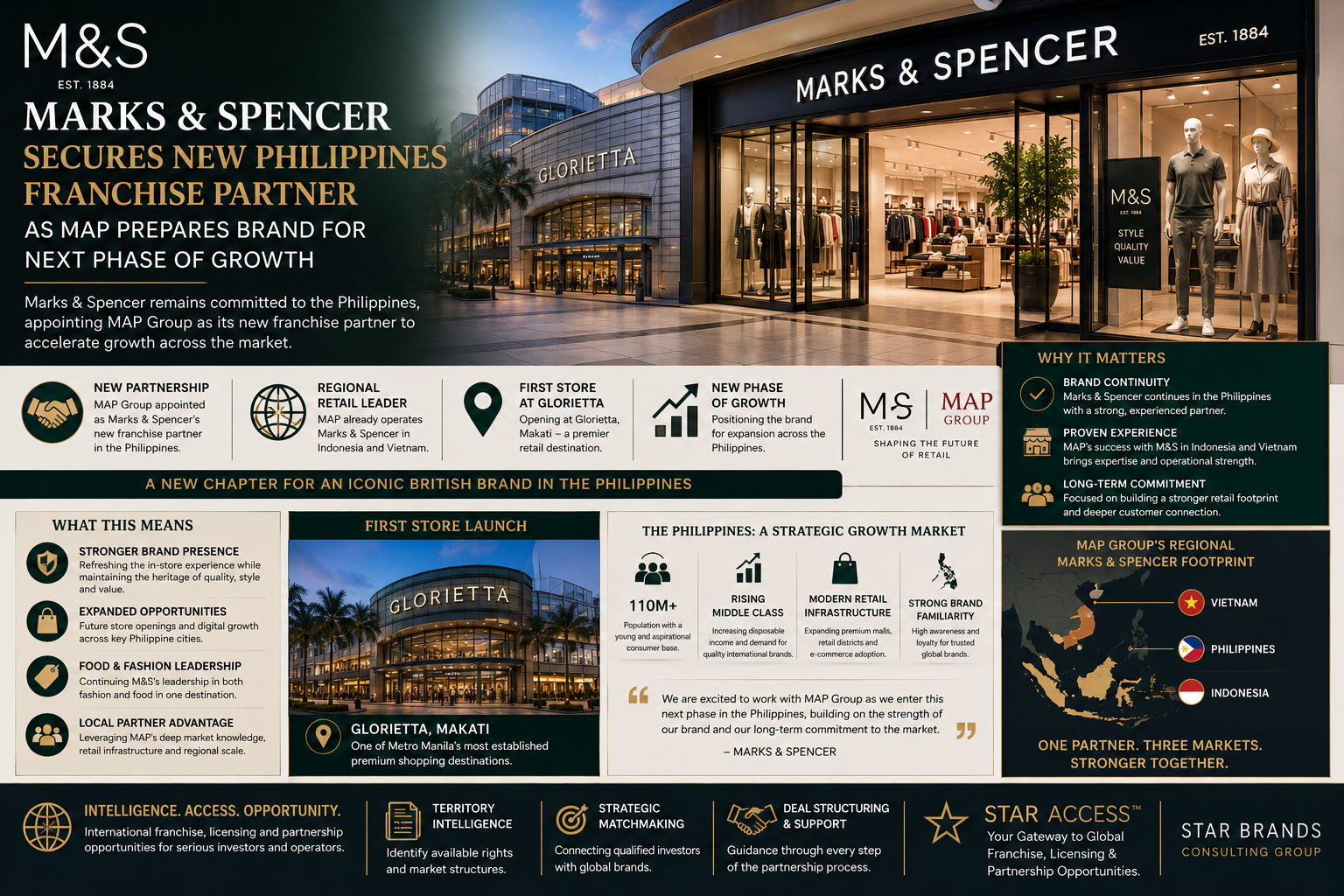
Marks & Spencer is preparing for a new chapter in the Philippines after appointing MAP Group as its new franchise partner for the market.
The agreement keeps Marks & Spencer in the Philippines following the conclusion of its previous operating arrangement and places the business in the hands of a regional retail group that already works with the British retailer in Indonesia and Vietnam.
The first store under the new partnership is expected to open at Glorietta in Makati, one of Metro Manila’s most established premium shopping destinations.
For Marks & Spencer, the decision represents more than continuity in an existing market.
It demonstrates how an international brand can change operating partners without abandoning the territory — and how experienced regional franchise groups can use relationships established in one country to secure development opportunities in another.
For investors and operators, that makes the transaction particularly relevant.
Marks & Spencer Is Staying in the Philippines
The most important point is straightforward: Marks & Spencer is not leaving the Philippine market.
Instead, the company has chosen a new partner to take the business forward.
That distinction matters.
When an international franchise relationship ends, there are several possible outcomes.
A brand can:
- leave the country
- take operations in-house
- sell the business
- restructure its market presence
- appoint another franchise partner
Marks & Spencer has chosen the final option.
The decision indicates that the company continues to see commercial potential in the Philippines but believes the next phase of the business should be developed under a different operating structure.
MAP Brings Existing Marks & Spencer Experience
MAP is not approaching Marks & Spencer as an unfamiliar brand.
The Indonesian retail group already operates Marks & Spencer in Indonesia and Vietnam.
That experience is strategically important.
International franchisors generally prefer operators that already understand:
- brand standards
- merchandising
- store operations
- supply chains
- reporting requirements
- customer positioning
- regional market conditions
Extending an existing relationship into another country can therefore reduce execution risk for both parties.
MAP already understands Marks & Spencer.
Marks & Spencer already understands MAP.
The Philippines becomes an extension of an established regional partnership rather than an entirely new relationship.
Why Regional Franchise Partners Matter
This transaction illustrates an increasingly important model in international franchising.
Some of the world’s strongest franchise operators are no longer confined to a single country.
They are becoming regional brand-development platforms.
Once an operator proves that it can successfully manage a brand in one market, it may be considered for neighbouring territories.
The advantages are considerable.
A regional partner can provide:
- experienced management
- established brand knowledge
- purchasing scale
- regional logistics
- relationships with landlords
- local recruitment capability
- shared technology
- marketing efficiencies
For the brand owner, this can be more efficient than appointing an entirely different franchisee in every country.
For the franchise partner, each additional territory increases the scale and strategic importance of the relationship.
Glorietta Provides a High-Profile Restart
The first Marks & Spencer store under MAP is expected to open at Glorietta in Makati.
The choice is commercially significant.
Makati remains one of Metro Manila’s principal business, retail and affluent consumer districts.
Glorietta is part of a major shopping complex serving office workers, residents, tourists and consumers from across Metro Manila.
For a brand undergoing an operator transition, launching from a recognised retail destination provides several advantages.
It creates:
- immediate visibility
- access to established customer traffic
- stronger brand presentation
- a platform for communicating the new chapter
- an anchor from which further stores can be developed
The opening should therefore be viewed as the beginning of the new operating relationship rather than simply a replacement store.
Marks & Spencer Has a Long History in International Franchising
Marks & Spencer is fundamentally a British retailer, but international partnerships have been part of its business for decades.
The company has used franchise and partnership structures to reach markets where direct ownership may not provide the most efficient route.
Its international operations have historically included markets across:
- Asia
- the Middle East
- Europe
- other selected territories
The exact structure differs by country.
In some markets, Marks & Spencer operates more directly.
In others, established local or regional partners develop the brand.
This flexible approach allows the company to balance control with local expertise.
Why a Brand May Change Franchise Partners
Franchise relationships are often discussed as though securing the rights to a territory is permanent.
It is not.
International franchise agreements have contractual terms, performance expectations and development obligations.
Over time, circumstances can change.
A brand may reconsider a partner because of:
- insufficient store development
- changes in strategy
- operational performance
- financial capability
- ownership changes
- changing consumer behaviour
- disagreements over investment
- wider restructuring
Likewise, a franchisee may decide that a brand no longer fits its portfolio.
When that happens, territorial rights can potentially return to the brand owner.
The franchisor then has an important decision to make.
Should it exit the market?
Operate directly?
Or appoint another partner?
The Marks & Spencer Philippines situation demonstrates the third pathway.
Territory Rights Can Become Available Again
This is an important point for investors seeking international franchise opportunities.
A territory that appears unavailable today is not necessarily unavailable permanently.
Markets can reopen because:
- agreements expire
- franchisees withdraw
- operators restructure
- brands change strategy
- development targets are not achieved
- businesses are sold
- regional rights are reorganised
This is one reason franchise opportunity intelligence cannot rely exclusively on public franchise directories.
By the time a major international brand publishes that it needs a new country partner, discussions may already be advanced.
Serious investors therefore need to understand not only which brands franchise, but also who currently controls the rights and how stable that arrangement is.
Existing Relationships Can Lead to New Territories
MAP’s appointment provides another important lesson.
One of the strongest routes to securing additional international brand rights is successful performance with the same brand elsewhere.
A company that already operates a brand effectively in two countries has a very different proposition from an investor approaching the franchisor for the first time.
The operator can demonstrate:
- actual sales performance
- operational capability
- understanding of the brand
- existing management infrastructure
- financial commitment
- ability to execute across borders
Trust has already been established.
This is why many major international franchise groups build portfolios gradually.
They secure one brand.
Perform well.
Expand the store network.
Add another territory.
Then potentially add additional brands.
Over time, they become strategic partners rather than ordinary franchisees.
The Philippines Remains Attractive to International Brands
Marks & Spencer’s decision to remain in the Philippines also reflects the continuing attractiveness of the market.
The Philippines offers:
- a population exceeding 110 million
- a young demographic profile
- increasing urbanisation
- a large English-speaking consumer base
- expanding shopping-centre infrastructure
- growing middle-class consumption
- strong familiarity with Western brands
Metro Manila alone supports a substantial network of premium shopping centres and international retailers.
Beyond Manila, cities including Cebu and Davao provide additional opportunities for national expansion.
For established international brands, the country offers meaningful long-term potential when the right operating partner is in place.
Shopping-Centre Relationships Matter
International retail franchising is not simply about securing brand rights.
Real estate can determine whether the business succeeds.
Operators need access to:
- appropriate shopping centres
- commercially viable rental terms
- strong footfall
- suitable store sizes
- strategic locations within each development
Large regional franchise groups often possess an advantage because they already have relationships with major landlords.
Their wider brand portfolios can also give them greater negotiating power.
This is another reason international brands may favour established multi-brand operators when awarding country rights.
The partner is not merely providing capital.
It is providing an operating ecosystem.
What Makes a Serious Master Franchise Candidate?
Transactions such as this provide useful guidance for investors hoping to secure international retail brands.
For country or regional rights, capital is only one requirement.
Brands may also assess:
Existing Retail Experience
Has the investor successfully operated comparable businesses?
Market Knowledge
Does the proposed partner understand the country’s consumer, property and competitive environment?
Real Estate Capability
Can the operator secure appropriate locations?
Management Infrastructure
Is there a team capable of developing multiple stores?
Financial Capacity
Can the investor fund the entire development programme rather than merely the first location?
Brand Alignment
Does the operator understand how the brand should be positioned?
Development Commitment
How many stores can realistically be opened, and over what period?
The stronger the brand, the more important these considerations become.
The Difference Between Buying a Store and Developing a Market
Many investors searching for franchise opportunities think primarily at store level.
They ask:
“How much does it cost to open one?”
For major international retail brands, that may be the wrong starting point.
Country-level franchise rights can require responsibility for:
- national market development
- multiple store openings
- warehousing
- logistics
- marketing
- e-commerce
- recruitment
- local regulatory compliance
- long-term capital deployment
The investment proposition is therefore much larger than a single retail unit.
The operator is effectively building the brand’s local business.
MAP’s Marks & Spencer relationship illustrates this distinction.
What Investors Should Watch Next
Several developments will now be worth following.
The Glorietta Opening
The first store will establish the direction of Marks & Spencer’s refreshed Philippine retail proposition.
Additional Locations
The pace at which MAP adds stores will provide an indication of the scale of its development plans.
Food
Marks & Spencer’s food business is an important component of the brand in many markets.
How extensively it features in the Philippine strategy could influence customer traffic and positioning.
Digital Commerce
A modern market-development strategy will need to integrate stores with online shopping and digital customer engagement.
Regional Expansion by MAP
MAP’s relationship with Marks & Spencer now extends across Indonesia, Vietnam and the Philippines.
Further regional opportunities will therefore be worth monitoring.
Strategic Assessment
The Marks & Spencer Philippines agreement provides a useful example of how mature international franchise systems evolve.
The brand did not abandon the market when its previous operating structure changed.
It selected another partner.
More importantly, it chose an operator with which it already had an established relationship in neighbouring Asian markets.
That demonstrates the value of proven execution.
International franchising at this level is not simply about finding somebody capable of paying a franchise fee.
It is about finding an organisation capable of becoming a long-term extension of the brand.
MAP’s growing relationship with Marks & Spencer illustrates how that can develop across multiple countries.
Where Star Brands Consulting Group Fits In
For investors seeking country, regional or master franchise rights, understanding the existing territorial structure is essential.
Star Brands Consulting Group works with investors and operators seeking international franchise, licensing, distribution, partnership and market-entry opportunities.
Our work can include:
- identifying brands aligned with an investor’s objectives
- assessing territory availability
- examining existing franchise and operator structures
- evaluating market feasibility
- assessing investor readiness
- developing investor profiles
- preparing territory and market propositions
- supporting structured brand approaches
- identifying alternative opportunities where preferred rights are unavailable
Through Star Access™, qualified investors can evaluate opportunities based on actual market structures rather than relying only on publicly advertised franchise listings.
This is particularly relevant when pursuing established international brands.
The opportunity may arise not because a country has never had a franchisee, but because an existing territory is being restructured, reassigned or prepared for a new phase of development.
Recognising those changes early can be commercially significant.
Conclusion
Marks & Spencer’s decision to appoint MAP as its new Philippine franchise partner demonstrates the importance of relationships, performance and regional capability in international retail expansion.
The brand remains committed to the Philippines.
What has changed is the partner responsible for developing it.
MAP enters the market with a significant advantage: it already operates Marks & Spencer in Indonesia and Vietnam.
That experience gives both parties a foundation on which the Philippine business can be rebuilt and expanded.
For investors, the lesson extends well beyond Marks & Spencer.
International franchise territories are not static.
Rights change.
Partners change.
Strategies change.
And when they do, new opportunities can emerge.
The investors most likely to recognise those opportunities are those who understand who controls the market today, how the brand is performing, and where the expansion architecture may change tomorrow.
Leave a Reply