
Retail strategy · Italy · Direct-to-consumer
Stone Island’s reopened Milan flagship gives its clothing more room and gives visitors a reason to return beyond shopping. The business test is whether the larger format can justify the space and staff it takes to run.
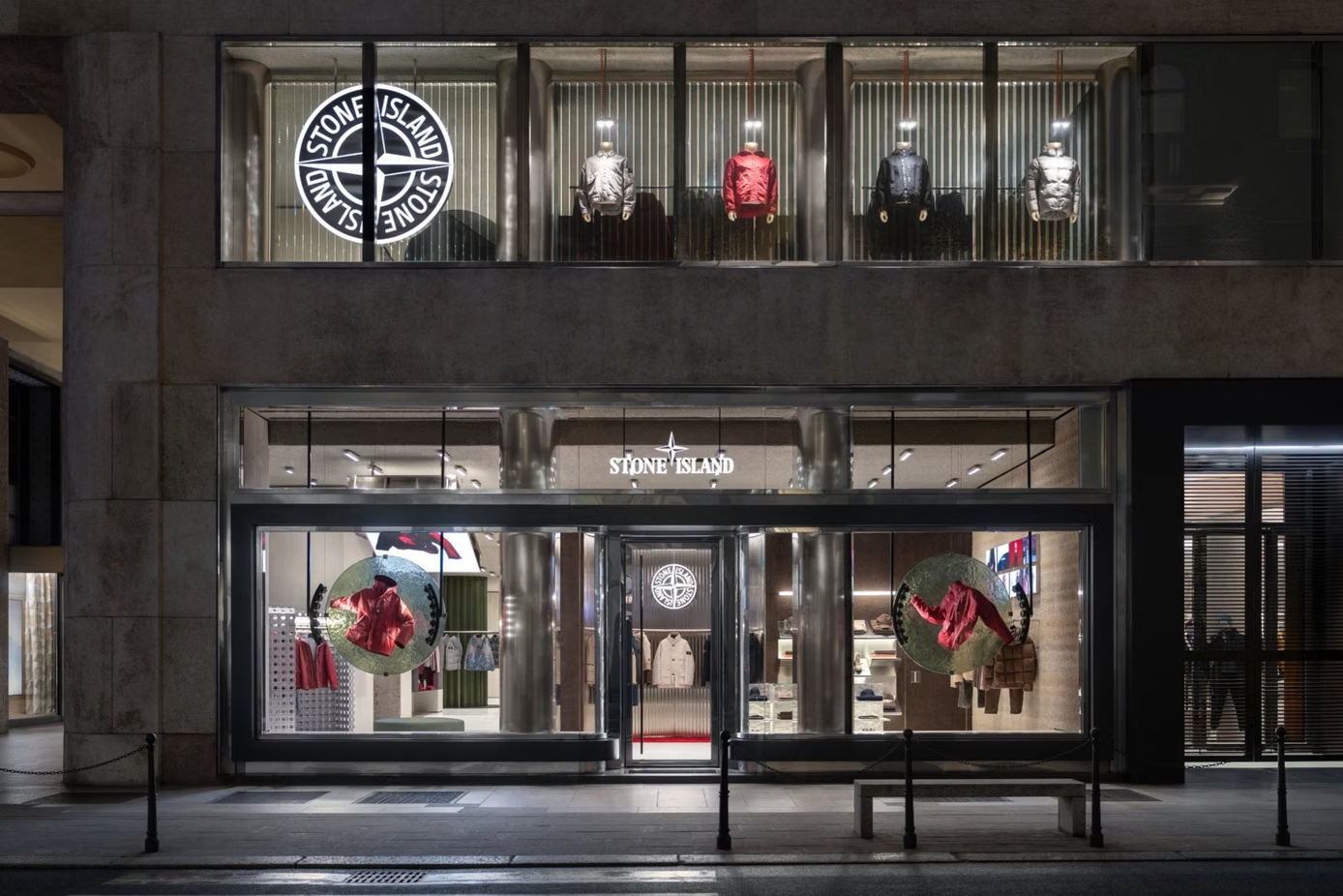
Featured photo: the two-storey exterior of Stone Island’s renovated Milan flagship on Corso Giacomo Matteotti at night.
What reopened on Corso Matteotti
Stone Island reopened its renovated and expanded flagship on 20 November 2026 at Corso Giacomo Matteotti 18, Milan. The brand’s opening feature describes a roughly 600-square-metre store across two levels, developed with OMA/AMO and partner Samir Bantal. The main retail area is on the ground floor. The first floor includes space for cultural programming. RetailBoss reported the reopening date and initial programming.
A large cork structure runs through the store, tying displays to the route between the floors. The design brings Stone Island’s emphasis on material experimentation into the space itself. The opening programme with Radio Raheem also gives the upper floor a role beyond merchandising. Milan is an expansion at an existing address, not a first entry into the city or a franchise announcement.
The additional space needs its own business case
Moncler Group reported €155.9 million in Stone Island direct-to-consumer revenue in the first nine months of 2026, up 11% at constant exchange rates and representing 51% of the brand’s revenue for the period. Those group figures predate the reopening. They give context for the priority placed on direct retail, but do not establish the Milan store’s sales, build-out cost or profitability.
The ground floor can be evaluated using familiar retail measures. Upstairs, sales per square metre on its own may tell the wrong story. Some visitors may buy on a later visit or online. Others may attend an event without becoming customers. That makes repeat visits and buying behaviour more informative than opening-week footfall alone.
What operators should measure before copying the format
- Use of both floors. Compare traffic between floors, event and non-event conversion, and customer return rates. Track whether the upper level attracts people who would not otherwise visit.
- Fully loaded cost. Count event production, staffing, security, maintenance and the opportunity cost of floor space that could have been assigned to merchandise. Compare recurring contribution before and after the renovation on like-for-like trading periods where possible.
- What travels. Separate the design and programming elements that depend on this Milan location from those that might work elsewhere. A smaller store could trial occasional events or material displays before committing permanent space and higher fixed costs.
The practical lesson is not that every retailer needs a cultural floor. It is that each part of a flagship should have a clear job and a way to tell whether it is doing it. Milan can deepen customers’ connection to the brand without becoming the template for every lease. See also our analysis of Superdry’s Paris flagship for a different use of additional retail space.
STAR BRANDS CONSULTING GROUP · PRIVATE INVESTOR ADVISORY
Test the flagship economics before signing the lease.
Evaluate site performance, fit-out exposure and the operating case for a larger retail format before taking it into a new market.
Site economics · Market entry · Retail operating models
Independent advisory. STAR Brands does not represent the featured company or award rights on its behalf. Engagement is subject to mandate qualification.
Sources and image credit
- Stone Island’s Milan reopening feature for the location, floor plan and design.
- RetailBoss’ 20 November coverage for the reopening date and programme.
- Moncler Group’s nine-month results presentation for brand-level revenue and channel mix.
Featured photograph supplied by STAR Brands Consulting.
Leave a Reply