
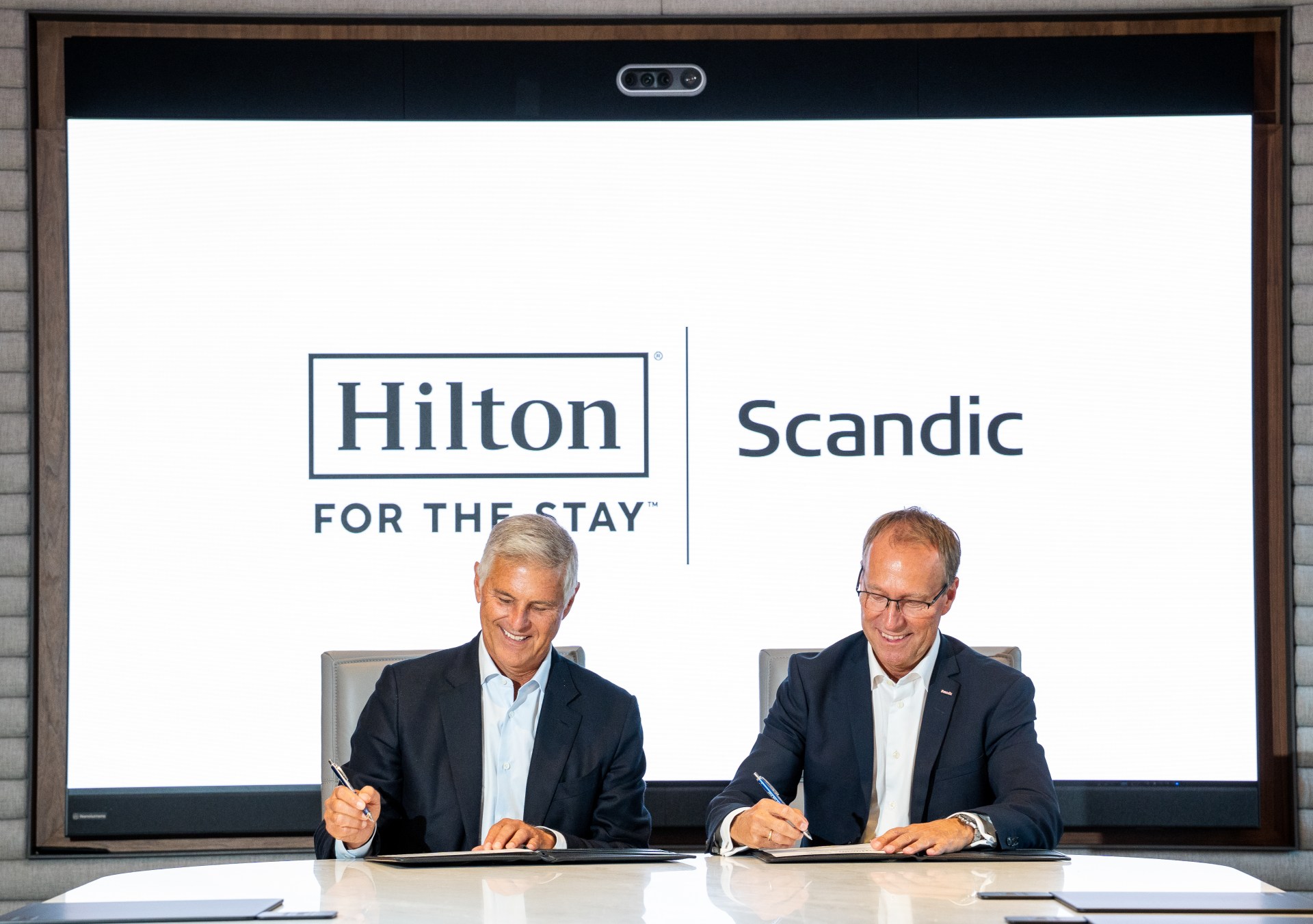
Hilton and Scandic Hotels Group have signed a multi-year development agreement covering Sweden, Norway, Denmark and Finland. The structure matters because it combines a global hotel brand system with an established regional operating platform—without converting Scandic’s wider portfolio.
The agreement, announced on 19 October 2026, gives both companies a framework for pursuing individual hotel developments across the four Nordic markets. Hilton brings a 28-brand portfolio, global commercial reach and Hilton Honors. Scandic contributes local operating infrastructure, regional expertise and a network of about 320 hotels with 68,000 rooms in operation or development.
That is a more precise commercial proposition than a broad portfolio tie-up. Scandic’s regulatory announcement explicitly says the agreement is focused on individual development opportunities and is not a wholesale conversion of Scandic hotels to Hilton brands.
The first project makes the operating model tangible
The first announced project is a 284-room Hilton Hotels & Resorts property at Scanport, beside Copenhagen Airport. Scandic will operate the hotel under a franchise agreement with Hilton, and the opening is expected in 2029. Construction is intended to begin once remaining conditions have been met.
This detail matters. The strategic agreement creates a pipeline mechanism, but the Copenhagen project shows how that mechanism can translate into a property-level contract: Hilton supplies the brand and commercial system; Scandic takes the operating role; and the real-estate project still depends on conditions and delivery through to opening.
The companies are not beginning from zero. Scandic already operates three Hilton Hotels & Resorts properties in Helsinki, and a multi-phase refurbishment is planned for Hilton Helsinki Airport. That operating history reduces one category of partner risk: the parties already have evidence that their systems can work together. It does not, however, remove project-specific development, capital or demand risk.
Why this is a platform deal, not simply a brand announcement
International hotel growth often stalls between brand interest and local execution. A brand may have distribution power and customer recognition but lack the local operating depth to qualify sites, recruit teams and navigate a fragmented ownership market. A regional operator may understand those markets but lack the global demand engine needed to strengthen a project’s financing and positioning.
The Hilton–Scandic framework is designed to bridge that gap. It allows the partners to select projects individually, rather than forcing a single brand across a mixed portfolio. That should preserve flexibility over brand fit, asset class, location and owner economics.
For Hilton, the arrangement creates a route to expand across four markets through an operator with an established Nordic platform. For Scandic, it opens development opportunities under Hilton brands without requiring Scandic to build a new global reservation and loyalty ecosystem. The commercial value will depend on whether the partnership produces viable signed hotels—not on the breadth of the framework alone.
Loyalty integration could become a second layer of value
Hilton and Scandic also plan to announce benefits for Hilton Honors and Scandic Friends members at a later date. The current release does not disclose the form, cost or timing of those benefits, so it would be premature to treat loyalty integration as completed.
If executed well, reciprocal benefits could widen customer access on both sides: Hilton Honors has more than 260 million members globally, while Scandic describes Scandic Friends as the Nordic hotel sector’s largest loyalty programme. But operators and owners should test how any benefit structure allocates redemption costs, customer ownership, direct-booking economics and data responsibilities. A loyalty promise becomes commercially meaningful only when those operating rules are clear.
The demand case is real, but it is not a guarantee
The companies cite strong Nordic travel momentum. Official 2025 statistics referenced in the announcement recorded more than 70 million guest nights in Sweden, around 68 million in Denmark, more than 40 million in Norway and over 23 million in Finland. Those figures support the strategic relevance of the region, but they do not establish the economics of any particular future hotel.
Property underwriting still needs to test local supply, seasonality, labour costs, construction pricing, financing terms, airport or city-centre demand, and the specific brand’s ability to command rate. The Scanport hotel’s airport-adjacent position and full-service facilities may create a distinct business case that should not automatically be applied to other Nordic sites.
What investors, owners and operators should examine
- Project-level commitments: The announcement does not disclose a minimum number of hotels, investment amount or opening timetable beyond the Copenhagen property. Evaluate signed projects separately from a strategic pipeline.
- Brand and market fit: Determine which Hilton brand, location and customer segment best match each asset rather than treating the global portfolio as interchangeable.
- Franchise economics: Model franchise fees, distribution charges, loyalty costs, required capital expenditure and owner returns. The commercial terms of the new framework were not disclosed.
- Operator accountability: Define who controls development delivery, pre-opening work, staffing, quality assurance, performance reporting and any remediation when milestones slip.
- Territory and opportunity rules: Clarify how projects are sourced, allocated and approved, and whether either party has priority, exclusivity or rejection rights. None should be assumed from the public announcement.
- Loyalty execution: Treat future reciprocal benefits as an implementation project with measurable customer, cost and data outcomes—not merely a marketing enhancement.
The wider lesson for cross-border hotel growth
This agreement illustrates a scalable market-entry route for asset-light brands: combine global brand and demand infrastructure with a qualified regional operator, then approve opportunities one property at a time. The structure can accelerate access while limiting the risk of a blanket conversion.
Its success will be visible in the quality, economics and delivery of the hotels that follow. The 284-room Copenhagen project is the first concrete test; future signings, loyalty mechanics and property performance will show whether the platform creates durable value for owners and guests.
For brand owners and operators evaluating comparable multi-market structures, Star Brands Consulting Group’s Market Entry Advisory supports partner qualification, operating-model design and commercial due diligence.
Leave a Reply