
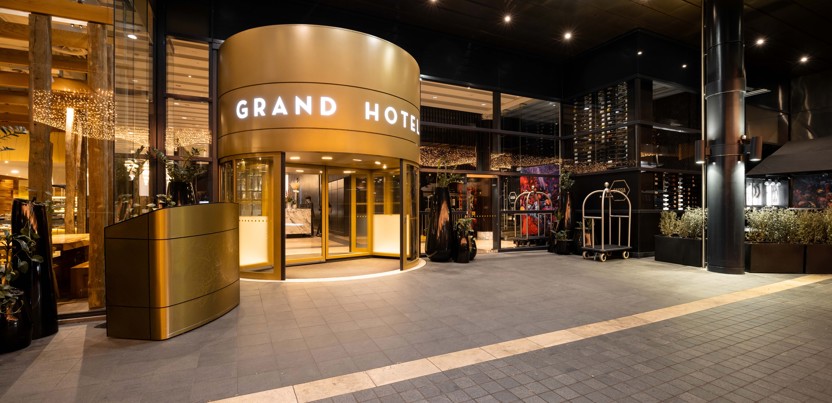
SkyCity Entertainment Group has signed a conditional agreement to sell The Grand Hotel and its business assets for NZ$221 million. The buyer will own the property, while SkyCity will continue managing and operating it only during a transitional period ending 30 June 2027. That separation makes the transaction a useful case study in asset monetisation, operating continuity and the limits of “asset-light” language.
The binding agreement replaces July’s preliminary deal
SkyCity announced the signed sale and purchase agreement on 16 October 2026. The purchasers are Eden Global Capital Private Limited and Auckland City Collective Limited, which SkyCity describes as constituents of a privately owned property investment and development organisation with interests across Australia, Singapore and wider Southeast Asia.
The announcement is a material change from the non-binding heads of agreement disclosed on 22 July 2026. At that stage, financial terms were confidential and the parties still had to negotiate binding documents after due diligence. The October agreement establishes the NZ$221 million price, but it does not mean the transaction has completed.
Completion remains conditional, including consent from New Zealand’s Overseas Investment Office. SkyCity expects the remaining conditions to be addressed through the rest of 2026 and is targeting settlement in mid-December. Investors should therefore distinguish three dates: the July preliminary agreement, the October binding contract and the future settlement date.
Ownership changes before operating control fully transfers
The unusual commercial feature is the transition period. SkyCity has agreed to continue managing and operating The Grand Hotel for the incoming owners until 30 June 2027. The disclosure does not describe this as a long-term hotel management agreement, and it does not publish a management fee, performance test or renewal right.
That matters because a sale-and-manage arrangement can mean very different things depending on duration and economics. A long-term management contract may convert property ownership into recurring fee income. Here, the confirmed arrangement is transitional. Its immediate purpose appears to be continuity while ownership changes, rather than a disclosed permanent asset-light operating model.
For the purchasers, continuity reduces handover risk across staffing, reservations, suppliers, systems and the hotel’s connection to the wider SkyCity Auckland precinct. For SkyCity, the transition provides time to separate a complex operating asset without abruptly disrupting guests or the surrounding entertainment ecosystem.
The capital story is debt reduction and flexibility
SkyCity says the transaction forms part of its asset monetisation programme and that proceeds will be used to repay debt and improve financial flexibility. This is the central investment rationale: the company is turning an owned hospitality asset into cash while preserving short-term operational continuity.
The hotel price should not be interpreted as net cash available for debt reduction. The announcement gives a gross sale price but does not disclose transaction costs, tax effects, working-capital adjustments or other closing movements. Nor does it provide hotel revenue, earnings, room count valuation or an implied capitalisation rate in the market release. Those omissions prevent a reliable valuation comparison from the headline alone.
SkyCity’s 30 September strategic update said its broader asset monetisation programme was targeting aggregate proceeds of NZ$275 million to NZ$300 million before the end of 2026, after an earlier commercial-property sale realised NZ$74.5 million. Adding NZ$221 million to NZ$74.5 million gives NZ$295.5 million. That is an arithmetic comparison with the stated programme target, not a forecast of net proceeds or proof that every condition will be met.
What hotel owners should test in a transitional management period
- Decision rights: Which party controls pricing, staffing, procurement, capital expenditure and commercial partnerships between settlement and 30 June 2027?
- Economic alignment: Is the manager paid a fixed fee, an incentive fee or another amount, and how are owner-funded costs approved?
- Brand and systems continuity: Which booking channels, loyalty relationships, technology platforms and precinct services remain available during and after transition?
- Employee and supplier transfer: Who carries employment obligations, outstanding contracts and transition costs at each stage?
- End-state planning: What operating platform will be ready on 1 July 2027, and what happens if regulatory approval or operational separation takes longer than expected?
These questions are relevant beyond hotels. Whenever a seller continues operating an asset after completion, the transition agreement needs to define authority, cost allocation, data access, service standards, liability and exit mechanics with the same care as the purchase contract.
The buyer’s regional profile also matters
SkyCity says the incoming owners are connected to a diversified property investment and development organisation with interests across Australia, Singapore and Southeast Asia. The release does not identify a future hotel brand, a replacement operator or a redevelopment plan. It would therefore be premature to infer repositioning, international expansion or a permanent operating mandate.
What can be said is narrower: the transaction brings cross-border property capital into a prominent Auckland hospitality asset, subject to foreign-investment approval, while the seller remains in place temporarily. That structure gives the buyers time to evaluate the operating model without forcing an immediate break in service.
The commercial lesson
The Grand Hotel agreement shows why asset monetisation should be analysed as a sequence rather than a single sale price. Signing, regulatory clearance, settlement, transition management and the post-transition operating model each carry different risks.
For investors, the most useful evidence will be the net debt reduction after settlement, the cost and quality of the transition, and the operating arrangement that follows June 2027. For hotel owners and operators, the deal is a reminder that separating real-estate ownership from day-to-day management only creates durable value when responsibilities and the end state are explicit.
Star Brands Consulting Group supports investors, brand owners and operating partners assessing ownership structures, management models and market-entry readiness. Learn more about our Market Entry Advisory.
Leave a Reply