
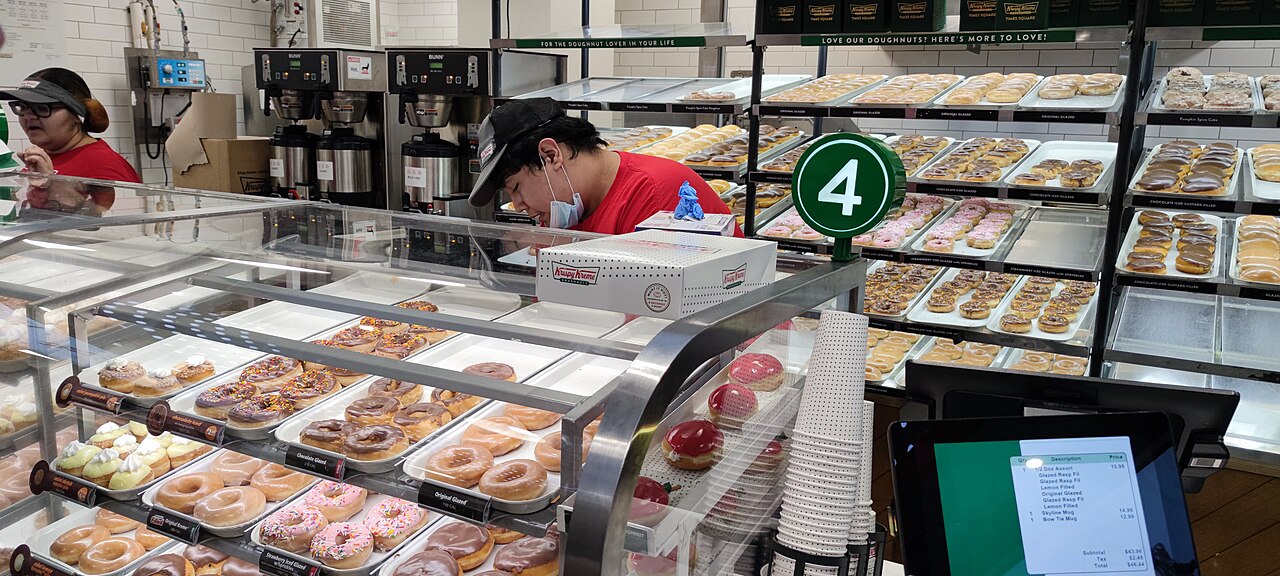

Krispy Kreme has signed a franchise development agreement for 33 shops across the New York metropolitan area over five years. The deal shows how a franchisor can pursue capital-light density by expanding with an operator that already runs 12 shops in the same complex market.
What the development agreement covers
According to Krispy Kreme’s official announcement dated 13 October 2026, Original Entrepreneurs LLC has committed to open 33 shops across New York City and the surrounding region, including Long Island and New Jersey, over the next five years.
The franchisee currently operates 12 Krispy Kreme shops. If all 33 additions open while the existing estate remains unchanged, the operator would control 45 shops—simple arithmetic, not a company forecast or guarantee. The agreement establishes a development ambition; it does not mean the proposed shops are already open, leased or under construction.
Why operator history matters
Original Entrepreneurs is not a new market entrant. Krispy Kreme said the group opened its first Hot Light Theater shop in Jersey City in 2017, then expanded in New Jersey through Springfield, East Rutherford, Paramus and Lakewood before entering New York.
That operating history is commercially relevant. A five-year, multi-site commitment requires more than access to capital: the franchisee must repeatedly source sites, secure approvals, recruit and train teams, open stores to standard and manage a growing portfolio without weakening existing operations. Prior local experience can reduce some market-learning risk, but it does not remove execution risk at the new scale.
Capital-light for the brand does not mean capital-light for the franchisee
Krispy Kreme described the agreement as supporting “capital-light franchise growth.” For the franchisor, that model can shift much of the property and store-development capital to the franchise partner while extending brand distribution and future royalty income.
The capital burden still exists. It moves to the operator and its financing structure. The franchisee must align development capital, leases, construction, equipment, pre-opening costs and working capital with a timetable that averages more than six openings per year if delivery is evenly spread. Actual phasing may differ, and Krispy Kreme did not disclose project-level budgets, franchise fees, debt arrangements or opening schedules.
The real strategy is metro density
This is more than a unit-count story. A concentrated regional portfolio can build advertising efficiency, management coverage, brand visibility, labour mobility and procurement leverage. It can also make digital ordering and local-store marketing more effective because customers encounter the brand more frequently across connected commuting and shopping patterns.
Density introduces its own risks. New shops can divide demand with existing locations, raise competition for suitable sites and labour, and create operational complexity if formats or production requirements vary. The operator must distinguish genuinely incremental catchments from locations that mainly redistribute existing sales.
What the announcement does not disclose
The release does not identify individual sites, the planned mix of shop formats, store-level investment, area exclusivity, development remedies, financing, sales expectations or expected returns. It also does not specify how many sites are already secured. Investors and prospective multi-unit operators should therefore treat 33 as a contractual development target, not evidence of completed capacity.
- Site pipeline: How many locations are approved, leased, in construction or still under search?
- Development cadence: What annual opening schedule is commercially sustainable rather than merely contractually possible?
- Unit economics: How do occupancy costs, labour, delivery and local marketing affect cash-on-cash returns?
- Portfolio effects: Which sites add new demand, and which could cannibalise existing shops?
- Operating capacity: Can management, training and quality-control systems scale ahead of the estate?
- Downside protection: What cure periods, extension rights or remedies apply if site delivery falls behind?
A scorecard for the next five years
The most useful measures will be shops opened versus the development schedule, time from site approval to launch, capital variance, opening productivity, same-market cannibalisation, labour stability, quality compliance and the performance of the existing 12-shop base during expansion.
The strategic lesson is clear: franchise development agreements create growth options, but value depends on operator qualification and repeatable execution. Krispy Kreme has chosen an experienced regional partner for a large density play. The commercial test is whether that experience can be converted into 33 viable shops without outrunning capital, sites or operating systems.
Star Brands Consulting Group supports brands and multi-unit operators evaluating franchise development structures, territory plans and partner readiness. Explore our Franchisor Services.
Leave a Reply