
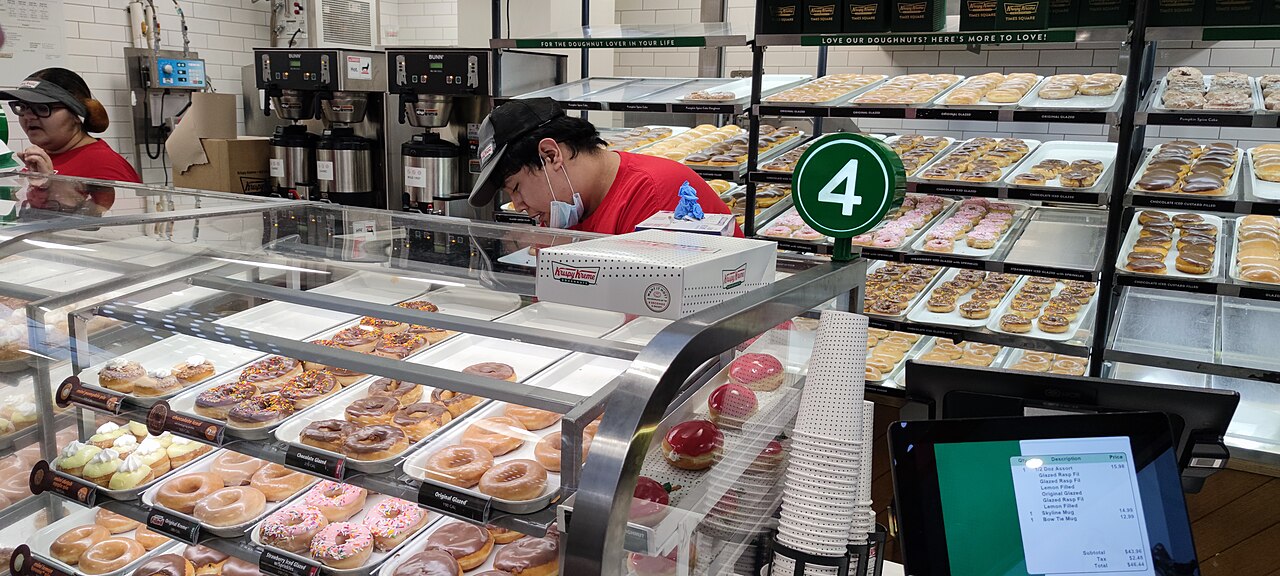

Krispy Kreme has signed a five-year agreement with an established franchisee for 33 additional shops across New York City, Long Island and New Jersey. The real test is whether territory planning, production capacity and operator execution can turn a capital-light commitment into profitable metropolitan density.
A 33-shop commitment with an experienced operator
Krispy Kreme announced on 13 October 2026 that Original Entrepreneurs LLC will develop 33 shops across the New York metropolitan area over the next five years. The stated territory includes New York City, Long Island and New Jersey.
The counterparty is not new to the system. Original Entrepreneurs opened its first Krispy Kreme Hot Light Theater shop in Jersey City in 2017 and currently operates 12 shops across New Jersey and New York, according to the company’s announcement.
If the operator retains all 12 existing shops and completes all 33 planned openings, its Krispy Kreme estate would reach 45 shops. That is an arithmetic implication, not a company forecast: the announcement does not disclose closures, transfers or any other portfolio changes that may occur during the five-year period.
The commitment also equates to an average of 6.6 openings a year. Again, that is only a planning benchmark. Krispy Kreme did not publish an annual opening schedule, exact addresses or a required cadence for the development programme.
Why the deal matters beyond store count
The agreement fits Krispy Kreme’s wider effort to reduce capital intensity and expand through franchise partners. In its 2025 annual report, the company described profitable US expansion and a capital-light franchise model as central parts of its turnaround. It said refranchising and franchise development should improve financial flexibility and returns on invested capital.
The company reported that franchise-operated locations generated approximately 25% of systemwide sales in fiscal 2025 and said it expected that share to approach 50% beginning in fiscal 2027. That is a company expectation rather than a guaranteed outcome, but it explains why a large domestic development agreement is strategically significant.
For Krispy Kreme, the arrangement can expand consumer access without requiring the company to fund every new shop directly. For the franchisee, however, the capital and execution burden does not disappear. It moves to the operator, whose returns will depend on site quality, development costs, labour, supply-chain capacity, sales productivity and the terms of the franchise relationship.
Format and production capacity are critical unknowns
Krispy Kreme’s model is not based on one uniform box. It includes Hot Light Theater Shops, Fresh Shops and fresh-delivery points supplied through production hubs. The company’s 2025 annual report put the average capital investment for a Hot Light Theater Shop at US$2 million to US$5 million and for a fresh-delivery door at US$2,000 to US$6,000.
Those figures are company-wide historical averages, not estimates for this agreement. The 13 October announcement does not identify the format mix for the 33 shops, disclose project costs or say how many production hubs will support them.
That missing detail matters. A network anchored by a small number of productive hubs and supported by Fresh Shops can have a different capital profile from a rollout dominated by full-production shops. Investors and operators should therefore avoid multiplying a single historical cost figure by 33 and treating the result as the programme’s investment requirement.
Metropolitan density creates both leverage and risk
New York’s density can support brand visibility, delivery demand and efficient market coverage. It also creates demanding property economics, complex permitting, intense labour competition and substantial variation between neighbourhoods.
A credible rollout plan should connect each proposed shop to a wider network design. The relevant questions include whether a location produces on site or is supplied from another facility; how delivery routes will work; what sales volume is needed to support occupancy costs; and whether openings are sequenced to build density without cannibalising existing shops.
The inclusion of New York City, Long Island and New Jersey adds another layer. These are connected consumer markets, but they involve different municipalities, property conditions, labour pools and regulatory processes. A five-year commitment provides time to phase development, yet it also exposes the operator to changing construction costs, interest rates and consumer demand.
What investors, operators and brand owners should test
1. Operator capacity
An existing 12-shop portfolio is relevant evidence of system experience, but a 33-unit pipeline requires a different scale of real-estate, construction, recruitment, training and field-support capability. Qualification should examine the people and systems behind the expansion, not simply the operator’s current unit count.
2. Territory and site sequencing
The public announcement does not disclose exclusivity, protected areas or the division of development responsibility across New York City, Long Island and New Jersey. Those details can materially affect site competition, rollout accountability and future development rights.
3. Capital resilience
Neither party disclosed franchise fees, royalties, development deposits, lease obligations or required equity. Stakeholders should test whether the operator can fund openings through different economic conditions without weakening existing restaurants or delaying the schedule.
4. Hub economics and fresh delivery
Krispy Kreme has said better utilisation of existing hubs can improve profitability because significant production costs are fixed. The commercial case for the new shops should therefore be assessed alongside production capacity, logistics and potential fresh-delivery distribution—not in isolation.
5. Development governance
The announcement confirms a five-year commitment but does not publish milestones or remedies for underdevelopment. Strong agreements normally connect territory rights to measurable opening obligations, reporting and performance standards. The confidential contract, not the press release, determines how those controls work here.
A capital-light strategy still requires execution-heavy partners
Krispy Kreme’s New York agreement illustrates a wider franchising principle: capital-light growth for the brand owner is not execution-light growth for the franchisee.
The 33-shop headline is commercially meaningful because it pairs a large territory programme with an operator that already knows the system and the regional market. The outcome will depend on the less visible architecture—format mix, hub capacity, real-estate discipline, capital resilience and development governance.
For brand owners, the lesson is to qualify for the capabilities required at the future scale, not only the operator’s present estate. For investors and multi-unit groups, the priority is to understand how each site fits a network and how capital is staged against measurable development evidence.
Star Brands Consulting Group’s Market Entry Advisory supports territory prioritisation, partner requirements and staged rollout planning for brands and operators evaluating multi-unit expansion.
Leave a Reply