
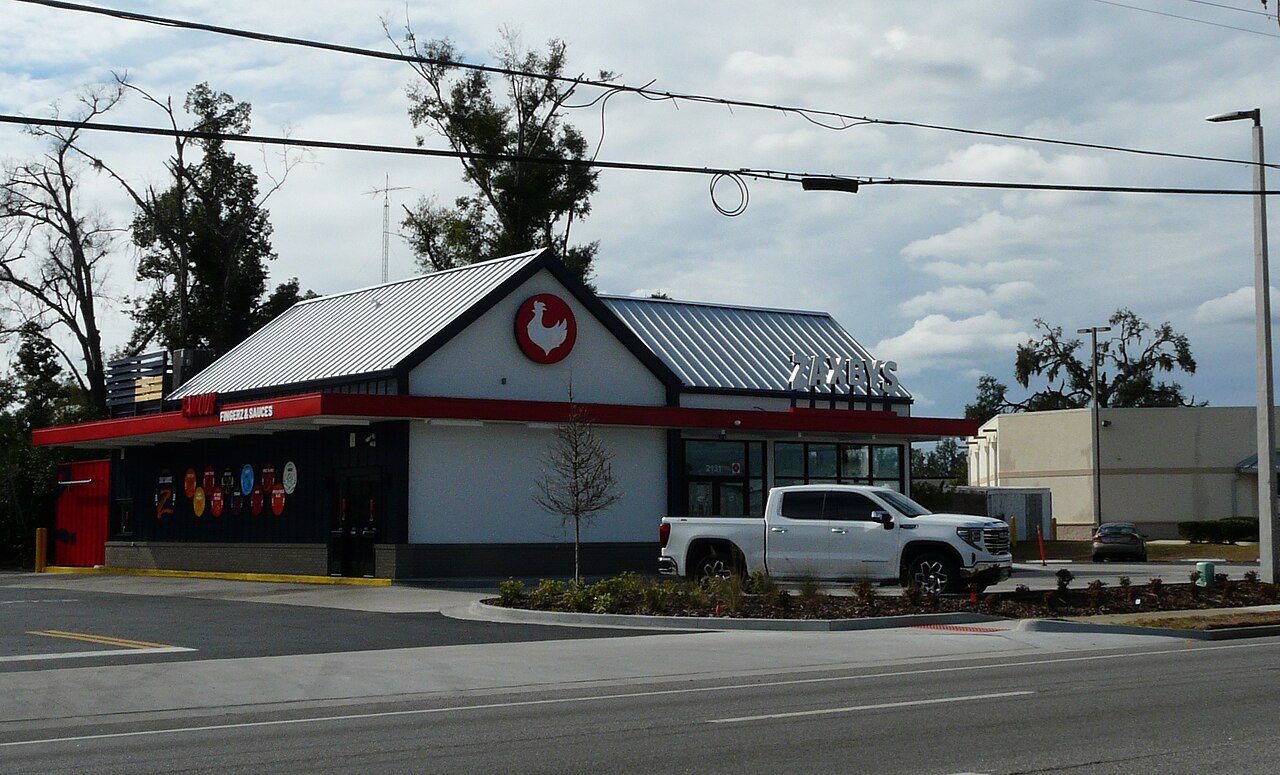

Zaxbys’ move into Florida Turnpike service plazas is a compact case study in non-traditional expansion: the brand gains access to high-traffic venues, but success depends on a specialist operator, format discipline and concession economics that differ from a conventional roadside restaurant.
What was announced—and what has already opened
On 6 October 2026, Zaxbys announced a five-restaurant agreement with travel-hospitality operator Areas USA for Florida Turnpike service plazas. The first unit had already opened on 29 September at Orlando’s Turkey Lake Service Plaza. The distinction matters: 6 October is the announcement date, while 29 September is the opening date of the first restaurant.
Zaxbys described the agreement as its largest non-traditional development deal to date. It also said it is exploring opportunities in airports, colleges and universities, military installations and other high-traffic destinations. Those are stated areas of interest, not confirmed additional contracts.
Why this is not a conventional five-unit deal
A service-plaza restaurant operates inside a travel ecosystem controlled by infrastructure, concession and access rules. The brand cannot evaluate the opportunity using only the trade-area logic applied to a freestanding suburban restaurant.
Star Brands analysis: the relevant unit of qualification is not simply the franchisee’s balance sheet. It is the operator’s ability to work within concession agreements, coordinate with transport authorities, manage compressed demand peaks, recruit for difficult-access locations and protect brand standards inside a multi-concept environment.
Areas USA brings that operating context. The company says it runs nearly 400 restaurants and travel-retail stores across 27 airports and 12 travel plazas, supported by more than 6,000 employees. It also says the business serves about 35 million customers annually. Those network figures demonstrate scale, but they do not disclose the economics or traffic of the five Zaxbys sites.
The commercial tests behind the rollout
- Throughput: Can the kitchen deliver the brand’s core menu at travel-peak speed without eroding product quality?
- Format design: Which equipment, seating and back-of-house elements are essential, and which can be adapted to constrained service-plaza footprints?
- Demand quality: How much traffic converts into transactions, and how exposed are sales to seasonality, weather and route disruption?
- Concession economics: Do occupancy charges, required operating hours and capital obligations leave adequate four-wall returns?
- Supply resilience: Can food, packaging and maintenance inputs reach highway sites reliably and at acceptable cost?
- Governance: Are performance data, audit rights and brand-remedy provisions strong enough for an operator managing several concepts?
Why the first unit should be treated as a prototype
The five-site commitment creates a useful learning sequence. The Turkey Lake restaurant can provide evidence on transaction mix, service times, labour scheduling, menu complexity and traveller conversion before later sites are fully configured.
That does not automatically make the first unit a formal pilot; neither party used that term in the announcement. It is an analytical inference. Commercially, however, a staged rollout allows the brand and operator to use real operating data to refine subsequent openings rather than duplicating assumptions across all five sites.
Implications for brand owners, operators and investors
For brand owners, non-traditional expansion can add distribution and awareness without relying exclusively on conventional development territories. The price is greater format complexity and dependence on operators with specialised venue relationships.
For operators, scale in airports or travel plazas is only part of the qualification case. Brands should also examine concept-level execution, labour systems, procurement, reporting and the operator’s capacity to fund mandated refurbishments.
For investors, store-count commitments are an incomplete measure of value. The stronger questions concern opening schedules, capital responsibility, site-level margins, concession tenure and whether the first locations establish a repeatable model for other travel venues.
Assessing an operator, format or non-traditional market-entry structure? Explore Star Brands Consulting Group’s Private Advisory.
Sources
Zaxbys announcement: agreement with Areas USA, published 6 October 2026; reviewed 7 October 2026. Areas USA company profile and operating footprint, reviewed 7 October 2026. Commercial implications and the prototype interpretation above are Star Brands analysis, not company forecasts.
Leave a Reply