
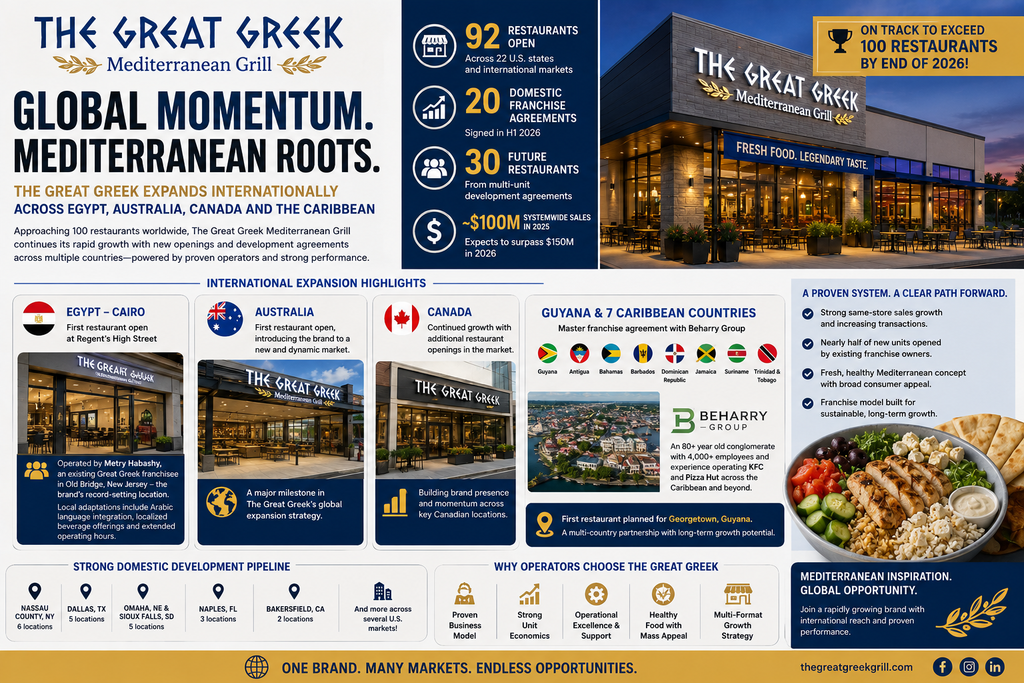
The Great Greek Mediterranean Grill is moving into a more significant stage of international development as it approaches the 100-restaurant milestone.
The Mediterranean fast-casual concept has 92 restaurants operating across 22 U.S. states and international markets and expects to surpass 100 open locations by the end of 2026.
Internationally, the brand has opened its first restaurants in Egypt and Australia, expanded further in Canada, and signed a master franchise agreement covering Guyana and seven Caribbean countries.
The expansion is notable not simply because of the number of new markets, but because of the operators behind them.
In Egypt, the franchisee already operates The Great Greek in New Jersey.
Across Guyana and the Caribbean, the brand has selected an 80-plus-year-old conglomerate with more than 4,000 employees and existing KFC and Pizza Hut operations.
Together, these developments show how a growing franchise brand can use both successful existing franchisees and established institutional operators to build international markets.
The Great Greek Is Approaching 100 Restaurants
The Great Greek has developed from a U.S. Mediterranean restaurant concept into a substantial franchise system.
By August 2026, it had reached 92 operating restaurants.
During the first six months of the year, the company signed 20 domestic franchise agreements, including four multi-unit agreements representing 30 future restaurants.
Development commitments include:
- six locations in Nassau County, New York
- five in Dallas, Texas
- five across Omaha, Nebraska and Sioux Falls, South Dakota
- three in Naples, Florida
- two in Bakersfield, California
- additional units across several other U.S. markets
Eight domestic restaurants also opened during the first half of 2026.
The company expects to pass 100 operating restaurants before year-end.
Growth Is Being Supported by Existing Franchisees
The development pipeline follows a strong 2025, when The Great Greek opened 20 restaurants and generated just under $100 million in systemwide sales.
Franchise sales increased approximately 41% year over year, and management entered 2026 targeting more than $150 million in systemwide sales.
One of the more meaningful indicators is that nearly half of recent unit growth has come from existing franchise owners.
That deserves attention.
Existing franchisees reinvest with considerably more information than first-time buyers. They already understand labour, food costs, property requirements, margins, franchisor support and the realities of operating the concept.
Their willingness to open additional restaurants provides a useful indication of confidence in the system.
Egypt Provides the Most Interesting International Case
The Great Greek’s first Egyptian restaurant opened at Regent’s High Street in Cairo, marking the brand’s first entry into the Middle East.
The operator is Metry Habashy, an existing Great Greek franchisee who already owns the brand’s restaurant in Old Bridge, New Jersey.
That New Jersey location established a weekly opening sales record for the brand.
Rather than simply adding another U.S. restaurant, Habashy has taken his experience with the franchise system into another country.
This gives The Great Greek something particularly valuable in its first Middle Eastern market: an operator who does not need to learn the brand from the beginning.
He already understands its menu, operating standards, training requirements and franchisor expectations.
The international challenge becomes adapting that knowledge successfully to Egypt.
Cairo Shows How Standardisation and Localisation Can Work Together
The Egyptian restaurant has not simply copied the New Jersey operation.
Local adaptations include Arabic-language integration, adjustments to the beverage offering and extended operating hours, with the restaurant trading until midnight to reflect local dining behaviour.
This is an important feature of internationally scalable franchise systems.
The strongest concepts protect their core identity while allowing sensible adaptation around local customer behaviour.
The brand remains recognisable.
The execution becomes relevant to the market.
Australia Adds a Very Different International Test
The Great Greek has also opened its first restaurant in Australia.
Australia presents very different operating conditions from Egypt, including a mature restaurant industry, sophisticated consumers, strong café culture and widespread familiarity with Mediterranean food.
That makes the two new markets useful tests of the brand’s international adaptability.
A concept capable of maintaining its identity across significantly different labour markets, property environments, competitive conditions and consumer cultures has a stronger foundation for wider international development.
Canada Continues to Build
Canada is also contributing to the brand’s international growth, with another location added to the network.
Unlike Egypt and Australia, Canada is not a completely new market for The Great Greek.
Continued Canadian development is therefore important for a different reason: it demonstrates whether the company can build greater market density rather than simply establish isolated international locations.
Long-term international success depends on both.
New-country announcements create reach.
Repeat development creates a business.
Beharry Group Takes Eight-Country Master Franchise Rights
The largest international development agreement is with Beharry Group, which has secured master franchise rights covering:
- Guyana
- Antigua
- The Bahamas
- Barbados
- Dominican Republic
- Jamaica
- Suriname
- Trinidad and Tobago
The first restaurant is expected to open in Georgetown, Guyana.
This gives The Great Greek a single regional partner responsible for developing the concept across eight countries.
For a franchisor entering several relatively small markets, this can be considerably more efficient than negotiating and supporting eight unrelated country operators.
Why Beharry Group Is a Significant Partner
Beharry Group has operated for more than 80 years and employs over 4,000 people.
Its wider businesses span areas including:
- commercial and merchant banking
- manufacturing
- insurance
- stock brokerage
- automotive distribution
- quick-service restaurants
More importantly, the company already has significant international franchise experience through KFC and Pizza Hut.
That means The Great Greek is entering the Caribbean with a partner that already understands multi-unit restaurant development, international brand standards, food safety, workforce management and supply-chain execution.
The company is not being selected simply because it can finance stores.
It already operates the type of infrastructure required to develop them.
The Great Greek Also Gives Beharry Portfolio Diversification
The deal makes sense from the operator’s perspective as well.
KFC and Pizza Hut give Beharry exposure to established global QSR categories.
The Great Greek adds a Mediterranean fast-casual proposition with a different consumer position around grilled proteins, salads, wraps and fresher meal occasions.
For sophisticated multi-brand operators, portfolio construction matters.
The objective is not necessarily to accumulate as many franchises as possible. It is to assemble brands capable of serving different customers, occasions and price points while making use of shared operating infrastructure.
Why One Operator Can Receive Eight Countries
The breadth of Beharry’s rights illustrates how franchise territory structures change with operator capability.
A company developing eight countries may be able to centralise:
- management
- training
- procurement
- marketing
- franchise support
- supply-chain functions
That can make a regional master franchise substantially more efficient than a collection of individual country agreements.
But those rights require a different level of capability from a single-unit franchise.
The operator is effectively helping create the franchisor’s regional infrastructure.
That requires management depth, capital, systems and long-term development capacity.
Existing Franchisees Can Graduate Into International Development
The Cairo transaction illustrates another important path.
A franchisee may begin with one store, develop into a multi-unit operator and eventually use that record to pursue opportunities in another country.
The progression can look like:
single-unit franchisee → multi-unit operator → area developer → cross-border operator → master franchise partner
Not every franchisee will—or should—follow that route.
International development introduces additional property, regulatory, supply-chain, currency and management complexity.
But for well-capitalised franchisees with strong teams and appropriate local knowledge, successful domestic operations can become a meaningful qualification for international rights.
Operating History Becomes an Asset
This is why sophisticated franchise operators should document their performance as carefully as they document their financial resources.
A credible international operator profile can include:
- brands operated
- number of units
- countries and territories
- opening history
- development commitments fulfilled
- management structure
- investment deployed
- operating performance
- employee base
- property relationships
- compliance history
- franchisor references
This record becomes evidence that the organisation can execute.
For a franchisor comparing several financially qualified candidates, that operating evidence can be decisive.
The International Model Is Flexible
The Great Greek’s current expansion provides several different examples within one franchise system.
Egypt demonstrates cross-border development by an existing franchisee.
Guyana and the Caribbean demonstrate regional master franchising through an established institutional operator.
Canada shows continued growth within an existing international market.
Australia represents another new-country entry.
The structures are different because the operators and markets are different.
That flexibility is important.
International franchise growth does not require every country to be developed through exactly the same type of partner or agreement.
The Domestic Pipeline Still Matters
International expansion is more credible when the domestic franchise system continues developing at the same time.
The Great Greek signed 20 domestic franchise agreements representing 30 future restaurants during the first half of 2026 and opened eight U.S. locations during the same period.
The company also reported growth in franchised same-store sales and transactions.
That provides useful context for the international expansion.
The brand is not relying on overseas agreements to create the appearance of growth while its core market stalls.
Domestic and international development are happening together.
Open Restaurants Matter More Than Announced Pipelines
There is still an important distinction investors should maintain.
The Great Greek currently has 92 operating restaurants.
Its signed development pipeline is larger.
Those figures should not be treated as interchangeable.
Professional franchise analysis should distinguish between:
- rights awarded
- development agreements signed
- projects funded
- sites secured
- construction underway
- restaurants actually operating
A large development pipeline can demonstrate demand for a franchise system.
Open, performing restaurants demonstrate execution.
Both matter, but they measure different things.
What Investors Should Watch Next
The next stage of The Great Greek’s international development will be determined by execution rather than announcements.
In Egypt, additional restaurants would provide evidence that the Cairo entry is capable of developing into a meaningful market.
In Australia, the first location will test the concept in a mature and competitive restaurant environment.
In Canada, further openings will show whether the brand can create density.
And in Guyana and the Caribbean, the speed at which Beharry progresses beyond Georgetown will test the value of the eight-country master franchise structure.
Continued reinvestment by existing franchisees should also remain an important indicator of confidence in the system.
Strategic Assessment
The Great Greek is entering an important stage of its development.
It has 92 restaurants, expects to exceed 100 by the end of 2026, has a substantial domestic development pipeline and is now building a more meaningful international presence.
But the strongest signal is the quality and progression of its operators.
An existing New Jersey franchisee has taken the brand into Cairo.
An established KFC and Pizza Hut operator has secured rights across eight Caribbean markets.
These examples show two routes into international franchise development:
prove the brand from inside the system and expand across borders, or bring an established operating platform capable of developing a region from the outset.
Both rely on the same underlying currency: execution.
Where Star Brands Consulting Group Fits In
Star Brands Consulting Group works with investors and established operators seeking international franchise, licensing and market-entry opportunities.
For serious operators, qualification should extend well beyond net worth.
Through Star Access™, an Investor File™ can capture:
- brands currently operated
- unit count
- territories
- store-opening history
- development performance
- management infrastructure
- sector experience
- property access
- financial capacity
- cross-border capability
This allows an operator to be assessed not simply as someone seeking a franchise, but as a potential multi-unit, territory or international development partner.
Star Brands Consulting Group can also evaluate whether an existing franchise platform is positioned to pursue:
- additional units
- another complementary brand
- neighbouring territories
- cross-border development
- master franchise rights
For qualified operators, the objective is to move beyond buying individual franchises and towards building strategically valuable multi-brand and multi-territory businesses.
Conclusion
The Great Greek Mediterranean Grill is beginning to demonstrate genuine international reach.
The company has 92 operating restaurants, expects to surpass 100 by year-end, has entered Egypt and Australia, continues to grow in Canada and has awarded an eight-country Caribbean master franchise to Beharry Group.
The expansion also demonstrates how franchise credibility compounds.
A successful New Jersey franchisee can become an Egyptian operator.
An established KFC and Pizza Hut franchise group can become the developer of another brand across eight countries.
For ambitious operators, that is the more important lesson.
Capital can open the first door.
A proven operating record can open much larger ones.
Leave a Reply