
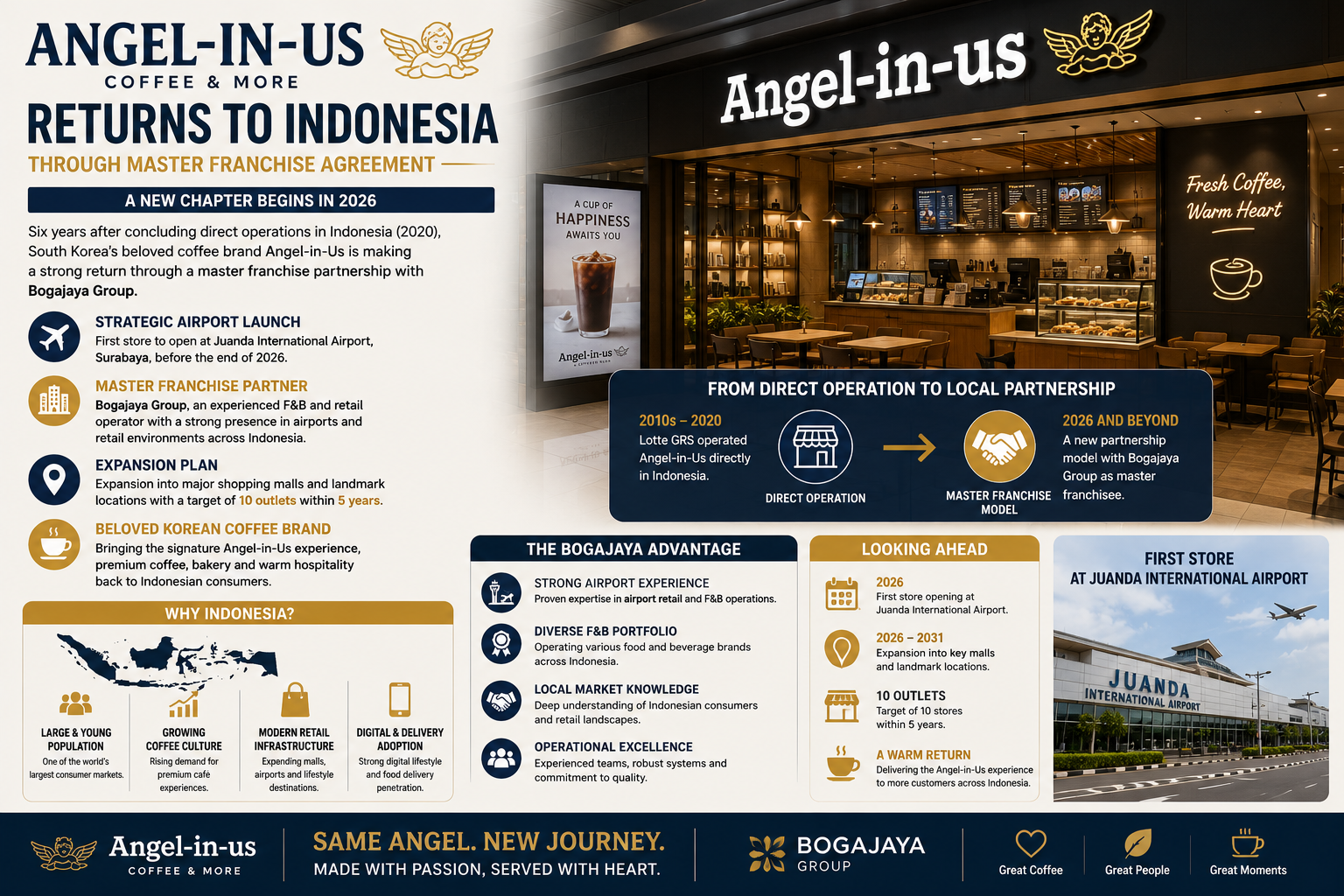
South Korean coffee brand Angel-in-Us is returning to Indonesia, six years after withdrawing from the market.
But it is not returning under the same structure.
Lotte GRS has signed a master franchise agreement with Indonesia’s Bogajaya Group, replacing the direct operating model previously used by the brand with a locally led franchise structure.
The first new Angel-in-Us location is expected to open at Juanda International Airport before the end of 2026, followed by expansion into major shopping centres and prominent retail locations.
The partners are targeting 10 outlets within five years.
At first glance, this is a relatively modest restaurant development programme.
Strategically, however, it is considerably more interesting.
Angel-in-Us previously entered Indonesia through direct corporate operations and ultimately exited.
It is now returning through a master franchisee with existing food, retail and airport infrastructure.
The brand has not abandoned the market.
It has changed the market-entry model.
Angel-in-Us Is Returning to Indonesia
Angel-in-Us is part of Lotte GRS, the South Korean restaurant group behind several foodservice concepts.
The coffee brand previously operated directly in Indonesia but withdrew in 2020.
Six years later, Lotte has decided the Indonesian opportunity deserves another look.
This time, however, the company will not attempt to rebuild the business primarily through direct corporate operations.
Bogajaya Group will become the local master franchise partner responsible for developing the brand.
That changes the economics and operating structure of the business substantially.
Lotte provides the brand, product systems, operating knowledge and international platform.
Bogajaya provides the local execution.
For international expansion, that distinction can determine whether a market works.
Why the Previous Exit Matters
It would be easy to interpret Angel-in-Us’ 2020 withdrawal as evidence that Indonesia was unsuitable for the brand.
The new agreement demonstrates why that conclusion would have been premature.
International brands can struggle in attractive markets for reasons that have little to do with the long-term potential of the country itself.
Problems may arise from:
- the operating model
- local management
- property strategy
- supply-chain complexity
- consumer positioning
- cost structure
- insufficient scale
- weak local relationships
- timing
A market exit therefore tells investors what happened under one particular structure.
It does not necessarily tell them what would happen under another.
Angel-in-Us is effectively testing that proposition.
Direct Operation and Master Franchising Are Very Different Models
When a foreign brand operates stores directly, the company assumes substantial responsibility.
It must build local management.
It must understand property.
It must recruit.
It must establish suppliers.
It must manage regulation.
It must develop marketing.
It must understand consumer behaviour.
It must fund the local business.
For a company headquartered thousands of kilometres away, this can create considerable complexity.
Master franchising changes the allocation of those responsibilities.
The local master franchisee typically assumes a much greater role in developing the territory.
Depending on the agreement, that can include:
- opening stores
- securing locations
- investing development capital
- managing employees
- local marketing
- procurement
- logistics
- regulatory compliance
- adapting execution to local conditions
The international brand retains standards and strategic oversight without necessarily carrying the full operating burden itself.
Bogajaya Is Not Starting From Zero
The selection of Bogajaya Group is central to understanding the return.
Bogajaya already operates food-and-beverage and retail businesses in Indonesia and has experience within major airport environments.
That is particularly relevant because Angel-in-Us’ first new Indonesian location is planned for Juanda International Airport.
Airport retail is specialised.
Operators need to understand:
- concession structures
- passenger traffic
- security requirements
- restricted delivery environments
- staffing
- operating hours
- travel-retail purchasing behaviour
- landlord relationships
A company already familiar with those conditions can bring immediate advantages to an incoming international brand.
This is precisely the kind of infrastructure global franchisors increasingly value.
The First Store Will Be at Juanda International Airport
Choosing Juanda International Airport for the first location is strategically interesting.
The airport serves Surabaya and the wider East Java region, giving Angel-in-Us access to a large consumer market as well as domestic and international passenger traffic.
Airports can be powerful launch environments for beverage brands.
They provide:
- concentrated customer traffic
- long operating hours
- travellers with dwell time
- premium convenience demand
- high brand visibility
- exposure to consumers from multiple cities
For a returning brand, the environment can also provide a controlled way to rebuild awareness before committing to a much larger conventional street or shopping-centre network.
Shopping Centres and Landmark Locations Will Follow
The airport is intended to be the beginning rather than the entire strategy.
The development plan calls for expansion into major malls and landmark locations, with 10 outlets targeted within five years.
That pace is measured.
And that may be intentional.
A brand returning to a market after a previous withdrawal has good reason to expand carefully.
The partners can use the first locations to assess:
- customer response
- product preferences
- pricing
- store economics
- site productivity
- localisation requirements
If the model performs strongly, the development programme can subsequently be accelerated.
The important point is that Lotte is not repeating the previous strategy unchanged.
Indonesia Is a Very Different Market From 2020
The Indonesian consumer economy continues to develop.
The country has one of the world’s largest populations and a substantial young consumer base.
Urbanisation continues.
Shopping-centre development remains significant.
Digital ordering and food delivery have become deeply integrated into restaurant behaviour.
International travel has recovered.
Coffee consumption and café culture continue to evolve.
These changes create a different environment from the one Angel-in-Us faced during its earlier period in the country.
The competitive environment is also intense.
Indonesia has a strong domestic coffee culture and numerous established local and international café operators.
Angel-in-Us therefore cannot rely on international branding alone.
The local execution needs to be competitive.
Indonesia’s Coffee Market Requires Local Understanding
Indonesia is not a market where a foreign coffee brand is introducing consumers to coffee.
It is one of the world’s major coffee-producing countries.
Consumers have access to:
- traditional coffee
- local café concepts
- international chains
- specialist coffee operators
- convenience-led beverage brands
- digitally native beverage concepts
That makes positioning particularly important.
Angel-in-Us must establish a reason for consumers to choose it.
The brand’s Korean identity may provide an advantage.
South Korean culture has substantial international influence across entertainment, beauty, food and lifestyle.
But cultural interest still needs to translate into a commercially sustainable store proposition.
Bogajaya’s local market knowledge becomes important here.
Korean Consumer Brands Are Becoming More International
Angel-in-Us also forms part of a broader international expansion trend among South Korean consumer brands.
Korean companies have developed considerable global influence across:
- beauty
- fashion
- food
- entertainment
- cafés
- convenience retail
- lifestyle
The international popularity of Korean culture has created a favourable environment for many Korean consumer concepts.
But successful internationalisation still requires appropriate operating structures.
A brand may have strong cultural recognition and still fail if:
- the wrong locations are selected
- pricing is unsuitable
- supply chains are weak
- local marketing is ineffective
- the operating partner lacks capability
The Bogajaya agreement gives Angel-in-Us a local platform intended to address those execution challenges.
The Bigger Story Is Direct-to-Franchise Conversion
From a franchise strategy perspective, the most important aspect of the transaction is the shift from direct operation to master franchising.
This is a category of opportunity investors frequently overlook.
A brand may enter a market corporately.
It may later close.
Years later, management may conclude that the market remains attractive but that direct ownership is no longer the preferred structure.
The territory can then re-emerge as:
- a master franchise opportunity
- a licensing opportunity
- a joint venture
- a distribution arrangement
- an area-development opportunity
In other words, a previous corporate market can become a future franchise market.
A Corporate Exit Can Create Future Franchise Rights
This has important implications for franchise intelligence.
Conventional franchise portals typically focus on brands actively advertising franchise opportunities.
But some of the most interesting rights may never appear there.
They emerge from strategic changes.
Consider the sequence:
A brand operates directly.
The brand exits.
Several years pass.
Market conditions improve.
A capable local operator emerges.
The brand wants to return but does not want to rebuild a corporate subsidiary.
A master franchise agreement becomes the solution.
That is effectively what Angel-in-Us is demonstrating in Indonesia.
Why Brands Convert From Direct Operation to Franchising
There are several reasons a company may choose this route.
Lower Capital Exposure
The franchise partner provides much of the development capital.
Local Knowledge
The operator understands the consumer, property market and regulatory environment.
Faster Infrastructure Access
The partner may already possess offices, employees, suppliers, warehouses and property relationships.
Reduced Management Complexity
The brand does not need to build a complete local corporate organisation.
Better Local Accountability
The franchisee has direct financial exposure to the success of the operation.
Expansion Potential
A capable master franchisee can sometimes develop the territory faster than a foreign corporate team.
These advantages explain why franchising can become attractive even after direct operation has been attempted.
But Franchising Does Not Automatically Fix a Market
There is an important qualification.
Changing the structure does not guarantee success.
The new operator still needs viable unit economics.
Consumers still need to want the product.
Locations still need to perform.
Competition still matters.
Pricing still matters.
Supply chains still matter.
Master franchising can improve local execution, but it cannot rescue a fundamentally unsuitable proposition.
This is why the first phase of the Indonesian return will be particularly important.
The 10-Store Target Is Sensible
Ten stores over five years may appear conservative compared with development agreements announcing dozens or hundreds of locations.
But announced store numbers should never be assessed in isolation.
For a returning brand, a measured rollout can be a strength.
It gives the partners time to:
- validate locations
- refine products
- build management capability
- understand demand
- establish supply chains
- test store formats
Opening ten profitable restaurants can create more long-term value than signing an agreement for fifty locations that never materialise.
Execution matters more than headline commitments.
What Investors Should Watch
Several developments will show whether the new structure is working.
Juanda Airport Performance
The first location will provide an important early test.
Speed of the Second and Third Openings
Moving beyond the launch location will demonstrate whether the partners have established a repeatable development model.
Mall Expansion
Shopping-centre stores will test the brand against a different customer profile from airport passengers.
Product Localisation
The balance between Korean brand identity and Indonesian preferences will be important.
Store Economics
Sustainable unit economics will ultimately determine whether the partners accelerate beyond the initial 10-store plan.
Wider Indonesian Geography
Expansion beyond the initial regions would signal growing confidence in the concept.
Could Indonesia Become a Regional Platform?
Indonesia itself is a substantial opportunity.
But a successful relaunch could have implications beyond one country.
Southeast Asia contains several markets where:
- café culture is growing
- Korean consumer brands have strong recognition
- shopping-centre infrastructure is well developed
- younger consumers are receptive to international concepts
A proven Indonesian operation could strengthen Angel-in-Us’ case for additional international development.
The first objective, however, is demonstrating that the new structure works.
What Prospective Master Franchisees Can Learn From Bogajaya
Bogajaya’s selection reinforces the importance of existing infrastructure.
Prospective master franchisees should ask themselves what they can offer a global brand beyond money.
That may include:
- airport concessions
- retail locations
- restaurant operations
- distribution
- supply-chain capability
- property relationships
- management teams
- existing brands
- local market knowledge
- government and regulatory familiarity
The more of this infrastructure an operator already possesses, the easier it becomes for a franchisor to imagine that company successfully developing the territory.
Strategic Assessment
Angel-in-Us’ return to Indonesia is a useful case study because it demonstrates that market entry structure is not permanent.
A brand can operate directly in one period and franchise the same market in another.
The country did not change.
The brand did not disappear.
The operating architecture changed.
Lotte is effectively separating two questions:
Is Indonesia still an attractive market?
And:
Does Lotte need to operate the stores itself?
The answer appears to be:
Yes, the market remains attractive.
No, direct corporate operation is no longer the preferred route.
Bogajaya Group provides the alternative.
Where Star Brands Consulting Group Fits In
Star Brands Consulting Group works with investors, operating companies and brands evaluating international franchise, licensing and market-entry opportunities.
A key part of that work is understanding that territory status can change.
A market can move between:
- corporate operation
- franchise operation
- master franchise
- joint venture
- licensing
- distribution
- temporary closure
- market re-entry
Through Star Access™, territory assessment can therefore extend beyond asking whether a brand currently advertises franchises.
For qualified operators, the relevant analysis may include:
- markets previously exited by the brand
- territories where direct operations have been reduced
- expiring or changing master franchise relationships
- markets where replacement operators may eventually be required
- countries where a different entry structure could make expansion viable
The Investor File™ can then assess whether the prospective partner possesses the operating infrastructure required to credibly pursue those rights.
This creates a more sophisticated approach to international franchise opportunity discovery.
A territory that appears unavailable today may become strategically important when the brand changes how it intends to operate there.
Conclusion
Angel-in-Us’ return to Indonesia should not be read simply as another coffee-chain expansion announcement.
It is a second attempt at the market under a fundamentally different structure.
Lotte previously operated the brand directly and withdrew in 2020.
Six years later, Angel-in-Us is returning through a master franchise agreement with Bogajaya Group, beginning at Juanda International Airport and targeting 10 outlets within five years.
The strategic lesson extends far beyond coffee.
International brands sometimes leave markets because the operating structure is wrong rather than because the underlying market is permanently unattractive.
When a stronger local operator emerges, franchising can provide a second route.
For investors and operators, that creates an important category of opportunity:
markets where direct international expansion has ended, but the brand itself may still have a future through the right local partner.
Leave a Reply