
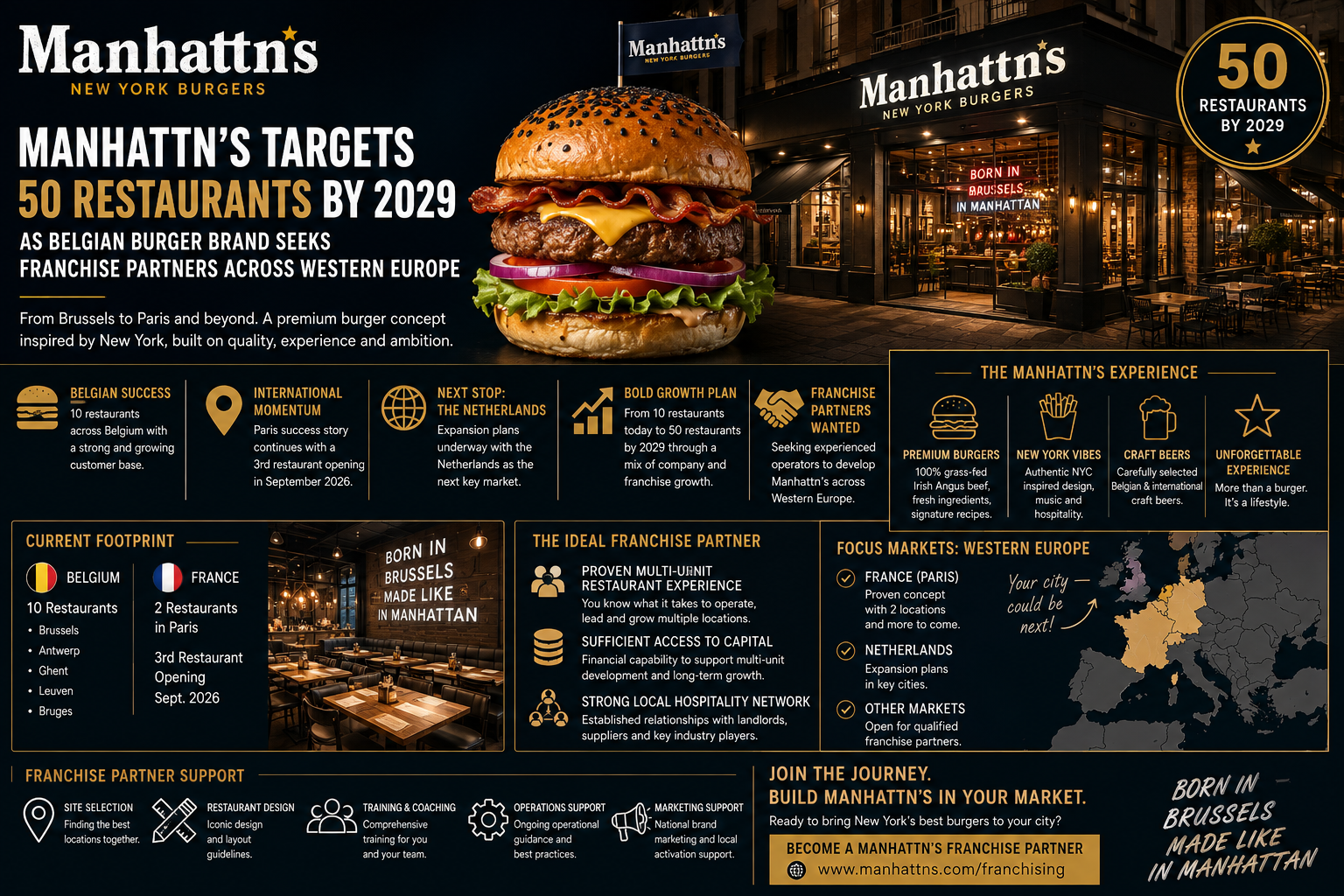
Belgian premium burger chain Manhattn’s is preparing for a major expansion phase, with ambitions to grow to 50 restaurants by 2029 and franchise partners expected to play an increasingly important role in taking the brand across Western Europe.
The company has already established a strong base in Belgium, recently opening its 10th Belgian restaurant, while Paris has become the first major test of the concept outside its home market.
A third Paris restaurant is scheduled to open in September 2026.
The Netherlands is next on the agenda, and Manhattn’s is actively looking for experienced franchise partners capable of developing the brand in other Western European markets.
For franchise investors, this makes Manhattn’s considerably more interesting than a mature international restaurant chain whose most attractive territories have already been allocated.
This is a brand that has proven its concept domestically, demonstrated that it can travel internationally and is now openly preparing to scale through franchising.
From Brussels Burger Concept to International Expansion
Manhattn’s was founded in 2014 by brothers Philippe and Jerome Vandermeulen.
The concept was inspired by New York and built around the idea of bringing the atmosphere, energy and food culture of Manhattan into a premium European burger restaurant.
The first locations opened in Brussels.
From there, the business expanded into cities including:
- Antwerp
- Ghent
- Leuven
- Bruges
- additional Brussels locations
The company has deliberately avoided positioning itself as another conventional fast-food burger chain.
Its proposition combines premium burgers with distinctive restaurant design, hospitality and a strong New York identity.
That positioning has allowed Manhattn’s to occupy a space between traditional fast food and full-service casual dining.
The Business Has Reached an Important Turning Point
For much of its first decade, Manhattn’s focused primarily on proving the concept and building its Belgian network.
That phase is changing.
Management now believes the organisation, concept and operating systems are ready for much faster growth.
The ambition has increased accordingly.
An earlier development plan targeted approximately 40 restaurants by 2029.
The company has now raised that ambition to 50 restaurants by 2029.
That change is significant.
It suggests confidence not only in consumer demand, but also in the ability of the business to scale through external operating partners.
Franchising is expected to provide much of that acceleration.
Paris Is the International Test Market
France represents the first major international test for Manhattn’s.
The company already operates restaurants in Paris, including locations around Montorgueil and Beaubourg, and a third Paris restaurant is scheduled to open in September 2026.
Paris matters for several reasons.
It is:
- one of Europe’s largest restaurant markets
- highly competitive
- internationally visible
- heavily visited by tourists
- home to sophisticated consumers with enormous dining choice
If Manhattn’s can build a successful multi-unit business in Paris, management believes the concept can travel into other major Western European cities.
That is an important part of the franchise proposition.
Prospective partners do not have to rely entirely on Belgian performance when evaluating the concept.
There is now evidence from another major European market.
The Netherlands Is Next
The Netherlands is another clear priority.
Manhattn’s has been actively considering expansion into the Dutch market and has identified franchising as the preferred route.
Cities such as Rotterdam provide the type of environment the company believes fits its proposition:
- strong urban populations
- established restaurant culture
- international consumers
- premium retail districts
- high pedestrian traffic
- strong delivery demand
Amsterdam would naturally be another market of considerable interest, although actual territory development will depend on partner selection, locations and the company’s rollout strategy.
The broader objective is clear.
Manhattn’s wants to move from a Belgian restaurant business with selected international stores into a Western European franchise platform.
Manhattn’s Is Actively Looking for Franchisees
This is where the opportunity becomes particularly relevant for investors.
Manhattn’s is not merely saying that franchising might become part of its strategy at some point in the future.
The company is actively seeking franchise partners.
Its franchise programme is focused on Western Europe, and the brand has set out the profile of operators it wants to work with.
This is therefore a genuine franchise-development opportunity rather than speculation based on store-opening activity.
What Manhattn’s Is Looking for in a Franchise Partner
The company’s requirements also tell us something important about the scale of the opportunity.
Manhattn’s is looking for franchisees with:
Proven Multi-Unit Restaurant Experience
The company is not primarily searching for first-time restaurant investors.
It wants operators that understand how to manage multiple locations.
That includes experience with:
- restaurant operations
- staffing
- food costs
- customer service
- site performance
- management structures
- multi-unit growth
This immediately places the opportunity at a more sophisticated level than a typical single-unit franchise.
Sufficient Access to Capital
Restaurant development requires meaningful capital.
The partner must be capable not simply of funding the first restaurant, but of supporting the broader development programme expected for the territory.
Depending on the market and agreement, that could eventually involve multiple locations.
A Strong Local Hospitality Network
Manhattn’s also values partners with established relationships in the local hospitality ecosystem.
That can include relationships with:
- landlords
- shopping-centre operators
- property agents
- suppliers
- hospitality professionals
- recruitment networks
- local business partners
For an international franchisor, these relationships can substantially accelerate market entry.
This Is Not Designed as a Passive Investment
The partner profile makes another point clear.
Manhattn’s is looking for operators.
This is not being positioned primarily as a passive investment where an individual provides capital and waits for somebody else to build the business.
The company wants partners capable of developing and managing restaurant operations at scale.
For experienced restaurant groups, hospitality companies and multi-brand franchise operators, that creates a more interesting proposition.
They can potentially add Manhattn’s to existing infrastructure rather than building an operating company entirely from scratch.
What Manhattn’s Provides Franchise Partners
The franchisor’s role extends beyond providing the brand name.
Manhattn’s says franchise partners receive support in areas including:
- coaching
- training
- site selection
- restaurant design
- store development
These areas are particularly important during international expansion.
A strong concept can still fail if the location is wrong, the restaurant is poorly designed or the operating team is inadequately trained.
Site selection becomes especially important because Manhattn’s positions its restaurants in high-profile urban environments.
The right location is therefore part of the brand proposition itself.
The Restaurant Experience Is Central to the Concept
Manhattn’s has built its identity around more than the burger.
The company emphasises a complete New York-inspired restaurant experience.
That includes:
- custom restaurant design
- distinctive packaging
- premium ingredients
- hospitality
- visual identity
- atmosphere
Its menu centres around freshly prepared burgers using grass-fed Irish Angus beef, alongside homemade sauces, double-cooked fries and Belgian craft beers.
The combination of American inspiration and Belgian execution gives the concept a distinctive identity.
That matters when expanding internationally.
Western Europe’s burger market is already crowded.
A new entrant needs more than a good product.
It needs a reason for consumers to remember the brand.
The Premium Burger Market Remains Competitive
Manhattn’s is entering international markets where consumers already have substantial choice.
Competition includes:
- multinational fast-food chains
- premium burger specialists
- independent restaurants
- delivery-first concepts
- casual dining groups
The company therefore cannot compete on scale alone.
Its opportunity lies in differentiation.
The New York identity, premium ingredients, restaurant design and hospitality positioning are intended to create that distinction.
Whether the proposition translates successfully across multiple Western European markets will be one of the most important questions as franchising accelerates.
Why Franchising Makes Sense at This Stage
The timing of the franchise strategy is important.
Manhattn’s spent its first decade building and refining the concept.
That gives the company something many early-stage franchisors lack: operating experience.
Now the challenge changes from proving the restaurant to scaling the network.
Corporate expansion alone can be expensive.
Every new company-owned restaurant requires the brand to fund:
- property
- fit-out
- equipment
- recruitment
- working capital
- management
Franchise partners can contribute much of that capital while also bringing local market expertise.
This allows the brand to grow more quickly without financing every restaurant itself.
For Manhattn’s, franchising therefore becomes a tool for accelerating international expansion rather than simply generating franchise fees.
Why Western Europe?
The company’s immediate geographic focus is deliberate.
Western Europe provides a large collection of relatively close markets with:
- substantial urban populations
- strong restaurant spending
- developed property markets
- high consumer mobility
- significant tourism
- sophisticated delivery infrastructure
Geographic proximity to Belgium also makes it easier for the franchisor to support new partners.
Expansion into France and the Netherlands can be managed much more closely than an immediate move into distant markets.
This allows Manhattn’s to build international franchising capability gradually.
If that model succeeds, a wider geographic expansion could become possible later.
The 50-Restaurant Target Changes the Opportunity
The ambition to reach 50 restaurants by 2029 gives prospective franchise partners a useful indication of management’s intentions.
This is not a company planning occasional opportunistic openings.
It wants meaningful network growth.
The current footprint means reaching 50 restaurants will require substantial additional development within a relatively short period.
Franchise partners will therefore be central to achieving the target.
For investors, timing matters.
Joining a franchise system while international territories are still being allocated can provide a fundamentally different opportunity from approaching the same brand after it has already established hundreds of locations.
Early international partners may have access to larger territories and greater development potential.
They also carry greater risk because the international model is less mature.
That balance needs to be assessed carefully.
The Difference Between a Store Opportunity and Territory Development
Investors interested in Manhattn’s should determine exactly what level of opportunity is being considered.
There is an important difference between:
- opening one restaurant
- developing several restaurants within a city
- securing regional development rights
- securing national franchise rights
The capital requirement, operating responsibility and potential value are very different in each case.
Given Manhattn’s emphasis on multi-unit restaurant experience, serious prospective partners should be prepared for discussions that extend beyond a single restaurant.
The brand is looking for growth partners.
Financial Capability Must Be Assessed Properly
Manhattn’s does not publicly present a universal investment figure that should be assumed to apply to every Western European territory.
That is sensible.
Restaurant development costs can vary substantially depending on:
- country
- city
- restaurant size
- property condition
- rent
- fit-out requirements
- equipment
- labour costs
- opening inventory
- working capital
An investor should therefore avoid relying on speculative online estimates.
The correct financial assessment should be based on the actual proposed market, development structure and franchisor documentation.
For a multi-unit opportunity, the more important question is not simply:
“Can I afford the first restaurant?”
It is:
“Can I capitalise the entire development programme?”
The Ideal Candidate May Already Operate Restaurants
The partner requirements suggest that some of the strongest candidates could be existing hospitality operators.
Examples might include:
- multi-unit restaurant franchisees
- regional food-service groups
- family-owned hospitality businesses
- multi-brand franchise operators
- restaurant investment groups
These organisations may already possess:
- management teams
- property relationships
- recruitment systems
- accounting infrastructure
- procurement expertise
- operational knowledge
Adding a new concept to that platform can be considerably easier than creating all of those capabilities from the beginning.
What Investors Should Evaluate Before Applying
A serious prospective Manhattn’s partner should assess several issues before approaching the brand.
Territory
Is the proposed market actually available?
Capital
Can the investor support a multi-unit development plan?
Experience
Does the management team meet the brand’s stated preference for proven multi-unit restaurant operators?
Real Estate
Can the investor secure the high-profile urban locations the concept requires?
Competition
How crowded is the premium burger category in the target market?
Unit Economics
Can expected restaurant sales support local rents, labour and food costs?
Organisation
Is there sufficient management capacity to scale beyond the first location?
Answering these questions before brand engagement produces a much stronger investor proposition.
What to Watch Next
Manhattn’s is entering a particularly important period.
Several developments will indicate how successfully the international franchise strategy is progressing.
Third Paris Restaurant
The September opening will deepen the company’s presence in its first international market.
Netherlands Entry
The selection of the Dutch franchise partner and first locations will provide important evidence about how Manhattn’s structures new territories.
Additional Western European Partners
The company is actively looking beyond France and the Netherlands.
New partner announcements could reveal which markets are being prioritised next.
Progress Towards 50 Restaurants
The pace of openings between now and 2029 will show whether the company’s accelerated growth target is achievable.
Franchise Mix
It will be worth monitoring how much of the future network is company-owned versus franchise-operated.
Strategic Assessment
Manhattn’s is at an interesting stage in the franchise-development cycle.
It is no longer an unproven start-up.
The company has more than a decade of operating history, an established Belgian network and growing experience in Paris.
At the same time, it has not yet become a mature international franchise system with most major Western European territories allocated.
That creates both opportunity and risk.
The opportunity is access to a growing brand while international development is still relatively early.
The risk is that the brand still needs to demonstrate that its Belgian and Parisian success can be repeated consistently across multiple countries and franchise partners.
For experienced restaurant operators comfortable with that balance, Manhattn’s deserves serious consideration.
Where Star Brands Consulting Group Fits In
For investors and operators seeking emerging international franchise opportunities, brands at the Manhattn’s stage can be particularly interesting.
The challenge is determining whether the investor, territory and brand are genuinely aligned.
Star Brands Consulting Group supports investors and operators seeking international franchise, licensing, distribution, partnership and market-entry opportunities.
For an investor interested in Manhattn’s, the process can include:
- assessing the proposed country or territory
- evaluating territory availability
- reviewing the investor’s restaurant operating experience
- assessing capital readiness
- evaluating competitive conditions
- developing the investor profile
- preparing the market and territory proposition
- assessing multi-unit development capability
- supporting structured engagement with the brand
- identifying comparable restaurant franchise opportunities where appropriate
Through Star Access™, qualified investors can evaluate brands based on actual expansion requirements rather than simply submitting generic franchise enquiries.
That is particularly relevant here because Manhattn’s has already made clear what it wants:
experienced multi-unit restaurant operators, access to sufficient capital and strong local hospitality networks.
A serious approach should demonstrate those capabilities from the beginning.
Conclusion
Manhattn’s is moving from controlled domestic growth into a much more ambitious phase.
The Belgian burger company now wants to reach 50 restaurants by 2029, is deepening its Paris presence, preparing for the Netherlands and actively seeking franchise partners across Western Europe.
For investors, this is a genuine franchise opportunity rather than speculation about whether a brand might someday consider franchising.
But it is also clearly not designed for everybody.
Manhattn’s is looking for experienced operators capable of building multiple restaurants, securing strong locations and developing the brand within their markets.
That makes the opportunity particularly relevant to established hospitality groups and multi-unit franchise operators.
If Manhattn’s successfully converts its Belgian and Paris performance into a scalable Western European franchise system, the next several years could represent the period in which many of its most important international territories are established.
For serious operators, that makes the brand worth watching now rather than after the network has already reached 50 restaurants.
Leave a Reply