
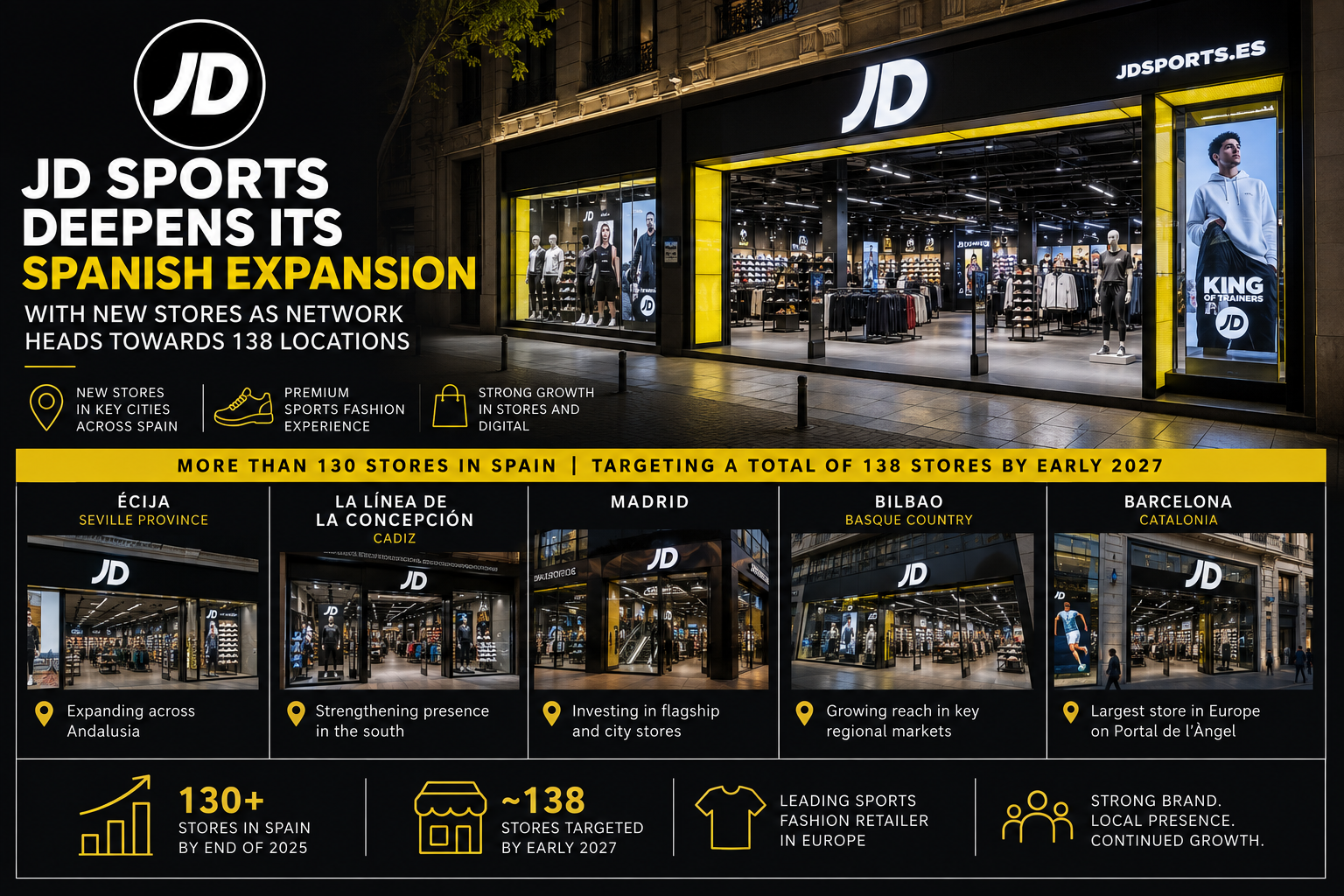
JD Sports is strengthening its position in Spain with another round of store openings, taking its national network towards 138 locations by early 2027.
The British sports-fashion retailer is preparing four additional openings as it continues investing in one of its important European markets.
The expansion is notable not simply because JD is adding stores. The company already has a substantial Spanish footprint.
What matters is that JD continues to see enough opportunity in Spain to invest in new cities, enlarge important existing locations and develop increasingly ambitious flagship stores.
For investors, retail developers and international brands assessing Spain, that provides another useful indication of the strength of the country’s physical retail market.
Four More Openings Are Planned
JD Sports’ latest expansion programme includes new locations across different parts of Spain, continuing a strategy that combines major metropolitan markets with regional cities.
The broader 2026 programme has included expansion in locations such as Écija in Seville province, La Línea de la Concepción in Cádiz, Madrid and Bilbao, alongside significant investment in Barcelona.
Rather than concentrating entirely on Madrid and Barcelona, JD is building a geographically diverse network.
That matters.
Once an international retailer moves beyond the largest gateway cities and continues opening in secondary markets, it usually indicates that management believes the underlying business model has sufficient national demand to support a broader network.
Spain Is Already a Major JD Sports Market
JD entered Spain years ago and has since developed one of the country’s most extensive sports-fashion retail networks.
The company finished 2025 with more than 130 stores across Spain.
Reaching approximately 138 locations therefore represents continued consolidation rather than initial market entry.
JD has already established stores across:
- Madrid
- Barcelona
- Valencia
- Seville
- Málaga
- Alicante
- Bilbao
- Zaragoza
- A Coruña
- and numerous regional cities
This gives the company significant national coverage and provides a strong physical platform alongside its digital business.
Barcelona Has Become an Important Showcase Market
Barcelona provides perhaps the clearest indication of how JD’s physical retail strategy is evolving.
In 2025, the company opened a major flagship on Portal de l’Àngel, one of Barcelona’s most important shopping streets.
The store became JD’s largest location in Europe and represented more than another point of sale.
It reflected the company’s increasing emphasis on stores as cultural and experiential destinations.
JD is also investing in its store at La Maquinista shopping centre, expanding the location to approximately 905 square metres.
These investments illustrate an important change taking place across international retail.
Leading retailers are not necessarily choosing between physical stores and digital commerce.
Instead, they are making their best stores larger, more distinctive and more commercially productive.
JD Sports Is Betting on Physical Retail
The Spanish expansion deserves attention because it comes at a time when many international retailers are still reassessing their physical estates.
JD is taking a more selective approach.
The company continues to open stores where it sees growth while simultaneously improving existing locations.
The objective is not simply to accumulate store numbers.
Increasingly, the strategy is about building stores that can function as:
- retail destinations
- product discovery environments
- brand showcases
- community touchpoints
- omnichannel fulfilment locations
JD’s broader European strategy reflects this approach, with management placing considerable emphasis on store presentation, product assortment and what it describes as brand theatre.
Sports Fashion Has Moved Beyond the Traditional Sports Store
JD’s success also reflects a broader structural change within retail.
Sportswear is no longer purchased only for sport.
Sneakers, technical apparel, tracksuits and performance-inspired clothing have become central components of everyday fashion.
That has significantly expanded the addressable market for retailers such as JD Sports.
Its customers are not simply athletes.
They include consumers interested in:
- sneakers
- streetwear
- fashion
- music
- youth culture
- limited releases
- international sports brands
This positioning has allowed JD to sit between traditional sporting-goods retail and fashion retail.
Relationships with Global Brands Remain Critical
A major part of JD’s competitive position comes from its relationships with leading international sportswear brands.
Its stores bring together products from companies such as:
- Nike
- Adidas
- New Balance
- Puma
- ASICS
- Under Armour
- The North Face
The ability to secure desirable products, exclusive ranges and high-demand footwear is particularly important in the sneaker market.
As consumers become more selective, retailers with strong brand relationships and differentiated assortments have a significant advantage over generalist competitors.
Why Spain Continues to Attract International Retail Investment
JD Sports is not alone in increasing its exposure to Spain.
The Spanish retail market has attracted growing attention from international companies because of a combination of domestic demand, tourism and attractive retail economics.
Several factors support the market.
Large Consumer Base
Spain has a population of approximately 49 million and several major metropolitan areas capable of supporting substantial international retail networks.
Tourism
Spain remains one of the world’s most visited countries.
Madrid, Barcelona, Málaga, Valencia, Alicante, the Balearic Islands and the Canary Islands all benefit from significant international visitor spending.
For fashion and sports retailers, this creates demand beyond the resident population.
Strong Shopping Centre Infrastructure
Spain has a mature network of shopping centres and retail parks, giving expanding brands access to established locations across both major and secondary cities.
Continued Importance of Physical Shopping
Spanish consumers continue to demonstrate strong engagement with physical retail, particularly in fashion, footwear and lifestyle categories.
That creates opportunities for retailers capable of combining physical stores with digital commerce.
Regional Cities Are Becoming Increasingly Important
Perhaps one of the more useful signals from JD’s strategy is its willingness to continue expanding beyond Spain’s largest cities.
Écija and La Línea de la Concepción are very different markets from Madrid or Barcelona.
Opening stores in locations such as these suggests JD believes its brand has sufficient recognition to support a much wider national footprint.
This is relevant for other international brands assessing Spain.
Madrid and Barcelona may provide the obvious starting points, but they do not represent the full opportunity.
Cities across Andalucía, the Basque Country, Galicia, Valencia and other regions can support substantial international retail demand.
Spain’s Role Within JD Sports’ European Strategy
JD Sports operates across a large international network, but Europe remains fundamental to the business.
During its latest financial year, the company continued adding stores across continental Europe, with particular attention to markets including Spain, Italy and Poland.
Spain is therefore part of a broader strategy to deepen JD’s position in markets where the brand already has meaningful scale.
This is different from speculative international expansion.
JD has already demonstrated that the Spanish market works.
The current phase is about increasing density, improving productivity and strengthening its competitive position.
What Investors and Retail Operators Should Watch
Several aspects of JD’s Spanish expansion deserve continued attention.
Store Productivity
Adding locations only creates value if the wider network remains productive.
JD’s willingness to continue investing suggests confidence in the economics of its Spanish business.
Larger Store Formats
Flagships and expanded stores provide more space for brands, experiences and differentiated product categories.
The performance of these locations will influence future development.
Secondary-City Expansion
Further openings outside Madrid and Barcelona could demonstrate how much additional network capacity remains in Spain.
Competition
The Spanish sportswear and sneaker market includes substantial competition from international and domestic retailers.
JD will need to maintain product relevance and customer loyalty as the market develops.
Omnichannel Integration
Stores increasingly support digital commerce through services such as click-and-collect and fulfilment.
The relationship between JD’s physical network and online business will become increasingly important as the estate grows.
Strategic Assessment
JD Sports’ latest Spanish openings should not be viewed in isolation.
The more important story is the development of a retailer that has moved from market entry to national scale and is still finding opportunities for additional growth.
A network approaching 138 Spanish stores gives JD considerable reach.
At the same time, investments in major locations such as Portal de l’Àngel and La Maquinista show that the company is also focused on improving the quality and impact of its physical estate.
This combination of network expansion and flagship investment provides a useful model for international retailers assessing mature European markets.
Growth does not always require entering a new country.
Sometimes the larger opportunity is increasing penetration in a market where the brand has already proven itself.
Where Star Brands Consulting Group Fits In
For international brands considering Spain, the JD Sports story illustrates why market-entry decisions require more than a national-level assessment. The commercial opportunity can vary significantly between Madrid, Barcelona, Málaga, Seville, Bilbao, Valencia and smaller regional cities. Star Brands Consulting Group supports brands, investors and operators evaluating international expansion through areas including:
- market-entry strategy
- territory assessment
- retail and consumer intelligence
- franchise and licensing structures
- local partner identification
- operator assessment
- location strategy
- expansion planning
For investors seeking international franchise, licensing and brand partnership opportunities, Star Access™ provides a structured pathway for evaluating brands, markets and realistic entry opportunities. The objective is not simply to identify a well-known brand. It is to understand where the brand is growing, how that growth is being structured, and where genuine opportunities for participation may exist.
Conclusion
JD Sports’ continued investment in Spain demonstrates confidence in a market where it already operates at considerable scale. With the network moving towards 138 stores by early 2027, new openings across different regions and continued investment in larger flagship locations, Spain is becoming an increasingly important part of JD’s European retail platform. The wider signal is equally important. International retailers are still finding meaningful physical growth opportunities in Spain — not only in Madrid and Barcelona, but across a much broader network of cities.
For brands, investors and retail operators assessing European expansion, that makes Spain a market worth watching closely.
Leave a Reply