
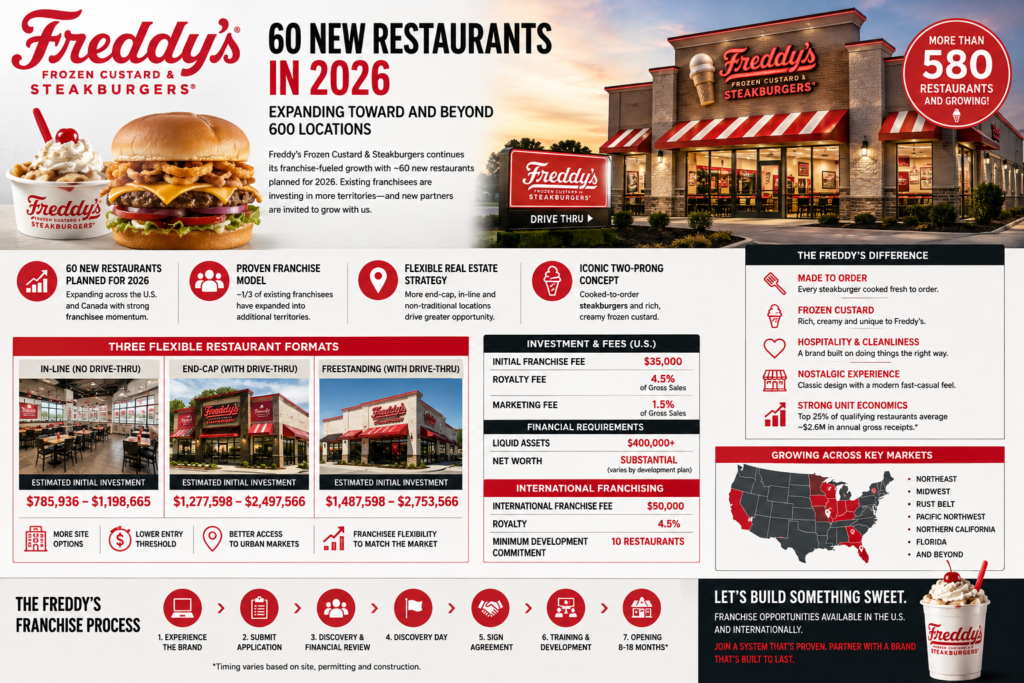
Freddy’s Frozen Custard & Steakburgers is accelerating its franchise expansion, with approximately 60 new restaurants planned for 2026 as the American fast-casual chain moves towards and potentially beyond the 600-location milestone.
The expansion is being driven largely by franchise partners, including existing operators that are committing additional capital to new territories.
Approximately one-third of Freddy’s existing franchise owners have expanded into additional territories, an important indicator of franchisee confidence in the system.
At the same time, Freddy’s is changing the economics of expansion.
The company is moving beyond its traditional freestanding restaurant model by increasing its use of end-cap and in-line formats, giving franchisees greater flexibility in real estate selection and creating lower-cost entry options in markets where standalone development may be difficult or expensive.
For investors, the combination is noteworthy:
Freddy’s is expanding.
Territories remain available.
The company is recruiting franchise partners.
International franchising is open.
And unlike many major restaurant brands where access can be difficult to establish, Freddy’s publicly provides considerable information about what it expects from prospective operators.
Freddy’s Has Grown Beyond 580 Restaurants
Founded in 2002 in Wichita, Kansas, Freddy’s has developed from a regional restaurant concept into one of America’s substantial fast-casual franchise systems.
The brand now operates more than 580 restaurants.
Its core menu combines two categories that have traditionally performed strongly in American food service:
- cooked-to-order steakburgers
- frozen custard
The wider menu includes:
- shoestring fries
- all-beef hot dogs
- chicken
- sandwiches
- frozen custard concretes
- sundaes
- shakes
That combination gives Freddy’s a broader daypart and customer proposition than a burger-only concept.
The restaurant identity is also deliberately distinctive.
Freddy’s combines contemporary fast-casual operations with an American nostalgic design language built around hospitality, cleanliness and made-to-order food.
Sixty New Restaurants Are Planned for 2026
The company expects to open approximately 60 restaurants during 2026.
That would take the network beyond 600 locations if development proceeds as planned.
The new restaurants are expected across both existing and developing territories, with the company targeting growth across regions including:
- the Northeast
- Midwest
- Rust Belt
- Pacific Northwest
- Northern California
- Florida
- additional U.S. markets
Canada also forms part of the wider North American expansion.
This is not simply a company opening additional corporate restaurants.
Franchisees remain central to the growth strategy.
Existing Franchisees Are Buying More Territories
One of the more important numbers for prospective franchise investors is not the 60 planned openings.
It is the fact that approximately one-third of Freddy’s existing franchisees have acquired additional territories.
Repeat investment by existing franchisees can provide useful information about a franchise system.
Operators already inside the network understand:
- restaurant economics
- labour requirements
- supply chain
- franchisor support
- construction costs
- customer demand
- operational challenges
When those operators commit additional capital to more locations, it deserves attention.
It does not guarantee future returns for another investor, but it provides a different signal from growth driven entirely by new franchise recruitment.
Freddy’s expansion is being supported in meaningful part by operators who already know the business.
Freddy’s Franchise Investment: The Numbers
Freddy’s publishes relatively detailed financial requirements for prospective franchisees.
The estimated initial investment currently ranges from approximately:
$785,936 to $2,753,566
The substantial range reflects the different restaurant formats now available.
In-Line Restaurant Without Drive-Thru
Estimated initial investment:
$785,936 – $1,198,665
This is currently the lowest-cost conventional format within the published franchise programme.
End-Cap Restaurant With Drive-Thru
Estimated initial investment:
$1,277,598 – $2,497,566
This provides drive-thru capability without requiring a completely freestanding building.
Standalone Restaurant With Drive-Thru
Estimated initial investment:
$1,487,598 – $2,753,566
This remains the most capital-intensive of the principal restaurant formats.
Actual investment will depend on factors including:
- real estate
- construction
- market
- restaurant size
- equipment
- local labour costs
- site conditions
Investors should therefore evaluate the applicable Franchise Disclosure Document and actual development proposal rather than treating the headline range as a guaranteed project cost.
Franchise Fee and Ongoing Fees
For a conventional U.S. Freddy’s restaurant, the published initial franchise fee is:
$35,000
The ongoing royalty is:
4.5% of gross sales
The published marketing fee is:
1.5%
International terms can differ.
This is particularly important for investors considering country or regional development outside the United States.
International franchise economics should be assessed according to the specific territory and development agreement rather than assuming U.S. terms automatically apply.
Financial Requirements
Freddy’s is seeking investors with meaningful financial capacity.
Its current published qualifications include substantial net worth and liquid capital requirements, particularly for multi-unit development.
Prospective multi-unit operators should expect requirements around:
Liquid assets: approximately $400,000 or more
and substantial net worth, with the precise requirement dependent on the proposed development structure.
For larger development agreements, actual capital needs can be significantly greater than the minimum qualification threshold.
This distinction matters.
Qualifying financially to speak with a franchisor is not the same as having sufficient capital to execute an entire multi-unit development programme.
Freddy’s Is Opening More Flexible Store Formats
One of the most strategically important changes within Freddy’s development programme is the move towards more flexible real estate.
Historically, the classic Freddy’s format has often been a freestanding restaurant with drive-thru capability.
That format can perform strongly, but it also requires substantial real estate and development capital.
The company is now increasing its focus on:
- end-cap restaurants
- in-line restaurants
- non-traditional locations
The effect is significant.
Smaller formats can:
- reduce development costs
- increase the number of viable sites
- improve access to dense urban markets
- allow entry into existing shopping centres
- reduce land requirements
- create opportunities where standalone sites are scarce
For franchisees, real-estate flexibility can materially change the expansion equation.
The In-Line Format Lowers the Entry Threshold
Inside Retail reported that in-line restaurants can begin at around $854,834, compared with approximately $1.59 million for a traditional standalone format under the development figures referenced in the company’s current expansion programme.
Freddy’s official franchise materials provide a broader estimated investment range depending on site-specific conditions.
The strategic point remains the same:
A franchisee no longer necessarily needs to develop a large freestanding restaurant every time the brand enters a new trade area.
That creates considerably more flexibility.
For multi-unit operators, it can also allow different formats to be used within the same territory.
A suburban market might support a freestanding drive-thru.
A dense urban district might be better suited to an in-line restaurant.
A shopping centre could support an end-cap.
The brand can therefore adapt the real-estate strategy to the market rather than forcing every location into one prototype.
Non-Traditional Locations Create Another Growth Channel
Freddy’s is also developing non-traditional locations.
The company has already opened restaurants in environments such as:
- airports
- stadiums
Other potential non-traditional environments can include:
- college campuses
- casinos
- travel locations
- institutional environments
These locations create another route for expansion beyond conventional roadside restaurant development.
For specialist concession operators, travel-retail groups and institutional food-service companies, non-traditional franchising can represent a different type of opportunity from standard restaurant ownership.
Average Unit Volume Deserves Attention — With Context
Freddy’s reports an average annual gross receipts figure of approximately $2.6 million for the top 25% of qualifying company-operated and franchised restaurants.
This figure requires careful interpretation.
It is not the average sales figure for every Freddy’s restaurant.
It represents the average annual gross receipts of the top-performing quarter of qualifying restaurants covered by the company’s relevant disclosure.
Prospective investors should therefore avoid interpreting $2.6 million as expected revenue for a new location.
The appropriate analysis should consider the complete Item 19 financial performance representation in Freddy’s Franchise Disclosure Document.
That will provide a more meaningful basis for assessing the system’s performance.
Freddy’s Prefers Experienced Operators
Financial capability is only part of the qualification process.
Freddy’s states that it prefers prospective franchise owners with backgrounds in areas such as:
- restaurant operations
- franchising
- restaurant management
- multi-unit development
The company also emphasises cultural alignment.
Prospective franchisees are expected to understand the brand, experience its restaurants and demonstrate a commitment to the hospitality model.
For larger multi-unit and international opportunities, operating capability becomes even more important.
A franchisor expanding across dozens of markets does not simply need capital providers.
It needs operators capable of executing the system consistently.
The Franchise Process Is Structured
Freddy’s publicly outlines a clear franchise development process.
It begins with experiencing the brand and submitting an application.
Qualified candidates then progress through discussions with the franchise development team and receive the relevant Franchise Disclosure Document.
The process subsequently includes:
- financial qualification
- territory discussions
- Discovery Day
- development planning
- franchise agreement
- training
- restaurant development
Once the franchise agreement has been signed, Freddy’s indicates that opening can generally take approximately 8 to 18 months.
Actual timelines depend on:
- location
- permitting
- construction
- restaurant prototype
- whether property is leased or purchased
- local market conditions
U.S. Territories Remain Available
Another reason Freddy’s deserves attention from franchise investors is straightforward:
The company still has expansion territory available across the United States.
This is increasingly important as franchise brands mature.
With some established restaurant systems, attractive territories can become heavily developed, leaving new investors with limited geographic options.
Freddy’s is already a substantial national brand but still has room for domestic development.
That places it at an interesting stage of the franchise lifecycle.
The concept has hundreds of operating restaurants and more than two decades of history, while meaningful geographic expansion remains available.
International Franchising Is Open
For Star Brands Consulting Group readers outside the United States, this is perhaps the most important part of the opportunity.
Freddy’s explicitly offers international franchising.
The company is seeking experienced restaurant operators in selected international markets.
Its published international development terms currently include:
International franchise fee: $50,000
Royalty: 4.5%
Minimum development commitment: 10 restaurants
The 10-unit minimum immediately changes the nature of the opportunity.
This is not designed as an international single-store franchise.
It is a multi-unit market-development proposition.
What a 10-Unit International Commitment Means
An investor considering international Freddy’s rights needs to think beyond the economics of one restaurant.
A 10-unit commitment potentially requires:
- substantial development capital
- a local management organisation
- real-estate capability
- supply-chain infrastructure
- recruitment systems
- marketing
- training
- working capital
- multi-year expansion planning
Depending on the country, local sourcing and distribution may also need to be developed.
This makes the opportunity more relevant to:
- established restaurant groups
- multi-brand franchise operators
- hospitality companies
- family offices with operating capability
- strategic food-service investors
rather than purely passive investors.
International Expansion Requires More Than Capital
A prospective country-level Freddy’s operator would need to demonstrate the ability to translate an American restaurant system into a local market.
That involves questions such as:
- Is there demand for steakburgers and frozen custard?
- How should the menu be adapted?
- What price points are commercially viable?
- Can the required ingredients be sourced?
- Which cities should launch first?
- What real-estate formats make sense?
- Is drive-thru culture established?
- How should delivery be integrated?
- What competitive brands already operate locally?
These are market-entry questions, not simply franchise questions.
The success of an international franchise depends on both the strength of the brand and the quality of local execution.
Why the Frozen Custard Component Matters
Freddy’s has a useful point of differentiation within the crowded burger category.
Frozen custard gives the concept a second product platform.
Consumers can visit for:
- burgers
- meals
- desserts
- shakes
- frozen custard
This potentially broadens customer occasions and creates additional opportunities for repeat visits.
It also gives Freddy’s a recognisable identity in markets dominated by conventional burger chains.
Internationally, however, consumer familiarity with frozen custard will differ considerably.
In some markets, the category itself may need to be introduced and explained.
That creates both an opportunity and a marketing challenge.
The Competitive Landscape
Freddy’s operates in one of the world’s most competitive restaurant categories.
Its competitors can include brands across burgers, fast casual and dessert-led food service.
The company therefore needs to differentiate through:
- cooked-to-order food
- product quality
- hospitality
- restaurant design
- frozen custard
- operational consistency
For an international investor, competitive analysis should be conducted at market level.
A concept that occupies a differentiated position in the United States may face a completely different competitive environment in another country.
What Investors Should Evaluate
Before pursuing Freddy’s, prospective franchisees should examine several issues carefully.
Territory Availability
Is the desired city, state or country available?
Investment Capacity
Can the investor fund the required restaurant format and development commitment?
Multi-Unit Capability
For international development, can the organisation realistically build at least 10 restaurants?
Operating Experience
Does the investor or management team have restaurant and multi-unit experience?
Real Estate
Are appropriate drive-thru, end-cap or in-line locations available?
Market Fit
Will the Freddy’s proposition translate effectively to the local consumer?
Supply Chain
Can product standards be maintained economically?
Development Timeline
Can the investor meet the required store-opening schedule?
These questions should be resolved before serious brand engagement.
Strategic Assessment
Freddy’s occupies an attractive position within the franchise market.
It is not an emerging concept with only a handful of restaurants.
It has:
- more than 580 locations
- more than two decades of operating history
- substantial franchisee participation
- repeat investment from existing operators
- multiple restaurant formats
- domestic territory availability
- an active international franchise programme
At the same time, the system still has meaningful room for expansion.
That combination makes Freddy’s particularly relevant for investors seeking a franchise with an established operating base but continued development potential.
The planned 60 restaurant openings in 2026 reinforce that momentum.
Where Star Brands Consulting Group Fits In
Star Brands Consulting Group works with investors and operators seeking international franchise, master franchise, licensing, distribution and strategic brand-development opportunities.
For investors interested in Freddy’s Frozen Custard & Steakburgers, our advisory process can include:
- evaluating target territory availability
- assessing investor financial readiness
- reviewing multi-unit operating capability
- analysing the proposed market
- assessing competitive conditions
- evaluating the appropriate store formats
- preparing the investor profile
- developing the market-entry proposition
- supporting structured engagement with the brand
- evaluating alternative restaurant franchise opportunities where appropriate
Through Star Access™, qualified investors can approach international franchise opportunities from a position of preparation rather than simply submitting an enquiry.
This becomes particularly important with Freddy’s international programme because the minimum commitment is 10 restaurants.
A serious prospective partner therefore needs to demonstrate not only the ability to open a restaurant, but the ability to build a market.
Conclusion
Freddy’s Frozen Custard & Steakburgers is entering another important phase of franchise growth.
Approximately 60 new restaurants are planned for 2026, the network is moving beyond 600 locations, existing franchisees continue acquiring additional territories, and new restaurant formats are creating greater development flexibility.
For domestic investors, territory remains available across numerous U.S. markets.
For international investors, the opportunity is even more strategically interesting.
Freddy’s is actively seeking experienced international restaurant operators and has established a 10-unit minimum development model for overseas expansion.
That makes this a genuine international franchise opportunity — but one designed for serious multi-unit operators rather than speculative single-store investors.
For qualified restaurant groups and investors with the capital, infrastructure and operating capability to develop a market, Freddy’s is a brand worth examining while its international network is still taking shape.
Leave a Reply