
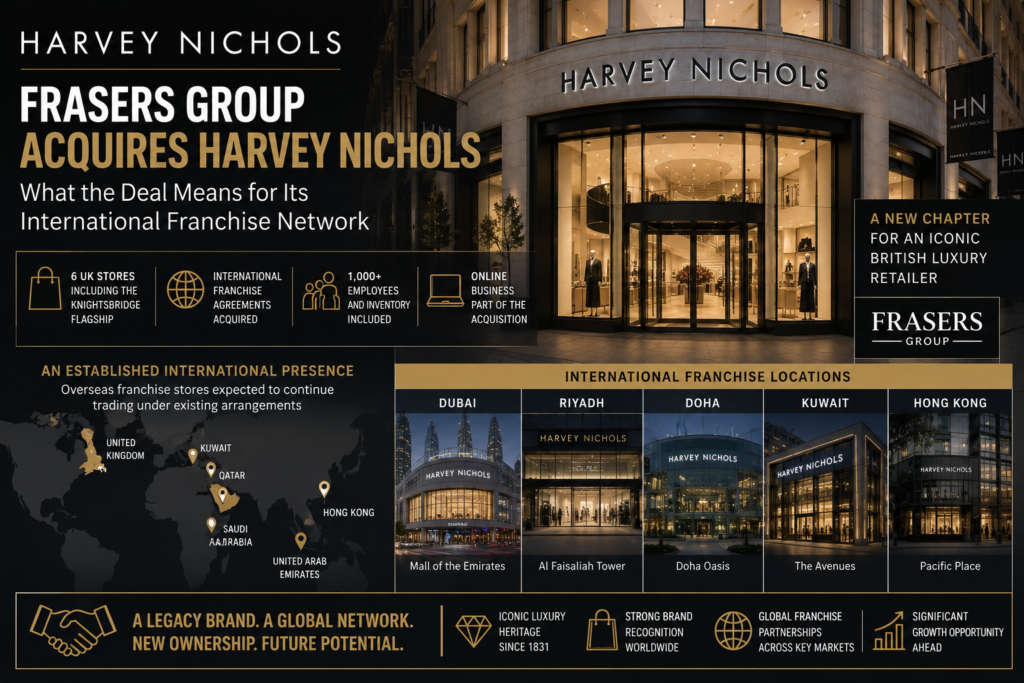
Frasers Group has acquired Harvey Nichols out of administration, bringing one of Britain’s best-known luxury department store businesses into a retail portfolio that already stretches across sports, premium fashion, luxury and department stores.
The transaction includes Harvey Nichols’ six UK stores, online business, inventory, more than 1,000 employees and, significantly, its international franchise agreements.
For the British business, the immediate priority will be restructuring and establishing a sustainable future after several difficult years.
Internationally, however, there is another important story.
Harvey Nichols has spent decades extending its name beyond Britain through franchise and licensing relationships in major luxury markets. Those international agreements form part of the Frasers transaction, and the overseas franchise stores are expected to continue operating under their existing arrangements.
That makes this more than a British retail rescue.
Frasers has also acquired an established international luxury franchise platform.
What Frasers Group Has Acquired
The acquisition covers Harvey Nichols’ six UK department stores:
- Knightsbridge, London
- Manchester
- Birmingham
- Leeds
- Edinburgh
- Bristol
The Knightsbridge flagship is particularly important.
Harvey Nichols has recently invested heavily in repositioning and refurbishing the store, which remains one of London’s most recognisable luxury retail destinations.
The transaction also includes the company’s e-commerce operation, inventory and international franchise agreements.
The Dublin business is being treated separately, although Frasers has said it continues to support trading at the store.
The OXO Tower restaurant operation in London is not included in the acquisition.
Harvey Nichols Brings More Than a UK Store Network
Looking only at the British stores understates what Frasers has acquired.
Harvey Nichols is an internationally recognised luxury retail name with a history dating to 1831.
Over time, the brand moved beyond Britain by licensing its department-store concept to established international partners.
That model allowed Harvey Nichols to establish a presence in important luxury markets without funding every international store directly.
International locations have included markets such as:
- United Arab Emirates
- Saudi Arabia
- Qatar
- Kuwait
- Hong Kong
These are not peripheral markets for luxury retail.
The Gulf states in particular have developed into some of the world’s most important destinations for international fashion, beauty and luxury brands.
Harvey Nichols’ presence in these markets gives Frasers an international asset that could prove strategically valuable if handled correctly.
The International Franchise Agreements Are Particularly Important
For Star Brands Consulting Group readers, this may be the most interesting part of the transaction.
Harvey Nichols’ international stores are not simply overseas branches of the British company.
Several operate through local franchise or licensing partners.
That means the international network combines:
- Harvey Nichols’ brand
- merchandising and luxury positioning
- local operating expertise
- regional capital
- established retail infrastructure
It is a model used extensively across international retail.
Rather than a brand investing directly in every country, a sophisticated local operator secures the rights to develop and operate the concept in an agreed territory.
The brand gains international reach.
The local partner gains access to an established international retail proposition.
Dubai Shows How the Model Works
Harvey Nichols’ presence in Dubai provides a useful example.
The store at Mall of the Emirates operates through a local licensing relationship rather than as a conventional company-owned British branch.
That structure gives the brand access to one of the world’s leading luxury retail markets while benefiting from local operational expertise, real-estate relationships and regional consumer knowledge.
For international brands, this type of arrangement can substantially reduce the complexity of entering a new market.
For local operators, it creates an opportunity to introduce a globally recognised retail concept without having to build an entirely new brand from the ground up.
The Middle East Remains Strategically Important
Harvey Nichols’ international network is particularly concentrated in markets where luxury consumption remains strong.
The Middle East has become increasingly important to international luxury retail because of:
- high consumer purchasing power
- substantial tourism
- premium shopping-centre development
- younger luxury consumers
- demand for international fashion and beauty brands
- sophisticated local retail groups
Cities including Dubai, Riyadh, Doha and Kuwait City continue to attract significant investment from global retailers.
For Frasers Group, inheriting established Harvey Nichols relationships in these markets creates opportunities that extend well beyond the immediate UK turnaround.
Frasers Group Has Been Moving Upmarket for Years
The Harvey Nichols acquisition also makes sense within Frasers Group’s broader strategy.
The company is still widely associated with Sports Direct, but that no longer adequately describes the group.
Frasers has spent years building exposure across different levels of the consumer market.
Its portfolio and investments now extend into:
- sports retail
- premium fashion
- luxury retail
- department stores
- digital commerce
- consumer brands
The group’s Elevation Strategy has focused heavily on improving stores, strengthening relationships with premium brands and moving parts of the business further upmarket.
Harvey Nichols gives Frasers something particularly valuable within that strategy:
A recognised British luxury institution.
Harvey Nichols Is Not an Easy Turnaround
The prestige of the name should not obscure the financial reality.
Harvey Nichols entered administration after a prolonged period of losses and funding pressure.
Like many department-store businesses, it has faced structural challenges including:
- changing consumer behaviour
- growing online competition
- high property costs
- pressure on discretionary spending
- intense competition within luxury retail
- changing international tourism patterns
Frasers has already made clear that difficult decisions will be necessary.
The future Harvey Nichols may therefore look different from the business Frasers has just acquired.
Some stores could be reconsidered.
The operating model could change.
Investment may become concentrated around the strongest locations.
Parts of the estate could potentially be integrated more closely with Frasers’ wider premium and luxury operations.
The immediate objective is not simply growth.
It is sustainability.
The Knightsbridge Flagship Could Be Central to the Reset
Harvey Nichols’ Knightsbridge store remains the company’s most important asset from a brand perspective.
Located opposite some of London’s most prestigious retail and hospitality destinations, it carries international recognition that regional stores cannot easily replicate.
Recent investment in the flagship also means Frasers is acquiring a business where repositioning work had already begun.
A successful turnaround could therefore place greater emphasis on Knightsbridge as:
- a global flagship
- a luxury brand showcase
- an experiential retail destination
- an international marketing platform
- a connection point between Harvey Nichols and its overseas partners
This would be consistent with wider changes taking place across luxury department stores.
The strongest stores increasingly function as destinations rather than simply places to purchase products.
What Happens to the International Franchisees?
For now, continuity is the key message.
The international franchise agreements form part of the Frasers acquisition and overseas franchise stores are expected to continue trading under their existing arrangements.
That is commercially important.
Changing ownership at the brand level does not automatically terminate properly structured international franchise and licensing relationships.
The new owner inherits contractual relationships alongside the brand assets it has acquired, subject to the specific terms of those agreements.
For international partners, the larger question will be what Frasers ultimately intends to do with Harvey Nichols.
If the new owner successfully strengthens the brand, franchise partners could benefit from:
- renewed investment
- stronger digital capabilities
- improved merchandising
- greater marketing resources
- access to Frasers’ wider brand relationships
- stronger international positioning
The acquisition could therefore become an opportunity for the international network rather than simply a period of uncertainty.
Could Frasers Expand Harvey Nichols Internationally Again?
This is where the transaction becomes particularly interesting.
There has been no indication that Frasers is immediately preparing a major new international franchise programme.
The UK turnaround clearly comes first.
But if the business is stabilised successfully, the international franchise model provides a potential route for future growth.
Harvey Nichols already has:
- international brand recognition
- operating history outside Britain
- established franchise relationships
- credibility in luxury retail
- experience in Middle Eastern markets
Those foundations could eventually support expansion into additional territories without requiring Frasers to fund every store directly.
Potential future growth could take several forms:
- additional stores with existing partners
- new territorial franchise agreements
- licensing relationships
- smaller luxury formats
- beauty-led concepts
- digital partnerships
- strategic joint ventures
Whether Frasers chooses to pursue any of these options will depend on the direction it establishes for the brand.
The Deal Demonstrates the Value of International Franchise Rights
There is a broader lesson here for brands considering international expansion.
A strong franchise network can become an asset in its own right.
International franchise agreements can provide:
- recurring revenue
- international brand visibility
- local market intelligence
- reduced capital requirements
- access to established operators
- geographic diversification
When a company is acquired, those agreements can form part of the strategic value being transferred to the buyer.
This is why international franchise development should not be treated simply as a way to open more stores.
Properly structured, it becomes part of the long-term enterprise value of the brand.
What Existing and Prospective Operators Should Watch
Several developments will now be important.
Frasers’ Long-Term Brand Strategy
The first question is whether Frasers intends to maintain Harvey Nichols as a distinct luxury brand over the long term.
UK Store Restructuring
The size and composition of the British estate may change substantially.
International Partner Relationships
How Frasers engages with existing franchisees will provide an early indication of its international ambitions.
Investment in Digital
Harvey Nichols needs a stronger connection between its physical stores, international network and digital business.
Luxury Brand Relationships
Frasers’ existing relationships across premium fashion could potentially strengthen Harvey Nichols’ proposition.
Future Territory Development
Once the UK business is stabilised, attention may turn to whether additional international markets could support the concept.
Strategic Assessment
Frasers Group has not simply bought six struggling British department stores.
It has acquired:
- an historic luxury brand
- a recognised Knightsbridge flagship
- an established e-commerce operation
- relationships with international luxury brands
- an overseas franchise and licensing network
- decades of international retail recognition
The challenge is considerable.
But so is the strategic optionality.
If Frasers can restore Harvey Nichols’ relevance and financial stability, the international franchise network could become an important component of the next phase of the brand.
For international operators, the acquisition is therefore worth watching closely.
Ownership changes can alter expansion priorities.
They can also create new opportunities.
Where Star Brands Consulting Group Fits In
International franchise and licensing relationships become particularly important during periods of ownership change, restructuring and strategic repositioning.
For investors and operators interested in brands such as Harvey Nichols, the relevant questions extend beyond whether the company “offers franchises.”
They include:
- Who controls the target territory?
- Does an existing franchise agreement cover the market?
- Is the current operator expanding?
- Could new territories become available under the new owner?
- What capital and operating capabilities would be required?
- Is the brand seeking a franchisee, licensee, joint-venture partner or strategic operator?
Star Brands Consulting Group works with investors, operators and brands across international franchise, licensing, partnership and market-entry opportunities.
Through Star Access™, qualified investors can establish an investor profile, assess target brands and territories, evaluate realistic entry pathways and prepare for structured brand engagement where an opportunity is commercially viable.
The objective is not to assume that Harvey Nichols — or any other specific brand — currently has an available territory.
It is to establish the facts, understand the expansion architecture and determine whether a credible route to access exists.
Conclusion
Frasers Group’s acquisition of Harvey Nichols marks the beginning of a new chapter for one of Britain’s best-known luxury retailers.
The immediate challenge is rebuilding a business that has suffered years of financial pressure.
But the acquisition also gives Frasers something that should not be overlooked: an established international franchise platform across some of the world’s most important luxury markets.
For existing international partners, continuity has been preserved for now.
For prospective operators, there is no basis yet to assume new Harvey Nichols territories are being offered.
But the situation deserves close attention.
A new owner, a major restructuring and an inherited international franchise network can eventually produce a very different expansion strategy.
And if Frasers succeeds in rebuilding Harvey Nichols, the brand’s international franchise relationships may prove to be one of the more valuable assets it acquired.
Leave a Reply