
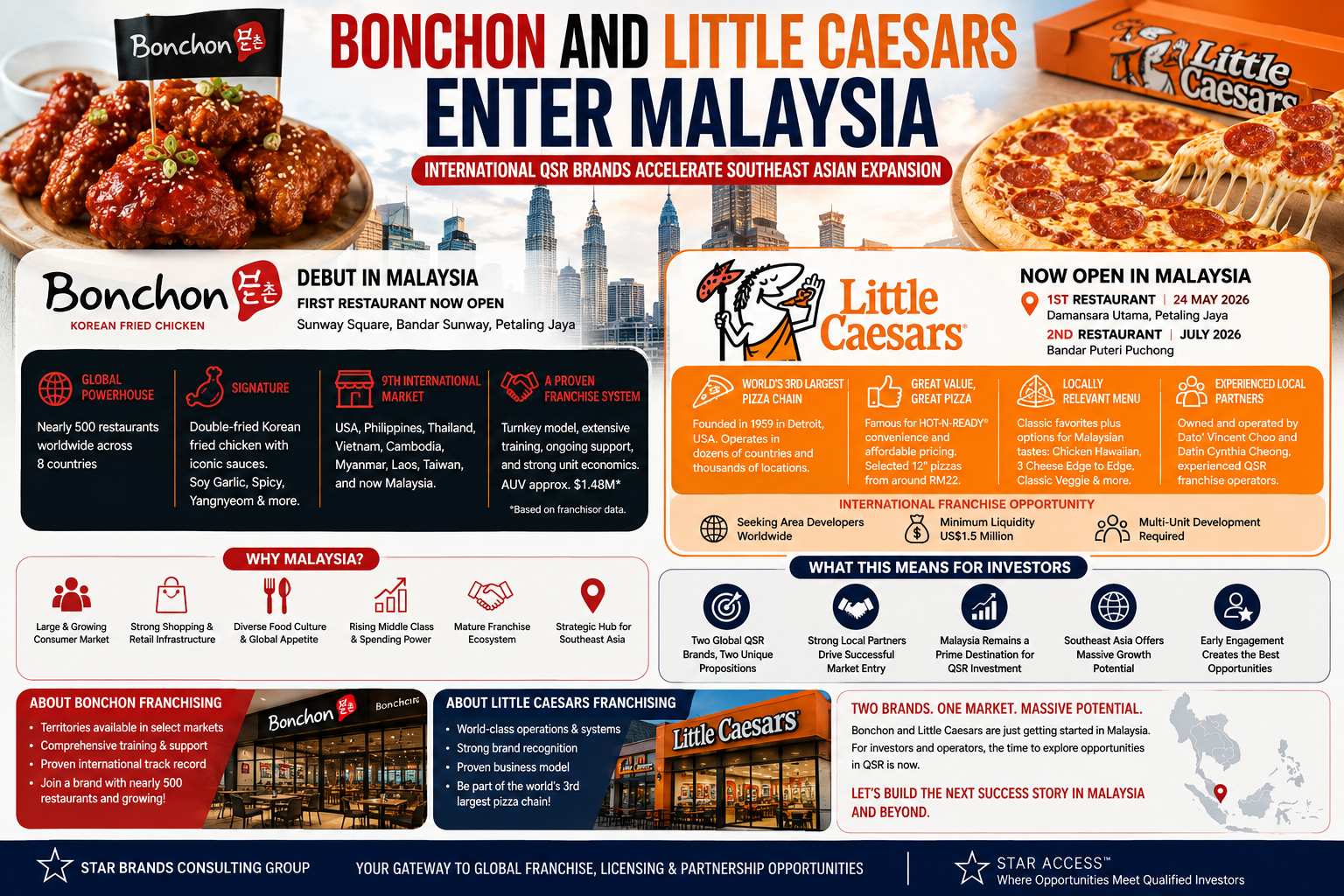
Malaysia has welcomed two significant international restaurant brands in quick succession, with Bonchon and Little Caesars both establishing their first locations in the country as global QSR operators continue to deepen their presence across Southeast Asia.
The two brands arrive from very different food cultures.
Bonchon brings Korean fried chicken and a global network approaching 500 restaurants.
Little Caesars brings one of the world’s largest pizza systems, backed by decades of international franchising experience.
But the Malaysian entries share something important.
Both demonstrate the continuing importance of experienced local franchise partners when established international restaurant brands enter new markets.
For investors and operators, Malaysia is therefore becoming more interesting not simply because international restaurants are opening there, but because it continues to attract brands looking for local partners capable of building meaningful national businesses.
Bonchon Makes Its Malaysian Debut
Bonchon has opened its first Malaysian restaurant at Sunway Square in Bandar Sunway, Petaling Jaya.
The opening adds Malaysia to an international network that is approaching 500 locations and extends a brand that began in South Korea into another important Southeast Asian consumer market.
Founded in Busan in 2002, Bonchon built its reputation around Korean fried chicken prepared using a distinctive double-frying process.
Its signature chicken is then hand-brushed with sauces including:
- Soy Garlic
- Spicy
- Yangnyeom
The wider menu has developed to include Korean comfort-food dishes, rice meals, sides and other products intended to broaden the restaurant beyond fried chicken alone.
The Malaysian flagship introduces that proposition to a market already highly familiar with Korean food and culture.
Malaysia Becomes Bonchon’s Ninth International Market
The Malaysian opening takes Bonchon into its ninth country, strengthening an international network that already spans several important markets.
The brand’s global expansion has been driven substantially through franchise partners.
That structure has enabled Bonchon to establish restaurants across markets including:
- United States
- Philippines
- Thailand
- Vietnam
- Cambodia
- Myanmar
- Laos
- Taiwan
- Malaysia
The company is simultaneously continuing its U.S. expansion, with development across markets including Southern California, Phoenix, Las Vegas, Nashville and Atlanta.
Puerto Rico is also being prepared as another new market.
This means Malaysia is not an isolated international experiment.
It is part of a much broader franchise-led growth strategy.
Bonchon Is Approaching 500 Restaurants Globally
Bonchon now has approximately 500 restaurants worldwide, giving prospective franchise partners a considerably different proposition from an early-stage restaurant concept.
The system has already been tested across multiple cultures, operating environments and consumer markets.
That international experience can be particularly valuable when entering a country such as Malaysia.
The franchisor has already had to address questions around:
- localisation
- supply chains
- franchisee training
- international operations
- food standards
- marketing
- consumer adaptation
The Malaysian partner therefore benefits from a business model that has already travelled well beyond its original Korean market.
Korean Culture Provides a Strong Tailwind
Bonchon’s Malaysian entry also benefits from a broader cultural trend.
Korean entertainment, beauty, fashion and food have developed significant international audiences.
Across Southeast Asia in particular, Korean consumer culture already has substantial recognition.
For restaurant brands, that can reduce the education required when entering a new market.
Consumers may already understand products such as:
- Korean fried chicken
- kimchi
- Korean rice dishes
- Korean sauces
- Korean-style casual dining
Bonchon is therefore entering Malaysia at a time when the category itself already enjoys meaningful cultural momentum.
That does not eliminate competition.
It does, however, provide a favourable environment for a specialist Korean brand with an established international reputation.
Bonchon Is a Genuine Franchise Opportunity
For investors researching Bonchon, an important distinction should be made.
This is not a company-owned restaurant system where franchise interest has to be inferred from expansion activity.
Bonchon actively franchises.
The company publicly promotes available territories and seeks experienced entrepreneurs capable of developing the brand.
Its franchise proposition includes:
- extensive training
- ongoing support
- a turnkey franchise programme
- site-development guidance
- established operating systems
- internationally recognised products
Bonchon also reports approximately $1.48 million in average unit volume under the performance measure used in its franchise materials.
As always, prospective investors should review the applicable Franchise Disclosure Document and relevant financial-performance representation rather than treating a headline AUV as guaranteed restaurant revenue.
Malaysia Rights Need to Be Viewed Separately
The fact that Bonchon franchises internationally does not mean Malaysian rights are generally available to additional investors.
The country has now been entered under an established local structure.
Any investor specifically interested in Bonchon Malaysia would therefore need to understand:
- who controls the territorial rights
- whether sub-franchising is permitted
- whether additional development partners are required
- what areas, if any, remain available
This distinction is essential in international franchising.
A brand can be actively seeking franchisees globally while a specific country is already allocated.
Little Caesars Enters Through Damansara Utama
Little Caesars made its Malaysian debut on 24 May 2026, opening its first restaurant in Damansara Utama, Petaling Jaya.
The opening brought one of America’s largest pizza brands into Malaysia for the first time.
Founded in Detroit in 1959 by Mike and Marian Ilitch, Little Caesars has grown from a single family restaurant into the world’s third-largest pizza chain.
Its international network extends across dozens of countries and territories.
Malaysia now becomes part of that global footprint.
The Second Restaurant Followed Quickly
Little Caesars did not wait long before adding another location.
The second Malaysian restaurant opened in Bandar Puteri Puchong, with its formal grand opening held in July.
The pace is noteworthy.
Moving quickly from the first restaurant to the second suggests the Malaysian entry was structured as the beginning of a broader development programme rather than a single-store market test.
Additional locations are expected as the franchisees continue building the national network.
Experienced Malaysian Operators Are Behind the Expansion
Little Caesars’ Malaysian development is being led by Dato’ Vincent Choo and Datin Cynthia Cheong.
Their background is particularly relevant.
They are experienced QSR operators who already own and manage multiple restaurant brands in Malaysia.
This is precisely the type of partner profile major international restaurant franchisors frequently seek.
Rather than relying solely on an investor’s financial capacity, the franchisor gains partners who already understand:
- restaurant operations
- Malaysian consumers
- local real estate
- staffing
- food-service economics
- regulatory requirements
- multi-unit management
For Little Caesars, that reduces market-entry risk.
For the franchisees, the partnership provides access to a globally established restaurant system.
Little Caesars Is Localising the Malaysian Menu
International expansion rarely succeeds by assuming consumers everywhere want exactly the same menu.
Little Caesars has retained core products associated with the global brand while introducing items designed for Malaysian preferences.
The Malaysian menu includes familiar products such as:
- HOT-N-READY Classic Pepperoni Pizza
- Crazy Bread
- Crazy Puffs
alongside offerings including:
- Chicken Hawaiian
- 3 Cheese Edge to Edge
- Classic Veggie
- other locally relevant options
The approach allows the company to preserve its international identity while adapting the proposition to the local consumer.
This balance is one of the central challenges in international food franchising.
Too much localisation can weaken the brand.
Too little can reduce local relevance.
Value Is Central to the Little Caesars Proposition
Little Caesars has historically differentiated itself around convenience and value.
That positioning is being carried into Malaysia.
Selected 12-inch pizzas have been offered around the RM22 price point, giving the company a clear value proposition within the Malaysian pizza market.
This could prove strategically important.
Malaysia has a large middle-income consumer base and a highly competitive restaurant sector.
International brands need to balance global recognition with prices consumers can justify for regular rather than occasional purchases.
Little Caesars’ operating model has long been designed around this principle.
The Malaysian rollout will test how effectively that proposition translates into Southeast Asia.
Little Caesars Is Also Actively Recruiting International Franchise Partners
The wider international opportunity is particularly relevant for Star Brands Consulting Group readers.
Little Caesars has an established international franchise programme and continues to seek qualified area developers.
Its current international franchise criteria indicate that prospective area developers should have at least:
US$1.5 million in minimum liquidity
The company is specifically looking for operators capable of owning and operating multiple stores within a geographic territory.
That immediately establishes the level of investor being targeted.
This is not simply a single-store overseas franchise proposition.
Little Caesars wants partners capable of developing markets.
What International Area Development Means
An international area developer may be responsible for opening multiple restaurants across an agreed geography according to a defined development schedule.
That requires significantly more capability than funding one restaurant.
A serious area developer may need:
- substantial liquid capital
- restaurant operating experience
- a management organisation
- local real-estate capability
- supply-chain infrastructure
- recruitment systems
- marketing resources
- multi-year investment capacity
This is why established restaurant groups frequently secure major international franchise rights.
They already possess much of the infrastructure necessary to execute the development programme.
Two Brands, Two Different Consumer Propositions
Bonchon and Little Caesars may be entering the same market, but they are not competing in exactly the same way.
Bonchon
Bonchon brings:
- Korean cultural relevance
- specialist fried chicken
- premium fast-casual positioning
- distinctive sauces
- a growing international franchise network
Little Caesars
Little Caesars brings:
- global pizza recognition
- value positioning
- convenience
- a highly developed franchise system
- decades of international operating experience
The differences are useful because they demonstrate the breadth of opportunity within Malaysia’s restaurant sector.
The market is capable of attracting both emerging international categories and highly mature global QSR systems.
Why Malaysia Continues to Attract International Restaurant Brands
Malaysia offers several advantages for international restaurant expansion.
Large Urban Consumer Markets
Greater Kuala Lumpur provides a substantial concentration of consumers with exposure to international food brands.
Developed Shopping Infrastructure
Malaysia has an extensive network of shopping centres and mixed-use developments suitable for international restaurant concepts.
Diverse Food Culture
Malaysian consumers are accustomed to a wide variety of cuisines.
This creates an environment where international concepts can potentially gain acceptance more quickly.
Growing Middle-Class Consumption
Increasing consumer spending supports continued development across fast food, fast casual and premium casual dining.
Strong Franchise Ecosystem
Malaysia has a long history of both importing and exporting franchise concepts.
Local operators understand the franchise model and international brands can find experienced potential partners.
Strategic Southeast Asian Position
Malaysia can also provide useful experience for brands considering wider ASEAN development.
Southeast Asia Is Becoming More Important to Global QSR Brands
The Bonchon and Little Caesars openings form part of a much larger trend.
Southeast Asia has become an increasingly important growth region for international restaurant companies.
The region combines:
- large populations
- young demographics
- increasing urbanisation
- expanding disposable incomes
- shopping-centre development
- strong food-delivery adoption
- increasing familiarity with international brands
Markets such as Malaysia, the Philippines, Indonesia, Thailand and Vietnam are attracting brands that previously concentrated international growth primarily on the Middle East, Europe or mature Asian markets.
For franchise investors, this creates a growing pipeline of opportunities.
Local Partners Remain the Critical Ingredient
The two Malaysian entries reinforce one of the most consistent themes in international franchising.
The brand may be global.
The execution is local.
A successful Malaysian franchise partner needs to understand issues including:
- halal requirements
- local tastes
- property economics
- staffing
- food costs
- supply chains
- delivery platforms
- marketing
- local regulation
The international franchisor provides the system.
The local partner translates that system into a functioning Malaysian business.
This is why partner selection can be more important than simply entering the market quickly.
What Serious Investors Should Learn From These Deals
Several lessons emerge from the simultaneous arrival of Bonchon and Little Caesars.
International Brands Want Operators, Not Just Investors
Capital matters, but established QSR brands increasingly seek partners capable of developing multiple stores.
Country Rights Can Be Allocated Early
By the time consumers see the first restaurant, the relevant franchise relationship may have been negotiated long before.
Market Entry Is Only the Beginning
The value of the territory depends on whether the partner can build a substantial network after the first location.
Localisation Matters
Both brands are adapting their propositions for Malaysian consumers rather than simply importing the home-market experience unchanged.
Timing Matters
Investors who identify internationally expanding brands before territories are allocated can have very different opportunities from those who approach after market entry.
Is Bonchon Malaysia Still a Franchise Opportunity?
Bonchon has now entered Malaysia, meaning investors should not assume national rights remain available.
However, several possibilities may exist depending on the terms of the local development agreement.
These could potentially include:
- sub-franchise opportunities
- regional development
- individual unit development
- future territory opportunities
Whether any of these are actually available needs to be established with the relevant rights holder.
The existence of a franchise system does not automatically establish territory availability.
Is Little Caesars Malaysia Still a Franchise Opportunity?
The same principle applies.
Malaysia already has appointed franchisees leading the Little Caesars rollout.
Investors should therefore not interpret the brand’s international franchise programme as evidence that Malaysian country rights remain available.
The relevant questions are:
- What rights have been granted to the current Malaysian operators?
- Are sub-franchisees part of the development structure?
- Are additional local partners required?
- Which territories remain available elsewhere internationally?
For an investor focused specifically on Little Caesars, neighbouring or other international markets may provide a more realistic route where rights remain unallocated.
Where Star Brands Consulting Group Fits In
This is precisely why international franchise investing requires more than searching for a brand name followed by the word “franchise.”
Star Brands Consulting Group works with investors and operators seeking international franchise, master franchise, licensing, distribution and strategic brand-development opportunities.
For investors interested in brands such as Bonchon or Little Caesars, our work can include:
- assessing target territory availability
- identifying existing franchise-rights structures
- evaluating investor financial capacity
- assessing restaurant operating experience
- evaluating market-entry feasibility
- developing the investor profile
- preparing market and territory propositions
- determining whether master franchise, area development or other structures are appropriate
- supporting structured brand engagement
- identifying comparable opportunities where preferred territories are already allocated
Through Star Access™, qualified investors can move beyond the question of whether a brand franchises and focus on the more commercially important issue:
Where are the rights actually available?
A famous franchise brand with no available territory may be less valuable to an investor than a rapidly growing international concept actively seeking the right market partner.
Understanding that distinction is central to serious franchise investment.
Conclusion
The arrival of Bonchon and Little Caesars in Malaysia provides another strong indication of Southeast Asia’s growing importance within international restaurant franchising.
Bonchon enters with a Korean fried chicken system approaching 500 global restaurants and substantial cultural momentum behind Korean cuisine.
Little Caesars enters with one of the world’s largest pizza franchise systems, experienced Malaysian operators and plans for continued national development.
Different brands.
Different products.
Different histories.
But the expansion architecture has something important in common.
Both rely on local franchise capability to translate an international concept into a successful Malaysian business.
For investors, that is the larger lesson.
The most valuable international franchise opportunities are often created well before the first restaurant opens.
They begin when a brand decides to enter a market and starts looking for the operator capable of building it.
Leave a Reply