
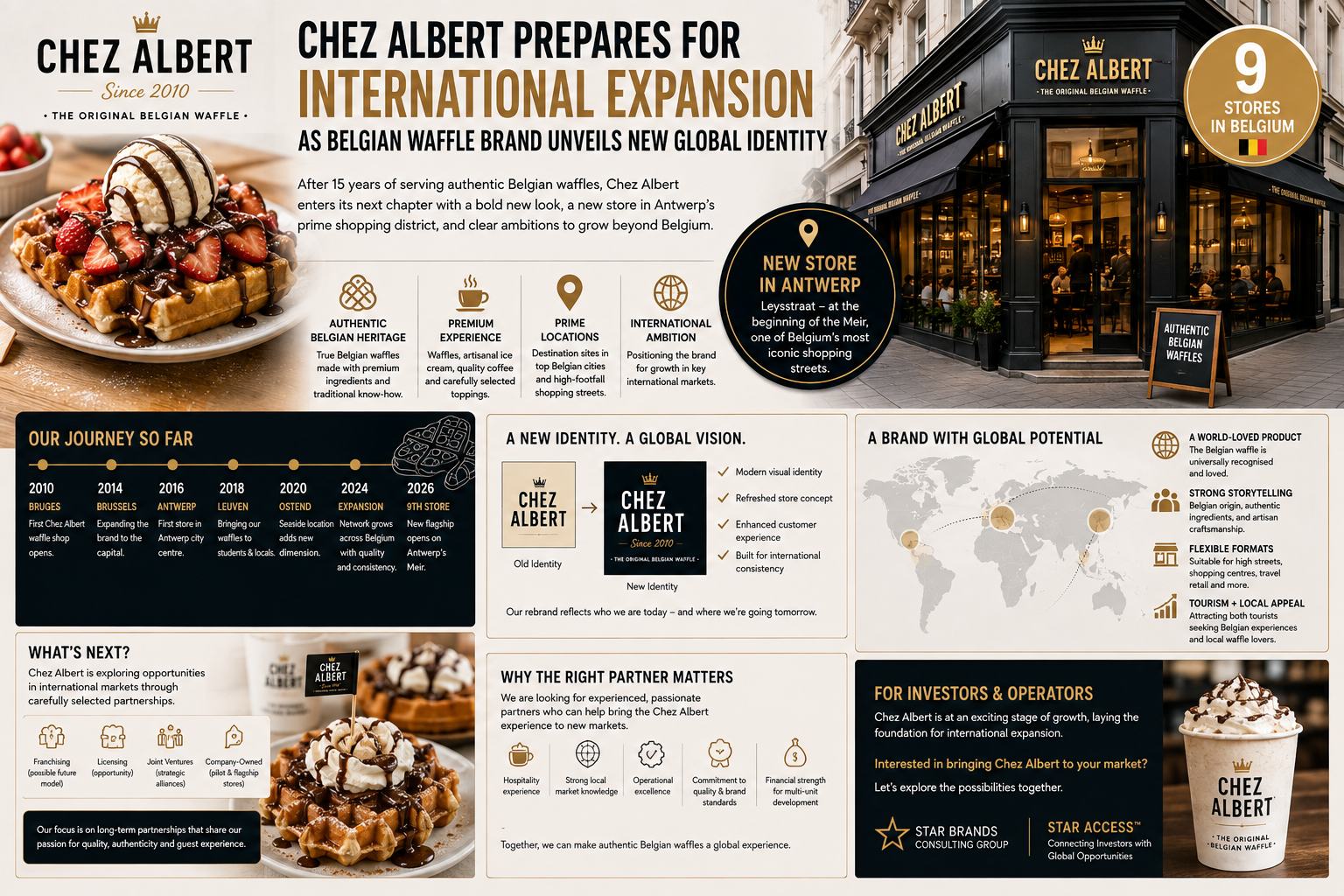
Belgian waffle specialist Chez Albert is preparing for the next stage of its development, unveiling a completely refreshed brand identity as it looks beyond Belgium for future growth.
The company has opened its ninth Belgian location, securing a prime site on Leysstraat at the beginning of Antwerp’s Meir, one of the country’s most important shopping streets.
But the new store is only part of the story.
After approximately 15 years of development, Chez Albert is repositioning the business for a larger future. The company has refreshed its visual identity, redesigned its store concept and made clear that international markets are now part of its growth ambitions.
For investors and operators following emerging European food concepts, this is an interesting stage in the company’s development.
Chez Albert is no longer simply building a collection of Belgian waffle shops.
It is beginning to build a brand designed to travel.
From Bruges to a Nine-Store Belgian Network
Chez Albert has built its reputation around one of Belgium’s most internationally recognised food products: the Belgian waffle.
The concept is deliberately focused.
Rather than becoming a broad café or casual dining operation, Chez Albert has built its identity around freshly prepared waffles supported by complementary products such as:
- coffee
- artisanal ice cream
- beverages
- premium toppings
Ingredients including Belgian strawberries and Callebaut chocolate reinforce the company’s connection to Belgian food heritage.
That authenticity gives Chez Albert something particularly valuable when considering international expansion.
The product already has global recognition.
Consumers in many countries understand what a Belgian waffle is before Chez Albert enters the market.
The company therefore does not have to create the category from scratch.
Its challenge is to establish Chez Albert as the brand consumers associate with an authentic premium Belgian waffle experience.
The Ninth Store Takes Chez Albert to Antwerp’s Meir
Chez Albert’s newest store is located on Leysstraat, at the beginning of the Meir in central Antwerp.
The location is strategically important.
The Meir is one of Belgium’s most heavily visited shopping streets, attracting both domestic consumers and international tourists.
Chez Albert already operates another Antwerp location on Melkmarkt in the historic centre.
Adding a second store in such a prominent retail corridor provides the company with greater visibility while also testing the concept in another high-footfall environment.
This type of location can be particularly useful for a brand preparing to expand internationally.
Tourists become customers.
Customers become international brand awareness.
A Belgian visitor may buy a waffle once.
A tourist from London, Paris, Dubai or New York may experience Chez Albert in Antwerp and later recognise the concept if it arrives in their home market.
Prime Locations Are Part of the Strategy
Chez Albert’s network demonstrates a preference for locations where tourism, pedestrian traffic and destination retail intersect.
The brand has established stores in Belgian cities including:
- Bruges
- Brussels
- Antwerp
- Leuven
- Ostend
These are not random markets.
Several benefit heavily from tourism and international visitors.
For a concept built around an iconic Belgian product, that makes commercial sense.
A tourist arriving in Belgium is already primed to seek:
- Belgian chocolate
- Belgian beer
- Belgian fries
- Belgian waffles
Chez Albert can therefore position itself as part of the Belgian experience.
The international opportunity is to take that experience abroad.
The New Brand Identity Is More Than a Cosmetic Change
The timing of Chez Albert’s rebrand is particularly significant.
Companies do not normally undertake substantial identity and store-concept changes immediately before expansion without a strategic reason.
Chez Albert’s refresh includes:
- a new visual identity
- an updated store concept
- a more contemporary customer experience
- stronger international positioning
Founder Bert Vanaudenaerde has made clear that the business sees opportunities both within Belgium and beyond its borders.
The objective is therefore not simply to make existing stores look newer.
It is to create a brand system capable of being reproduced consistently as the network grows.
That distinction matters.
International expansion requires repeatability.
A concept needs to look, feel and operate recognisably whether the customer encounters it in Antwerp, Brussels or eventually another country.
Why Brand Standardisation Comes Before International Expansion
One of the most common mistakes growing consumer brands make is expanding before their concept has been properly standardised.
A founder may understand instinctively how the original store should operate.
That does not mean an independent operator in another country will.
Before international development, a brand needs clarity around areas such as:
- visual identity
- store design
- product presentation
- recipes
- service standards
- equipment
- sourcing
- training
- operating procedures
- marketing
- quality control
The refreshed Chez Albert concept could provide the foundation for that level of replication.
If the company eventually expands through franchisees, licensees or other partners, standardisation becomes even more important.
The partner needs a system that can be learned and reproduced.
The Belgian Waffle Has Strong International Potential
Chez Albert has another advantage that many emerging restaurant brands do not possess.
Its core product is already internationally recognised.
“Belgian waffle” carries a geographic association in much the same way that certain other foods are connected with their places of origin.
That creates valuable positioning.
Chez Albert can potentially build around:
Belgian origin.
Belgian ingredients.
Belgian craftsmanship.
Belgian indulgence.
International consumers do not need a lengthy explanation of why Belgium has credibility in waffles.
The association already exists.
This provides the company with a strong foundation for international storytelling.
A Simple Product Can Be an Advantage
The relative simplicity of the Chez Albert concept may also support expansion.
Large restaurant menus create operational complexity.
They require:
- more ingredients
- more kitchen equipment
- additional training
- larger preparation areas
- more complicated supply chains
- greater waste management
A focused waffle concept can potentially operate from smaller footprints with simpler kitchen requirements.
That could make the business suitable for a variety of international environments, including:
- high streets
- shopping centres
- tourist districts
- transport hubs
- airports
- railway stations
- food halls
- leisure destinations
The actual format will depend on how Chez Albert chooses to develop the brand internationally, but the underlying concept offers considerable flexibility.
Tourism Could Be a Major International Growth Channel
Chez Albert’s proposition is particularly compatible with tourist markets.
Consider cities such as:
- Paris
- London
- Amsterdam
- Barcelona
- Dubai
- New York
These markets combine large resident populations with enormous visitor volumes.
An authentic Belgian waffle brand can potentially appeal to both.
The same logic applies to international airports and major railway stations.
For a concept built around a recognisable indulgence product that can be consumed relatively quickly, travel retail could eventually become an important development channel.
This is one area investors should watch as Chez Albert’s international strategy becomes clearer.
The Company Has Already Signalled an International Move
Chez Albert has previously indicated that its first international step was expected around early 2026.
The latest rebranding announcement reinforces the same direction: international growth remains part of the company’s ambition.
What has not yet been publicly established is equally important.
Chez Albert has not announced a broad international franchise recruitment programme with published:
- franchise fees
- royalty rates
- investment requirements
- territory packages
- master franchise criteria
Investors should therefore avoid assuming that international franchise rights are currently available simply because the company wants to expand abroad.
International ambition and franchise availability are not the same thing.
How Could Chez Albert Expand Internationally?
There are several realistic structures available to a brand at this stage.
Company-Owned Expansion
Chez Albert could fund and operate its first international stores directly.
This would provide maximum control and allow management to learn how the concept performs outside Belgium before involving external partners.
Joint Venture
The company could establish a new market alongside an experienced local investor or operator.
Both parties would contribute to the development of the business.
Licensing
Chez Albert could license its brand and operating concept to qualified international partners under agreed territorial conditions.
Franchising
A structured franchise programme could allow independent operators to open Chez Albert locations using the company’s brand and business system.
Master Franchising
For larger or more distant countries, Chez Albert could potentially appoint a master franchisee responsible for developing the entire market.
Strategic Retail Partnership
The company could work with established hospitality, travel-retail or food-service groups to enter selected high-value locations.
Which model Chez Albert ultimately chooses will determine the type of opportunity available to investors.
Franchising Could Be a Natural Route — If the System Is Ready
Chez Albert has several characteristics that could potentially support franchising.
It has:
- an established operating history
- multiple existing stores
- a recognisable product category
- a relatively focused menu
- strong Belgian provenance
- a refreshed brand identity
- a replicable retail concept
- international ambition
Those ingredients do not automatically make a business franchise-ready.
But they provide a useful foundation.
The next question would be whether the company has sufficiently developed:
- franchise documentation
- training systems
- operating manuals
- supply-chain standards
- unit economics
- partner-support infrastructure
- quality-control systems
- international sourcing solutions
A strong franchise system requires much more than permission to use the brand.
Why International Investors Should Watch Before Rights Are Publicly Advertised
This is where emerging brands become particularly interesting.
With mature franchise systems, investors often arrive after the most attractive markets have already been allocated.
An emerging international concept presents a different situation.
The brand may still be deciding:
- which countries to prioritise
- which entry structure to use
- what partner profile it needs
- whether to appoint country-level operators
- whether to franchise individual stores
- how much territorial exclusivity to offer
That period can be commercially important.
A qualified operator that approaches too early may find that the brand is not ready.
An operator that approaches too late may discover that the territory has already been assigned.
The objective is to understand the brand’s development stage and engage at the appropriate time.
What Could an Ideal Chez Albert International Partner Look Like?
If Chez Albert chooses a partner-led international model, the strongest candidates are likely to bring more than capital.
Potential capabilities could include:
Hospitality Experience
Experience operating food, beverage or retail concepts reduces execution risk.
Premium Real Estate Access
Chez Albert’s Belgian strategy favours prominent high-footfall locations.
An international partner should be capable of securing comparable sites.
Local Market Knowledge
Pricing, consumer behaviour and property economics differ substantially by country.
Operational Capability
The partner needs management, staffing and quality-control systems.
Supply-Chain Capability
Belgian authenticity must be preserved while ensuring the economics of local operations remain viable.
Development Capital
If territorial rights involve multiple stores, the investor needs sufficient capital to execute the entire development programme.
Brand Discipline
An authentic Belgian concept can be damaged quickly if international partners alter the proposition excessively.
The right partner must understand the value of consistency.
Belgium Itself Still Has Growth Potential
International ambition does not mean Chez Albert has finished expanding domestically.
The company has explicitly indicated that it continues to see opportunities within Belgium.
That is strategically sensible.
A stronger domestic network provides:
- additional cash flow
- more operating data
- greater purchasing scale
- improved management depth
- stronger brand awareness
- more locations for franchisee training and benchmarking
Domestic and international expansion can therefore reinforce each other.
Chez Albert does not necessarily need to choose between becoming larger in Belgium and moving overseas.
It can do both, provided growth remains controlled.
The Brand Could Travel Beyond Traditional Restaurant Locations
One of the more interesting long-term possibilities is format diversification.
A waffle concept could potentially operate in several formats.
Full Store
A complete Chez Albert environment in major city and tourist locations.
Compact Store
A smaller footprint for dense high-street locations.
Shopping-Centre Unit
Designed for strong pedestrian traffic and impulse purchasing.
Travel-Retail Format
Airports and railway stations could provide access to international consumers.
Kiosk
A highly compact format for selected malls, events or tourist destinations.
Different formats could significantly increase the number of viable international sites.
The new store concept may therefore become important not only aesthetically but economically.
International Expansion Must Protect the Belgian Identity
Scaling an authentic national product creates a particular challenge.
The further the brand travels from Belgium, the more important its Belgian identity may become.
Consumers in Antwerp do not need to be convinced that a Belgian waffle shop is Belgian.
Consumers thousands of kilometres away may value that provenance considerably more.
Chez Albert should therefore be careful not to dilute the very characteristics that make international expansion attractive.
Its Belgian origin can become part of the commercial advantage.
That includes:
- storytelling
- ingredients
- visual identity
- craftsmanship
- product preparation
- brand language
The objective should be international scale without becoming generic.
What Investors Should Watch Next
Several developments will reveal how Chez Albert intends to approach international expansion.
First International Market
The choice of country will provide an important indication of management’s ambitions.
A neighbouring European market would suggest controlled regional development.
A market such as Dubai or the United States would represent a much larger international step.
Expansion Structure
Will the first overseas stores be company-owned, franchised, licensed or developed through a local partner?
Franchise Programme
If Chez Albert launches formal franchising, investors should watch for published investment criteria, fees and territory structures.
Store Format
The type of location chosen internationally will indicate how portable the concept is.
Supply Chain
How Chez Albert preserves Belgian authenticity while sourcing economically abroad will be important.
Pace of Growth
The company needs to balance ambition with operational control.
Strategic Assessment
Chez Albert is entering one of the most interesting stages in a consumer brand’s development.
The concept has moved beyond a single-store business.
It has built a nine-location Belgian network, established itself in several important cities, secured another high-profile Antwerp location and refreshed its entire identity.
Management is now openly looking beyond Belgium.
That does not yet make Chez Albert a confirmed international franchise opportunity.
But it does make the company a brand worth monitoring closely.
If the refreshed concept proves sufficiently replicable and management chooses partner-led expansion, franchising or licensing could provide a logical route to international scale.
For investors, the attraction lies partly in timing.
Chez Albert is not a 5,000-unit global franchise where international territories have been allocated over decades.
It is a Belgian concept preparing to determine what its international future will look like.
That is a very different stage of opportunity.
Where Star Brands Consulting Group Fits In
Star Brands Consulting Group works with investors, operators and brands across international franchise, licensing, strategic partnership and market-entry opportunities.
For investors interested in emerging concepts such as Chez Albert, our role begins with establishing the commercial reality rather than assuming that rights are available.
This can include:
- assessing the investor’s proposed country or territory
- reviewing the brand’s existing footprint and expansion direction
- determining whether international partner discussions are appropriate
- assessing investor financial and operational readiness
- analysing local market potential
- evaluating possible franchise, licensing or partnership structures
- preparing an investor and territory proposition
- supporting structured brand engagement where commercially justified
- identifying comparable opportunities where the preferred brand is not yet accessible
Through Star Access™, qualified investors can monitor and evaluate international brands at different stages of their expansion cycle.
This is particularly relevant with emerging brands.
The opportunity is often not published in a franchise directory.
It begins with understanding which companies are preparing to cross borders and what they will need when they do.
Conclusion
Chez Albert’s new Antwerp store and refreshed brand identity mark more than another stage of Belgian growth.
They signal a company preparing itself for an international future.
With nine locations, approximately 15 years of operating experience, a highly recognisable Belgian product and a newly standardised brand environment, Chez Albert has several characteristics that could support expansion beyond its home market.
The exact structure of that expansion has yet to be publicly defined.
That distinction should be respected.
Chez Albert has confirmed international ambition.
It has not yet announced a broad international franchise offering.
For serious investors, that uncertainty does not make the story less interesting.
It makes the next decisions more important.
The first international market, the first operating structure and the first external partners could determine whether Chez Albert remains a successful Belgian waffle chain or develops into a much larger international Belgian food brand.
SEO Tags:
chez albert, chez albert belgium, chez albert franchise, chez albert franchise opportunity, chez albert international expansion, chez albert international franchise, chez albert antwerp, chez albert waffles, belgian waffle franchise, belgian waffle franchise opportunity, belgian food franchise, waffle franchise, waffle business opportunity, belgian brands international expansion, food franchise europe, european franchise opportunities, emerging franchise brands, international food franchise, international franchise opportunities, belgian franchise opportunities, master franchise opportunities, food retail expansion, international brand expansion, franchise market entry, brand licensing opportunities, star access, star brands consulting group
Meta Description:
Chez Albert unveils a new brand identity and opens its ninth Belgian store as the premium waffle concept prepares for international expansion beyond Belgium.
Leave a Reply