
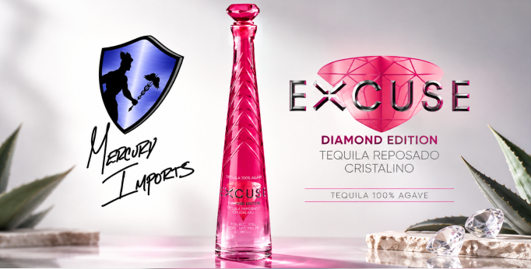
Chilco River Holdings has appointed Mercury Imports to support Excuse Tequila’s rollout across Texas. The agreement creates a route to market; the harder commercial test is now account acquisition, repeat orders and disciplined expansion.
Chilco River Holdings announced on 15 October 2026 that it had signed a distribution agreement with Houston-based Mercury Imports for Excuse Tequila Diamond Edition. The stated plan is to begin in Houston and pursue a phased expansion into other Texas markets.
The distinction between appointment and placement matters. Chilco River said Mercury was pursuing retail and hospitality opportunities, including preliminary discussions with a national specialty retailer, but it did not announce a confirmed chain listing. The parties also did not disclose pricing, minimum purchases, exclusivity, sales targets, commercial fees or the term of the agreement.
What the agreement actually changes
In Texas, a spirits brand needs more than consumer-facing marketing. The Texas Alcoholic Beverage Commission describes a three-tier system in which manufacturers, distributors or wholesalers, and retailers perform distinct roles. A wholesaler’s permit authorises distribution of distilled spirits and wine, while retailers make the final sale to consumers.
Mercury therefore becomes the operating bridge between the brand and licensed trade accounts. Its own website says it specialises in importing, developing and distributing premium spirits and wines, including regulatory support, market expansion and sales execution. That makes distributor selection a capability decision rather than simply a geographic one.
Chilco River said the product’s first production run was completed in Jalisco in August 2026, followed by importation through Laredo and the start of distribution in Houston. Those are meaningful readiness milestones. They do not, on their own, establish consumer demand or retailer velocity.
A large category, but not an easy launch window
The addressable category is substantial. The Distilled Spirits Council of the United States reported US tequila and mezcal supplier revenue of $6.4 billion in 2025. Yet that figure was 4.1% below 2024, while the Council’s category fact sheet shows volume easing from 32.199 million to 32.106 million nine-litre cases.
That combination—large scale but softer recent performance—raises the standard for a new premium entrant. Packaging and provenance may help a buyer notice the product, but durable distribution depends on profitable account economics, staff advocacy, consumer trial and reorder velocity.
Why a Houston-first rollout can be commercially sensible
A concentrated launch can protect working capital and make field execution easier to diagnose. The brand and distributor can focus tastings, trade education, inventory and account service in one metropolitan market before extending the playbook statewide.
The risk is that “statewide” becomes a headline rather than an operating plan. Geographic expansion should follow evidence that the first cluster is working, not merely the availability of a distributor licence or introductions to prospective buyers.
The milestones investors and brand owners should watch
- Active accounts, not conversations: confirmed on-premise and off-premise placements, segmented by account type and geography.
- Depletions and reorders: product moving from distributor inventory into trade accounts, followed by repeat purchasing.
- Inventory discipline: stock cover, fulfilment reliability and ageing inventory, especially during a staged launch.
- Activation productivity: whether tastings, bartender education and account-level promotion generate measurable sell-through.
- Expansion gates: the performance thresholds required before adding Dallas–Fort Worth, Austin, San Antonio or markets outside Texas.
Those indicators would be more informative than additional statements about prospective placements. Until confirmed accounts and repeat orders are disclosed, the agreement should be understood as a route-to-market milestone—not proof of commercial scale.
The broader lesson for distribution-led market entry
For emerging consumer brands, distributor reach is valuable only when it is matched by portfolio attention. Due diligence should test who will sell the brand, which accounts they already serve, how data will be reported, how launch inventory will be funded and what happens if agreed performance is missed.
Excuse Tequila’s Texas entry is therefore worth watching as an execution case. The agreement gets the product into the channel architecture. The next evidence must come from the market.
Star Brands Consulting Group helps brand owners and investors assess distributors, market-entry structures and operating milestones. Explore our Market Entry Advisory.
Leave a Reply