
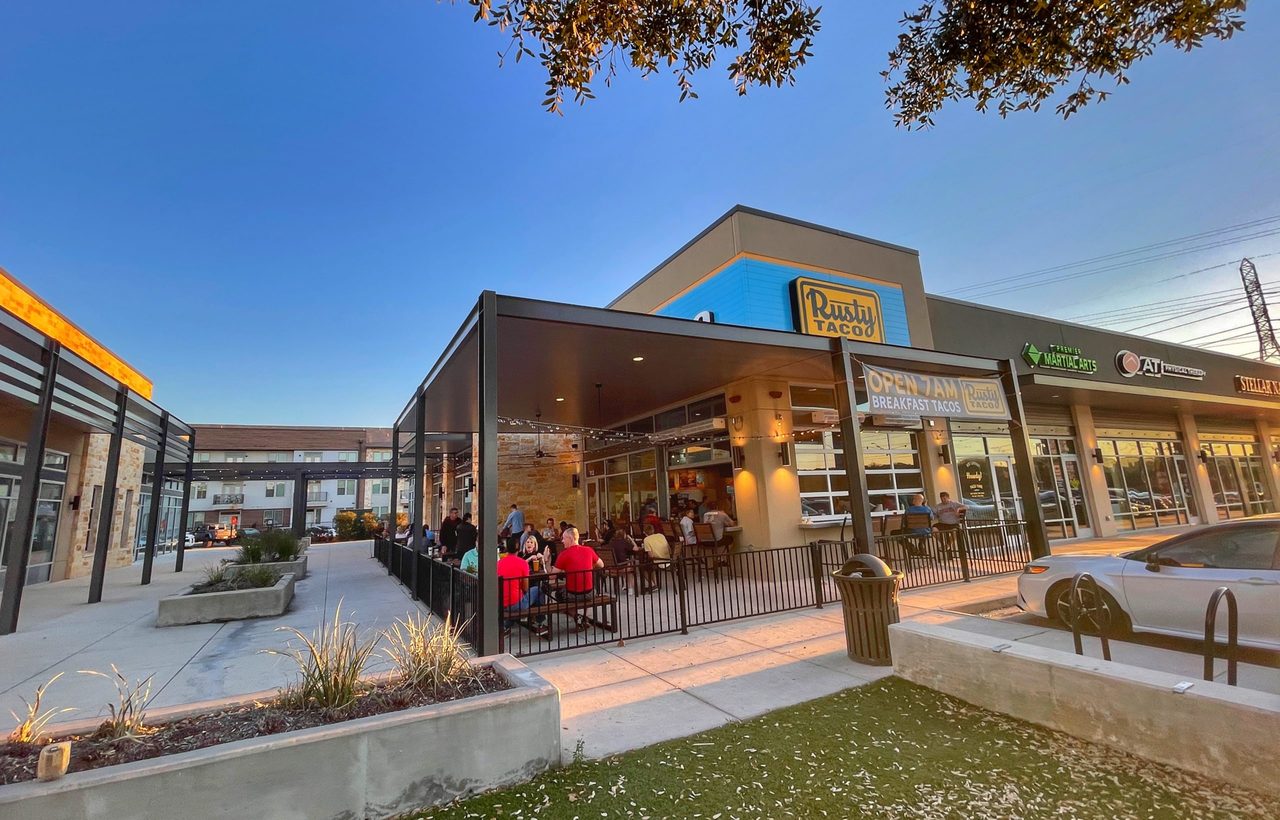
Rusty Taco has signed two franchise agreements with entertainment-venue operator Bowlski’s, creating a useful test of whether a restaurant brand can grow inside a host business without losing operating discipline.
A company-issued announcement dated 13 October 2026 says Bowlski’s owners Craig and Jennifer Spivey will bring Rusty Taco to two bowling-led venues: the historic Lakewood Theater at 1825 Abrams Parkway in Dallas, Texas, and an Aspen Valley location in Colorado. The Dallas unit is slated for later in 2026, with Aspen Valley expected in early 2027. Those are company timetables, not confirmed opening dates.
The commercial interest is not the unit count. It is the placement model. A restaurant inside a bowling and entertainment venue can draw on traffic generated by another activity, but the arrangement also creates dependencies that a conventional roadside or neighbourhood site may not face.
Why the host-venue model matters
Rusty Taco has been signalling a broader move into non-traditional sites. In a 9 September 2026 company announcement, the brand described airport, convenience-store, college, sports and entertainment venues as part of its development strategy. That release identified the Dallas Bowlski’s location as an upcoming opening; the October announcement adds a second agreement in Colorado and identifies the franchise partners.
This is therefore better understood as a channel test than as routine territory expansion. The brand is asking whether its menu, labour model and service proposition can work inside locations where the primary customer visit begins with bowling, travel or another host activity.
The attraction is straightforward: the host can provide an existing audience, shared destination appeal and potentially lower customer-acquisition friction. The trade-off is equally important. Traffic patterns, operating hours, alcohol service, event demand and guest ownership may be shaped by the venue rather than the restaurant alone.
The operator fit is more important than the real estate
Bowlski’s is not simply a landlord in the announcement. The Spiveys are named as the franchise partners, and the release says their Dallas entertainment business includes ten bowling lanes, food and craft beer. That matters because non-traditional formats often require the operator to coordinate two customer journeys at once: the host experience and the licensed restaurant experience.
Rusty Taco’s own franchise materials describe a model spanning breakfast, lunch, happy hour and dinner, as well as flexible formats including bars and non-traditional sites. The same materials say franchise candidates are assessed for liquidity, net worth, leadership and operating commitment. Those published criteria are general to the franchise programme; the company did not disclose the investment, fees or economics of the Bowlski’s agreements.
For brand owners, this is a reminder that a venue operator should not be qualified only on access to attractive property. Relevant questions include whether the operator can protect food quality during event peaks, manage separate revenue centres, maintain brand standards inside a host environment and produce reliable outlet-level data.
What the agreements do not establish
The announcement does not state that Bowlski’s has exclusive rights in Texas, Colorado or any wider territory. It does not disclose franchise fees, capital expenditure, revenue-sharing, rent structure, store size or sales expectations. It also does not say that the two locations will use identical formats.
Those omissions are commercially significant. A restaurant counter inside an entertainment venue can range from a conventional franchised unit with dedicated staff to a more integrated concession. Investors should not infer the structure from the words “inside Bowlski’s.” The allocation of kitchen space, procurement, staffing, alcohol responsibility, digital ordering, delivery rights and customer data should be clear in the franchise and site documents.
Four diligence questions for non-traditional franchise growth
- Who controls the customer journey? Brand standards should cover signage, ordering, service recovery and marketing within the host venue.
- Which traffic is truly incremental? A busy venue is not automatically a productive restaurant site; conversion, spend and repeat behaviour must be measured separately.
- How are shared costs allocated? Cleaning, utilities, security, maintenance, common areas and promotions can change the economics even when rent appears attractive.
- Can the format be replicated? A successful showcase location may depend on a distinctive building or operator. Expansion should be based on repeatable operating assumptions, not novelty alone.
The broader commercial signal
The two-unit agreement suggests that Rusty Taco sees entertainment venues as more than a one-off brand activation. However, two units remain a limited test. The more meaningful evidence will be whether the restaurants open on schedule, sustain brand standards across different venue profiles and produce economics that justify further development.
For franchisors, the lesson is to treat non-traditional growth as a distinct operating channel, with its own qualification criteria and unit model. For host operators, the value of a restaurant brand lies not only in name recognition but in systems, supply discipline and the ability to serve demand generated by the wider venue.
Star Brands Consulting Group supports brand owners and operators evaluating franchise structures, partner qualification and market-entry models. Explore Star Brands Consulting Group.
Leave a Reply