
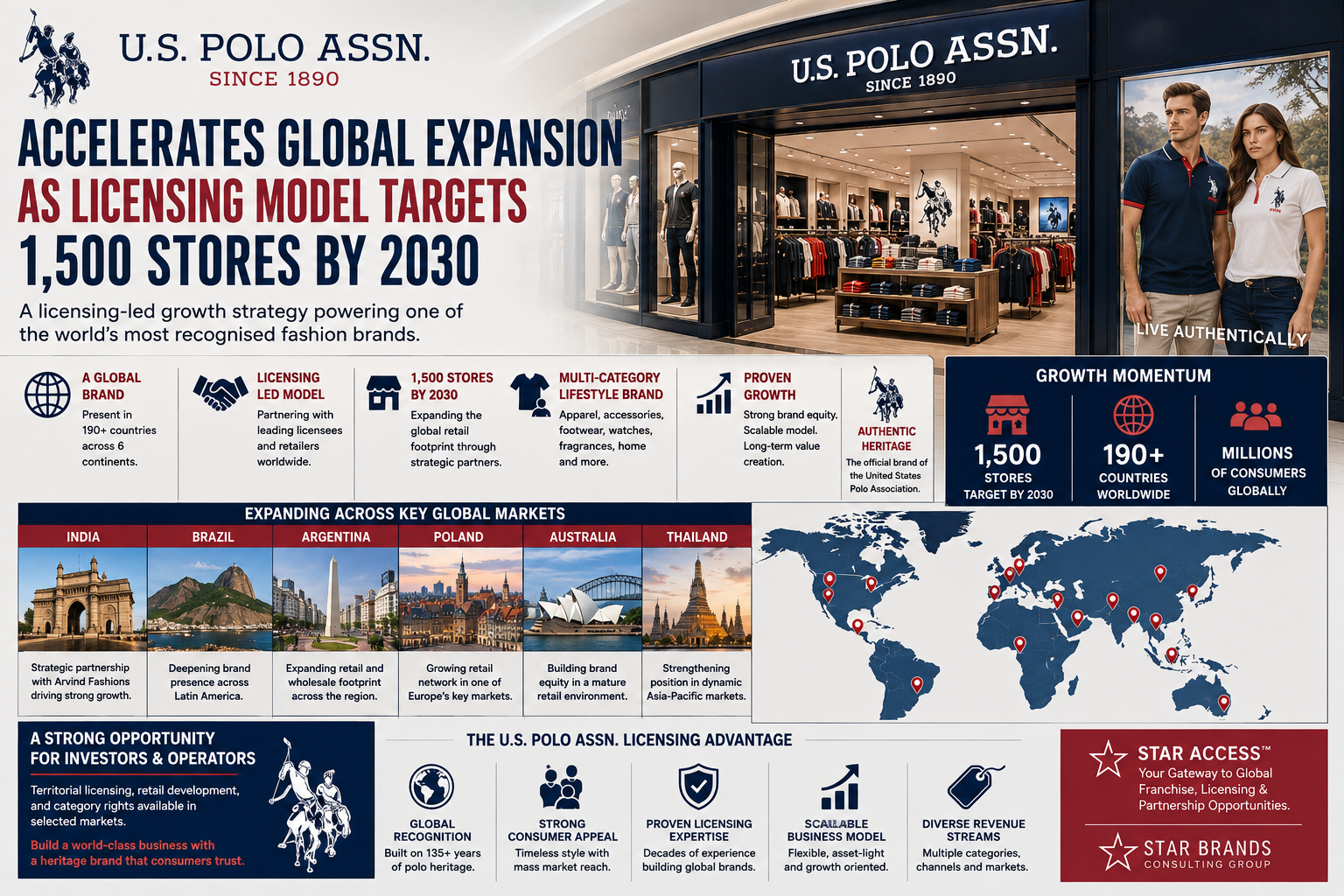
U.S. Polo Assn. is entering another significant phase of international growth, with the brand targeting a global network of approximately 1,500 stores by 2030 while continuing to expand across some of the world’s most important emerging consumer markets.
The scale is notable, but the structure behind the growth is even more important.
Unlike international fashion companies that build most of their overseas businesses through wholly owned subsidiaries, U.S. Polo Assn. has developed much of its global reach through an extensive network of licensees, retail partners and regional operators.
That approach has helped transform a brand connected to the United States Polo Association into a multibillion-dollar international consumer business with distribution across more than 190 countries.
For investors and operators interested in international brand licensing, U.S. Polo Assn. provides an important example of how intellectual property can be developed into a substantial global retail network without relying entirely on company-owned expansion.
U.S. Polo Assn. Is Much Larger Than Many Consumers Realise
U.S. Polo Assn. is the official brand of the United States Polo Association, the governing body for the sport of polo in the United States.
The consumer business has grown far beyond its American origins.
Today, the brand spans categories including:
- men’s fashion
- women’s fashion
- childrenswear
- footwear
- accessories
- watches
- luggage
- home products
- fragrances and related lifestyle categories
Its international reach extends across major markets in Europe, Asia, Latin America, the Middle East and Africa.
This breadth is important because it illustrates the scalability of a well-managed licensing platform.
U.S. Polo Assn. is not simply exporting clothing.
It is monetising a globally recognised identity across multiple product categories, territories and operating partners.
Licensing Is at the Centre of the Business Model
The international growth architecture is what makes U.S. Polo Assn. particularly relevant for investors.
The brand’s global development is overseen by USPA Global, which manages the commercialisation of the United States Polo Association’s intellectual property.
Rather than owning every factory, store and distribution network directly, the business works with established partners capable of developing the brand within specific countries, regions and product categories.
These partners can contribute:
- local market expertise
- capital
- manufacturing capability
- wholesale distribution
- retail development
- e-commerce
- logistics
- relationships with landlords and shopping centres
The brand owner provides the intellectual property, positioning, standards and wider international platform.
This creates a fundamentally different expansion model from conventional corporate-owned retail.
Why Licensing Can Accelerate International Expansion
Entering a new country directly can be expensive.
A brand may need to establish:
- a local corporate entity
- management teams
- warehouses
- logistics
- retail operations
- marketing infrastructure
- regulatory capability
- local supplier relationships
A strong licensing partner may already possess much of that infrastructure.
This can allow international expansion to happen faster and with considerably less direct capital from the brand owner.
The model also allows local specialists to adapt execution to market conditions while operating within the broader brand framework.
For U.S. Polo Assn., that architecture has enabled international scale that would have been considerably more capital-intensive under a fully company-owned model.
The 1,500-Store Ambition
U.S. Polo Assn. has outlined ambitions to expand its global physical retail footprint towards approximately 1,500 stores by 2030.
That target demonstrates how important physical retail remains even for a brand distributed extensively through wholesale and digital channels.
Standalone stores provide several advantages.
They give the brand:
- complete merchandising environments
- greater visual consistency
- stronger consumer recognition
- opportunities to showcase multiple categories
- direct relationships with customers
- prominent physical visibility in important markets
For licensees, physical stores can also provide a platform from which wider wholesale and digital businesses develop.
The result is an omnichannel licensing model rather than a simple product-distribution arrangement.
India Has Become One of the Brand’s Most Important Markets
India provides one of the clearest examples of the potential scale of the U.S. Polo Assn. licensing model.
The brand has developed a substantial Indian presence through Arvind Fashions, one of the country’s established fashion and retail groups.
India has grown into one of U.S. Polo Assn.’s major international businesses, supported by an expanding physical retail network, wholesale distribution and digital commerce.
The market offers several long-term advantages:
- a very large consumer population
- increasing disposable incomes
- a young demographic
- strong demand for international fashion
- rapidly improving retail infrastructure
- growing premium and aspirational consumption
For international brands, the ability to combine global recognition with a strong Indian operating partner can significantly improve the probability of successful market development.
Brazil and Latin America Offer Further Growth
Latin America is another important part of the international strategy.
Brazil in particular provides substantial potential because of its population, fashion culture and growing consumer market.
U.S. Polo Assn. has continued developing its presence across the region through local partners capable of managing distribution and retail execution.
Markets such as Argentina also form part of the wider expansion picture.
Latin America illustrates why regional expertise matters.
Consumer behaviour, import structures, currency exposure, retail economics and distribution networks vary significantly across the region.
A local licensee that understands those conditions can often execute more effectively than an international brand attempting to manage the market remotely.
Europe Remains an Important Expansion Region
U.S. Polo Assn. also continues investing across Europe.
Markets including Poland have been identified as part of the company’s ongoing development, while the brand already has substantial recognition across several European territories.
Europe presents a different challenge from emerging markets.
Consumers have access to a dense selection of international fashion brands, meaning expansion depends not simply on availability but on differentiation.
U.S. Polo Assn.’s connection to authentic polo heritage provides an important positioning asset.
The company is able to connect fashion products to an actual sporting institution and history rather than relying entirely on an invented lifestyle narrative.
Australia and Asia-Pacific Add Another Growth Dimension
Asia-Pacific continues to provide opportunities for international fashion and lifestyle brands.
Australia, Thailand and other markets across the region form part of U.S. Polo Assn.’s wider global development.
The region contains very different consumer economies.
Australia is a mature retail market.
India is a rapidly expanding mass consumer market.
Southeast Asian countries combine growing middle classes with significant shopping-centre development.
This diversity reinforces the value of a flexible licensing model.
The same international brand can be developed differently depending on the capabilities and characteristics of each territory.
The Brand Has Been Recognised as a Leading Global Licensor
U.S. Polo Assn.’s position within the international licensing industry has continued to strengthen.
The brand has ranked among the world’s major global licensors and has achieved leading recognition within the sports-brand category.
This is important because licensing businesses are often less visible to consumers than conventional retail companies.
Consumers see the finished product or store.
They do not necessarily see the commercial architecture behind it.
Yet licensing can generate substantial global sales while allowing the intellectual-property owner to operate a relatively asset-light international model.
U.S. Polo Assn. demonstrates how powerful that architecture can become when the brand, licensees and retail strategy are aligned.
More Than a Logo Licensing Business
Successful licensing cannot be reduced to placing a logo on products.
Poorly managed licensing can quickly damage a brand.
If products become inconsistent, distribution becomes excessive or partners fail to maintain standards, brand equity can decline rapidly.
The stronger licensing systems therefore require substantial control over:
- product quality
- design
- merchandising
- marketing
- store presentation
- distribution channels
- territory rights
- pricing architecture
- partner performance
U.S. Polo Assn.’s international scale demonstrates the importance of balancing partner independence with central brand governance.
The licensee needs enough flexibility to operate effectively in the local market.
The brand owner needs enough control to ensure that the consumer experiences one coherent global brand.
Why the Polo Connection Matters
U.S. Polo Assn. has an unusual competitive advantage.
It is connected directly to the governing body of the sport of polo in the United States.
That gives the brand an authentic heritage that can be incorporated into:
- product design
- sponsorship
- sporting events
- marketing
- retail environments
- storytelling
In an international fashion market crowded with lifestyle brands, authenticity can provide valuable differentiation.
The sporting connection also creates opportunities that extend beyond apparel.
Events and partnerships can reinforce the brand’s identity while creating consumer engagement that conventional advertising cannot always replicate.
The Difference Between Licensing and Franchising
For investors, the U.S. Polo Assn. model also provides a useful opportunity to understand the difference between licensing and franchising.
A traditional franchise normally provides a complete operating system.
The franchisee operates a business according to detailed standards established by the franchisor.
Licensing can be broader.
A licensee may receive rights to use intellectual property within:
- a country
- a region
- a product category
- a distribution channel
The licensee may then manufacture, distribute, wholesale or retail products under the agreed brand rights.
In international fashion, licensing can therefore involve considerably larger commercial responsibilities than operating a single franchise store.
An investor seeking U.S. Polo Assn. rights may consequently be evaluated not merely on whether they can fund one retail location, but on whether they possess the infrastructure required to develop an entire territory or category.
What Brands Look for in Licensing Partners
International licensing partners typically need more than capital.
Strong candidates may require:
Market Knowledge
The operator must understand local consumers, competitors, pricing and distribution.
Retail Capability
Where standalone stores are part of the strategy, the partner needs access to appropriate real estate and operating infrastructure.
Distribution
Fashion brands often require wholesale relationships extending beyond their own stores.
Financial Strength
Developing a national brand business can require significant capital over several years.
Brand Management
The local partner must be capable of building the brand without weakening its positioning.
Long-Term Commitment
International licensing agreements are often structured around multi-year development rather than short-term trading.
This is why major licensing opportunities are usually awarded selectively.
What the 2030 Target Signals for Investors
A target of approximately 1,500 stores implies continued international development.
Not every additional store will represent a new territory.
Many will come from existing licensees expanding their established networks.
But large global growth targets can also create opportunities for:
- new market entry
- territory development
- additional product-category licensing
- regional distribution
- retail development
- strategic partnerships
The critical issue is determining where rights remain available.
A global brand may be actively expanding while a specific investor’s preferred country is already allocated.
That distinction is essential.
Existing Territory Rights Must Be Understood First
This is one of the most common misunderstandings in international brand access.
A company may announce aggressive global expansion.
That does not automatically mean every market is available.
Territories may already be controlled by:
- master licensees
- franchisees
- distributors
- joint-venture partners
- company-owned subsidiaries
Before approaching a brand, serious investors should establish:
- whether their market is already allocated
- what rights the existing partner holds
- whether the brand is satisfied with current market development
- whether additional categories remain available
- whether neighbouring territories present opportunities
- what level of investment and infrastructure the brand expects
This intelligence can prevent months of pursuing an opportunity that is structurally unavailable.
Strategic Assessment
U.S. Polo Assn. demonstrates the power of international licensing when it is treated as a genuine growth architecture rather than simply a merchandising arrangement.
The brand has combined:
- authentic intellectual property
- international licensees
- physical stores
- wholesale distribution
- e-commerce
- sporting heritage
- regional operating expertise
to build a substantial global consumer business.
Its ambition to reach approximately 1,500 stores by 2030 indicates that expansion remains central to the strategy.
For investors and operators, the opportunity is therefore worth monitoring.
But the relevant question is not simply:
“Can I open a U.S. Polo Assn. store?”
It is:
“What rights are available in my market, and what level of partnership is U.S. Polo Assn. seeking there?”
That distinction can completely change the investment proposition.
Where Star Brands Consulting Group Fits In
Star Brands Consulting Group works with investors, operators and brands seeking international franchise, licensing, distribution, partnership and market-entry opportunities.
For an investor interested in U.S. Polo Assn. or another major international licensing brand, the process can include:
- assessing territory availability
- identifying existing licensees and market structures
- evaluating investor financial capability
- reviewing retail and distribution infrastructure
- assessing market-entry feasibility
- developing the investor profile
- preparing the market proposition
- identifying the appropriate licensing or partnership pathway
- supporting structured brand engagement where commercially justified
Through Star Access™, qualified investors can evaluate international brands based not simply on recognition, but on whether a realistic access pathway exists.
This is particularly important in licensing.
The opportunity may not be a single store.
It could involve developing an entire country, building a wholesale network, establishing multiple stores or managing specific product categories.
That requires a very different level of preparation.
Conclusion
U.S. Polo Assn.’s international growth demonstrates how far a licensing-led brand can scale when intellectual property is combined with capable regional partners.
With distribution across more than 190 countries and ambitions for approximately 1,500 stores by 2030, the company is continuing to deepen its presence across major global markets.
India, Brazil, Argentina, Poland, Australia, Thailand and other growth territories illustrate the geographic breadth of that strategy.
For investors, the lesson is equally important.
International brand opportunities do not always come packaged as conventional franchises.
Some of the largest opportunities involve territorial licensing, distribution rights and multi-market development partnerships.
Understanding the difference — and knowing which rights remain available — is where serious international brand investment begins.
Leave a Reply